


I recently attended Startups.watch’s quarterly review event on April 7th. At this event, which featured many eye-opening presentations, we saw through the numbers how the startup ecosystem in Turkey and around the world is transforming.
The opening presentation was striking: we examined in detail how the ecosystem in Turkey severely shrank in the first quarter of 2026, the reasons behind it, and how it compares to the rest of the world.
While AI investments have become the driving force globally, the gaming sector still dominates investments in Turkey. There are investments in AI startups, but they remain minuscule compared to the global scale.
Yes, the war in the Middle East and other macroeconomic uncertainties are causing investments to decline. However, entirely different issues are emerging that are truly making investors and entrepreneurs worry about the future.
In a world where AI can develop software instantly, the future of the startup ecosystem remains a huge mystery. Throughout the day, these big questions hovered in the air:
What type of startups will investors put their money into now?
Will the number of entrepreneurs decrease?
When even customers can easily build their own AI, who will buy what from whom?
The moment that best summarized this chaotic environment was Gaye Ör’s presentation. While on stage, she mentioned an AI startup I also follow closely: Feltsense, the “AI startup that clones Y Combinator startups within 24 hours”.
It seems that soon, no one will be able to stand out merely by writing code or adding standard features.
I actually covered these topics in detail in my newsletter a few weeks ago. I even shared a report on which business ideas will come to the forefront.

“Is SaaS Dying?”
At the event, upon the invitation of İş Bankası Workup, we had a fireside chat, and the lovely İrem Nur Yüksel asked me the most talked-about question of the year:
“Are SaaS companies dying? Their stocks have seriously plummeted. Yet, there was a time when they were the absolute darlings of VCs. Now, it seems like anyone will be able to develop their own software in-house using AI, without needing a technical team. This begs the question: Is the era of buying software externally truly coming to an end?”
My answer was crystal clear: Absolutely not.
On the contrary, the software market is preparing to experience one of the biggest leaps in its history, and SaaS is simply shedding its skin.
I’ll touch upon the kind of transformation we are going through in a moment, but first, let’s look back.
When we look at history, there is a very clear pattern: When the cost of a formerly expensive and inaccessible technology drops dramatically, that market doesn’t shrink; rather, it experiences massive growth.
There are many examples of this. But I think the most important one is the birth of cloud computing…
The Jevons Paradox and the Cloud Computing Curve
To explain what I mean, let’s take a close look at this updated chart I prepared, showing the market shift in Cloud Computing from 2006 to today:
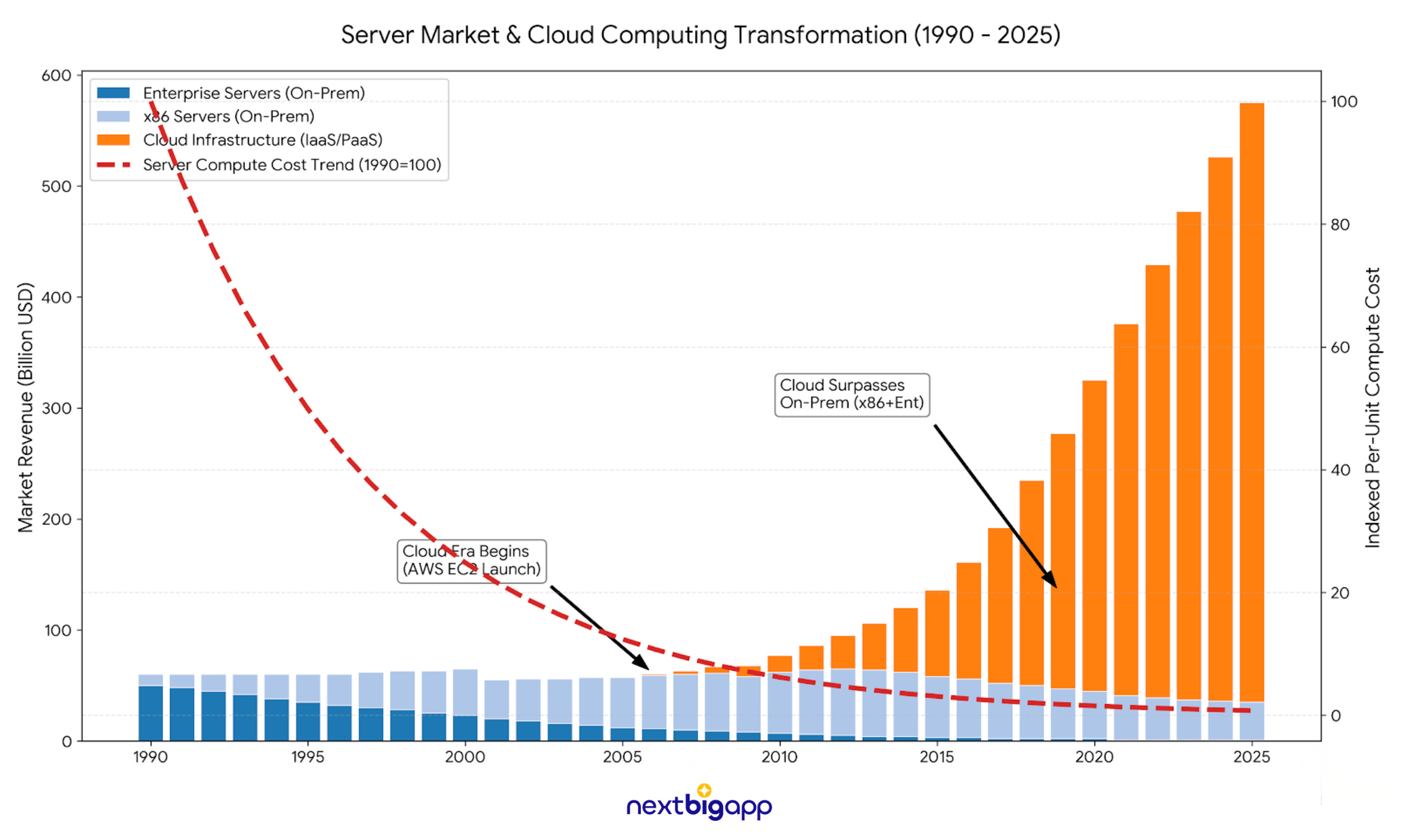
Enterprise Servers (Dark Blue): The dramatic collapse over the years of massive, costly, legacy enterprise servers like Unix and Mainframes.
x86 Servers (Light Blue): The rise of physical, on-premise servers kept by companies throughout the 90s and 2000s, reaching saturation in 2015 and slowly melting away against the cloud.
Cloud Infrastructure (Orange): The massive (IaaS/PaaS) cloud leap that began with AWS in 2006 and completely eclipsed on-premise hardware.
Unit Cost Trend (Red Dashed Line): While the market reached massive proportions, the unit cost of computing power continuously hit rock bottom thanks to economies of scale.
Setting up a server in the 1990s required massive capital. Then came virtualization and the cloud. Computing power became mind-bogglingly cheap.
So, did the server market die? On the contrary, it reached a trillion-dollar scale.
In economics, this is called the Jevons Paradox.
When the efficiency of using a resource increases and its cost drops, the demand for that resource does not decrease; it explodes.
As computing power became cheaper, companies didn’t use fewer servers; instead, they started processing more data, connecting every device to the internet, and running massive algorithms.
It’s exactly like how the cost of taking a photo dropped to zero with digital cameras, and instead of shrinking, the photography industry created giant economies like Instagram.
Software is Turning into Electricity
In the traditional world, developing software was expensive and difficult. That’s why it was only built for the biggest problems: Banking systems, giant e-commerce sites, enterprise ERPs...
But what happens if the cost of producing micro-software drops to a simple command given to an AI assistant and a few cents?
Solving Micro-Problems: It won’t just be giant corporations anymore; the local bakery will have an AI predicting its inventory, a hobbyist will have a personalized social network just for them, or there will be apps instantly analyzing the sunlight needs of your potted plants at home.
Disposable Software: Software will be generated in seconds for just a one-week event, a single meeting, or a temporary campaign, and then thrown away once the job is done.
Democratization of Ideas: Once the coding barrier is removed, millions of people with brilliant ideas but zero capital will enter the market.
The Shift in Value and “Invisible SaaS”
When AI makes software cheaper, the software market won’t end.
Yesterday, the value was in how the code was written (mechanical labor).
Tomorrow, the value will be in what problem is solved, how systems are integrated, and how the human experience is designed.
That is exactly why the rules of SaaS are being rewritten:
1. Clunky Business Models Are Dying
The days of per-user license fees, high setup costs, and paying whether you use the product or not, which used to seem like the cream of the crop, are becoming history. Companies now only want to pay for the value they see. For example, at Next Big App, we don’t charge setup, license, or per-user fees. We only charge for the minutes our AI assistant actually speaks. If there’s no output, there’s no cost.
2. Software is Becoming Invisible (Invisible SaaS)
In the past, SaaS meant fancy dashboards. We have very good dashboards too, but most of our customers don’t even open them! That’s because we take AI and integrate it invisibly right into the heart of the systems they already use. Data flows directly into their own systems.
Here are two clear examples from the field:
Real-time NPS and SAP/CRM Integration at Vitra: For Vitra, we manage an automated satisfaction (NPS) flow that kicks in the moment technical service is completed. As soon as a service technician marks a job as “completed” in their own system, our API is instantly triggered. Our AI assistant calls the customer within seconds to conduct a satisfaction survey and instantly feeds the scored results directly back into Vitra’s SAP or CRM system. The team doesn’t have to learn a new interface or spend hours making manual calls; with zero human involvement, they simply see ready, qualified data right on their screens through automation.
The Growth Engine at IdeaSoft: With a visionary team like IdeaSoft, we made their sales and retention processes autonomous in the background. On busy days, we call 3,000 potential customers within hours to pitch services, and we schedule 10-minute sales calls for those who are interested. With this system, we increased the “hot lead” conversion rate from 3% to 30%. Moreover, while a human sales rep used to make 60-80 calls a day and identify fewer than ten prospects close to buying, now thousands of calls reveal hundreds of hot prospects. Another invisible assistant uses a “churn” workflow to proactively call existing customers on their 30th day, listen to potential issues, and if action is needed, automatically creates a task in the sales team’s CRM. The operational flow of the teams doesn’t change at all, but the number of ready appointments and work orders dropping into their pipeline increases dramatically.
Conclusion: When Technology Gets Cheaper, It Stops Being a Luxury and Becomes Infrastructure
So why won’t SaaS die?
Because the pace of technological change is now at the speed of light, and no company can drop its core business to track technology every day, asking, “What did Google release, which model did Anthropic announce?”
I defined this as the “The Vertigo Era” in one of my previous articles.

For instance, at Next Big App, we have tested over 200 different AI models in the field over the last two years. It is impossible for a company to do this on its own amidst its daily operations.
Furthermore, keeping every tech stack healthy and up-to-date is still a highly labor-intensive job.
In the future, I believe companies will work with technology partners, functioning like agencies who closely follow the AI revolution, manage all this orchestration from a single hub, and integrate it into their systems. This is the only way transformation can approach the speed demanded by our era.
The crux of the matter is this: Whenever technology makes something cheap and accessible, that thing ceases to be a luxury and turns into infrastructure.
AI is bringing about this exact kind of change, and contrary to popular belief, it is not killing software; it is expanding it so broadly that it will be integrated into every molecule of the air we breathe, just like electricity, water, or the internet.
The software market is not shrinking; on the contrary, we are entering an era where we will witness it grow phenomenally.
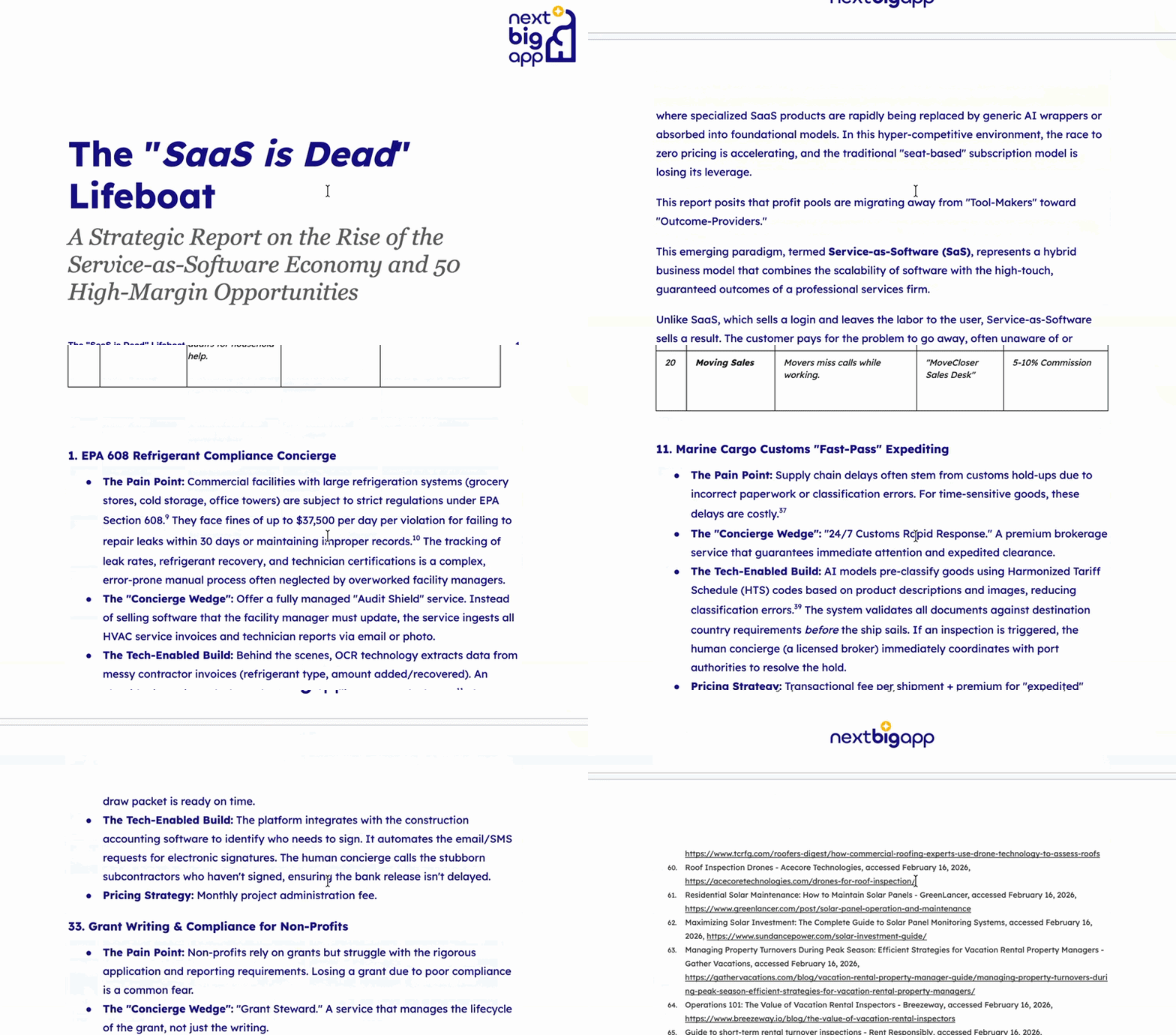
The “SaaS is Dead“ Lifeboat:
A Strategic Report on the Rise of the Service-as-Software Economy and 50 High-Margin Opportunities
You’ve read the warning: Pure software is becoming a commodity. The race to $0 is on.
So where does the profit go?
It goes to “Tech-Enabled Concierge” models, businesses that use software to run lean, but sell a guaranteed outcome delivered by humans (or agents), not just a login.
While everyone else is building another generic AI wrapper for marketers, smart founders are looking at “Blue Collar” industries, HVAC, logistics, waste management, compliance where the customers don’t want a tool; they want the problem gone.
We’ve compiled a database of 50 “Blue Collar” Verticals ripe for this model.
These are unsexy, high-ticket markets where you can charge $2k/month retainers or % of spend, not $19/month subscriptions.
Inside the Database:
50 Specific Niches: From elevator maintenance to maritime insurance.
The “Concierge” Wedge: The exact “Do It For Me” offer that replaces their current software.
Pricing Strategy: How to structure high-margin “Service-as-Software” contracts.
The Moat: Why AI can’t kill these businesses (yet).
Stop building tools. Start selling outcomes.