


We are entering the “YouTube Era” of Software.
For decades, building software was like Old Hollywood: it required deep expertise, massive budgets, and green lights from gatekeepers.
If you wanted to ship a mobile service in 2007 —back when we started 4play—you needed a server rack, a carrier deal, and six months of development time. The difficulty was the moat.
Then came the “Indie” era (think YC founders breaking in).
Now?
We are seeing the same explosion in software that YouTube brought to video. Thanks to LLMs and tools like Cursor and Replit, the barrier to entry hasn’t just lowered, it has collapsed.
Anish Acharya at Andreessen Horowitz calls this the shift where “Software becomes like Media”. The prediction is seductive:
The “Builder” market 100x’d: You don’t need to love syntax anymore; you just need to love good ideas.
Software = Expression: Apps are becoming like social posts. Funny, zeitgeisty, and personal.
Compounding Value: Unlike content which decays, software creates value that compounds.
The excuse of “I don’t know how to code” is dead. If you have an idea, you can ship the app.
Even Y Combinator’s famous application questions, “Do you write the code yourself?” feel like relics from a bygone era.
Today, you just tell Claude Coder what you want, and two minutes later, you have a prototype.
But here is the problem.
While everyone is celebrating the “democratization of creation”, they are ignoring the brutal economic reality that follows.
When a resource becomes abundant (like content), its price drops to zero.
If software is the new content, then “selling software” is a race to the bottom.
This article isn’t about how cool it is that you can build an app in a weekend.
It’s about why that ability might be a trap and where the real leverage is hiding for the founders who are paying attention.
The Verdict: Challenge Accepted
The narrative that “Software is becoming content” is dangerous because it is partially true but fundamentally flawed.
It lures founders into building “viral tools” that have the lifespan of a TikTok trend. It ignores the fact that while code has become a commodity, value has migrated elsewhere.
And that’s why your feed is flooded with videos titled something like:
“I’ll show you how to copy a billion-dollar company’s product in 3 prompts, launch it, and get rich overnight!”
If software were truly just “content”, we would see a flood of tools that rise and fall with a creator’s mood. But history shows that when a resource becomes abundant (like code), the value moves to the scarcest resource: trust and data.
Let’s dismantle the consensus view.
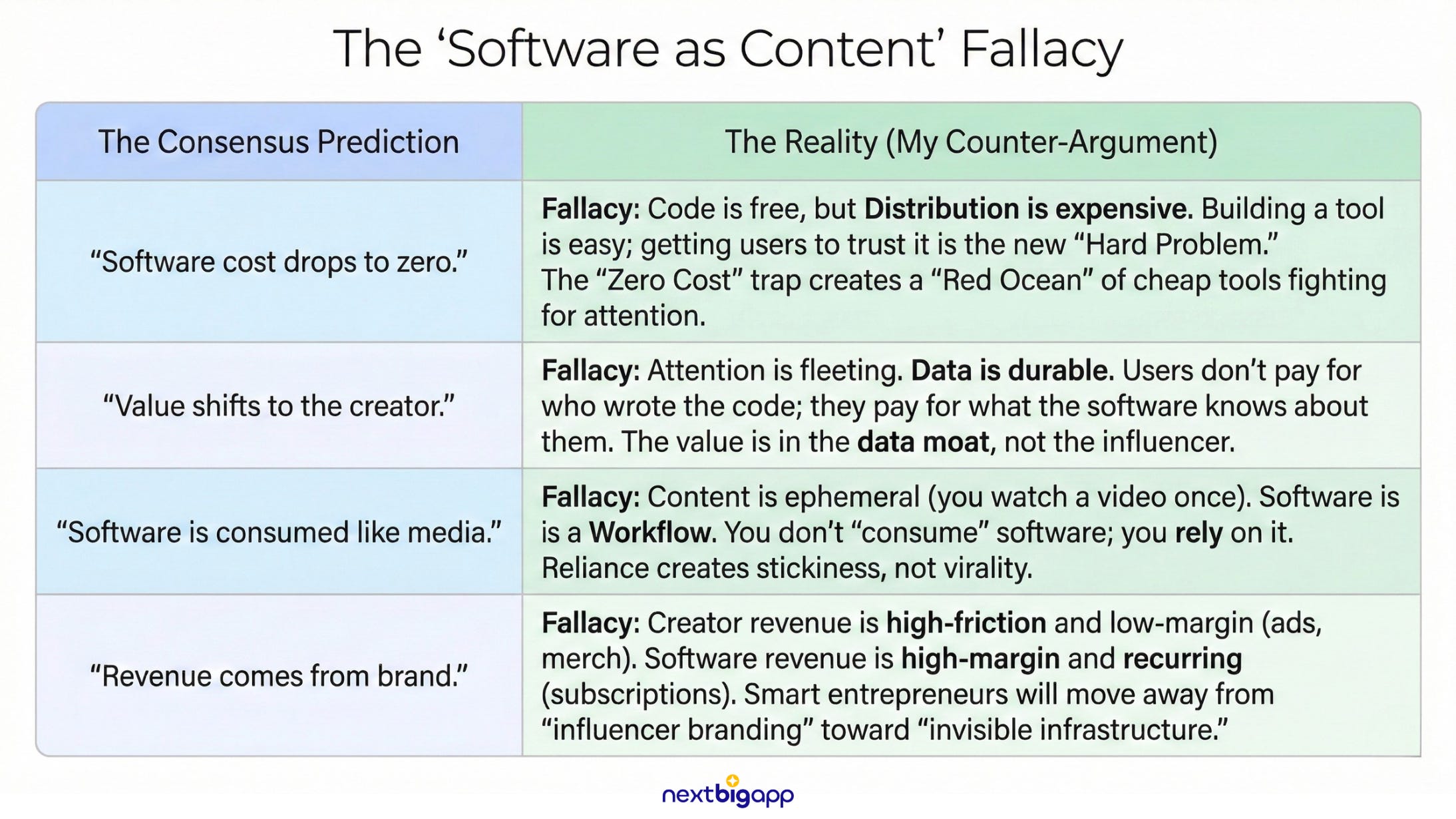
The Core Insight: The prediction misses the difference between “getting attention” and “building a business”. You can get attention with a viral app. You build a business with a system that retains users after the hype dies.
3 Scenarios: How This Actually Plays Out (2026–2028)
If we accept that the barrier to entry is gone, what happens next?
It’s not just “more apps”. It’s a fundamental restructuring of the digital economy.
Here are three plausible paths based on current trends in AI agents, creator economy consolidation, and enterprise adoption.
Scenario 1: The “Agent” Revolution (Most Likely)
The Shift: Software disappears. Users don’t open apps; AI Agents do the work for them.
The Reality: “Content” creators (influencers) are replaced by “Agent” builders (engineers). The primary user of your software isn’t a human, it’s another AI.
The Winner: Platforms enabling agents (e.g., LangChain, Zapier).
The Loser: Standalone “tools” that require a human interface. Why open a travel app when your agent can just book the flight via API?
Scenario 2: The “Creator Burnout” Crisis
The Shift: The “Content” model collapses. Users get tired of “AI slop” and personality-driven tools that break after two weeks.
The Reality: Trust in influencers drops. People realize that a “cool app” isn’t enough, they need support, reliability, and security.
The Winner: High-touch, human-led services that use AI as a backend but offer a “human face” on the frontend.
The Loser: Low-effort, AI-generated “shovelware” software.
Scenario 3: The “Platform Moat” Consolidation
The Shift: Big players (Microsoft, Salesforce) buy up niche “creator” tools to turn them into data moats.
The Reality: Small tools are acquired, not admired. The realization hits that “Data is the only moat” in an AI world.
The Winner: Data-rich platforms that own the user’s history.
The Loser: Standalone open-source tools with no data lock-in.
Where You Should Focus (To Actually Make Money)
If you are building today, chasing “viral content” is a trap.
You are playing a game where the odds of winning are lottery-ticket low, and the prize is fleeting.
Instead, focus on these four high-value areas. This is where the leverage lives.
1. Data-Moat Infrastructure (The “Anti-Commodity” Strategy)
The Opportunity: Build tools that learn from the user.
Why it Wins: As code becomes free, data becomes expensive. If your tool owns the user’s data context (e.g., a CRM that auto-tags emails based on your unique business jargon), you own the relationship. You can clone the code, but you can’t clone the data history.
Revenue Model: Subscription + Usage Tier.
2. Agent-as-a-Service (AaaS)
The Opportunity: Don’t build a “tool” (like a calculator). Build an “agent” (like a Junior Employee who calculates for you).
Why it Wins: Users will pay for outcomes (e.g., “Close a deal”), not features (e.g., “CRM”). The shift is from “Software as a Tool” to “Software as a Worker”.
Revenue Model: Pay-per-task / Outcome-based pricing.
3. “Blue Collar” Tech (The Resilience Play)
The Opportunity: Combine software with high-touch human service. (e.g., A “Software” that includes a human concierge).
Why it Wins: Pure software is a commodity. Service + Software creates a moat that AI can’t easily replicate. It builds trust in a low-trust world.
Revenue Model: Hybrid (SaaS + Service Fees).
4. Workflow Consolidation (The “Platform” Play)
The Opportunity: Build the “middle layer” that connects everything (e.g., connecting Slack + Notion + Salesforce).
Why it Wins: The “Creator Economy” is consolidating. Users want fewer tools that do more, not more influencers selling more fragmented apps.
Revenue Model: Integration/API Fees.
To see where we are going, look at how the drivers of value are changing.
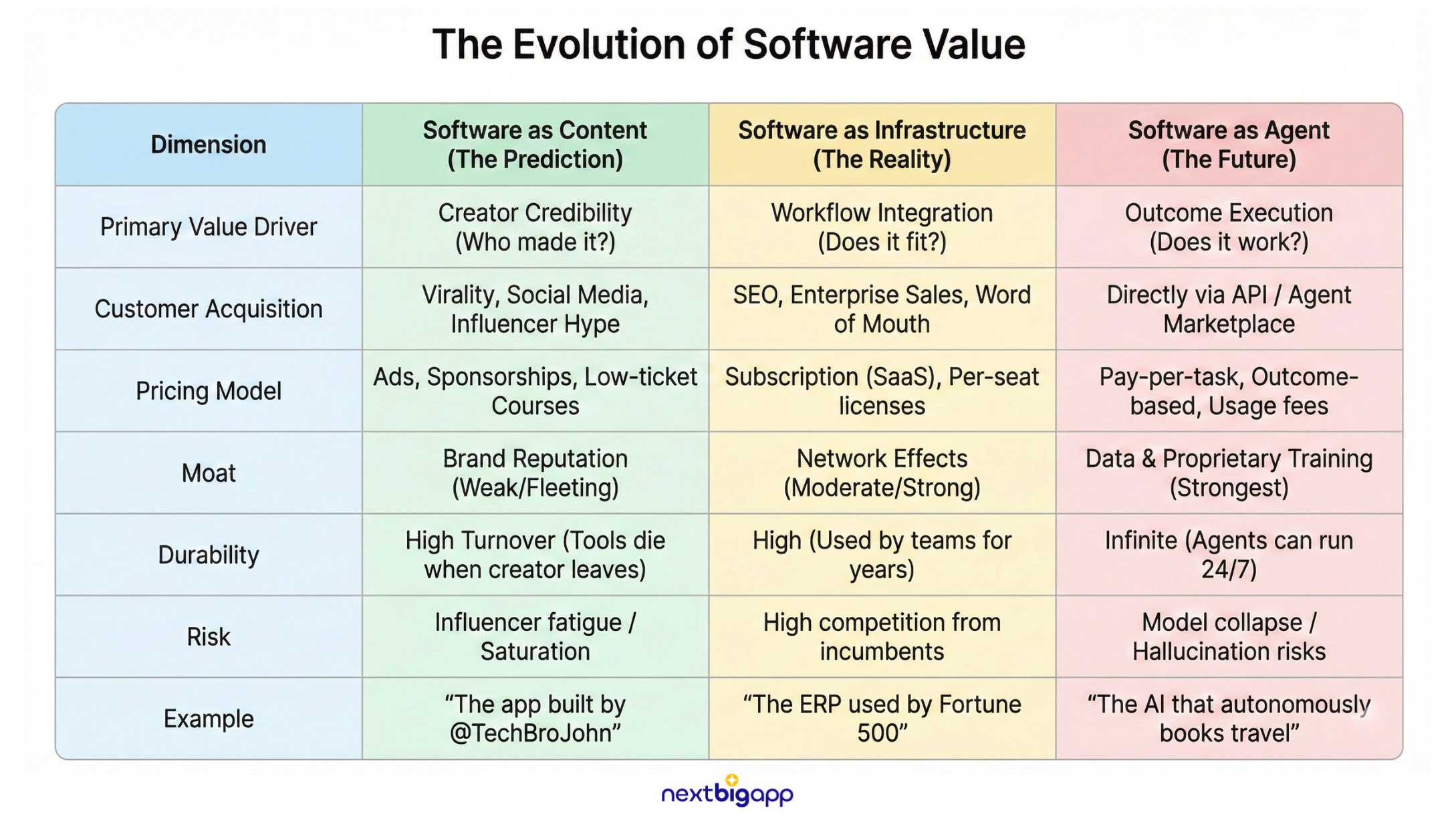
The Bottom Line
The “YouTube Era” of software is exciting, but don’t let the hype blind you to the economics.
Commoditization is coming.
When everyone can build, “building” is no longer the special sauce. The special sauce becomes what you build on top of the code.
Key insight for 2026: Stop building “tools”. Start building systems that learn, or agents that act.
The market for “shiny new software” is dead; the market for “invisible competence” is booming.
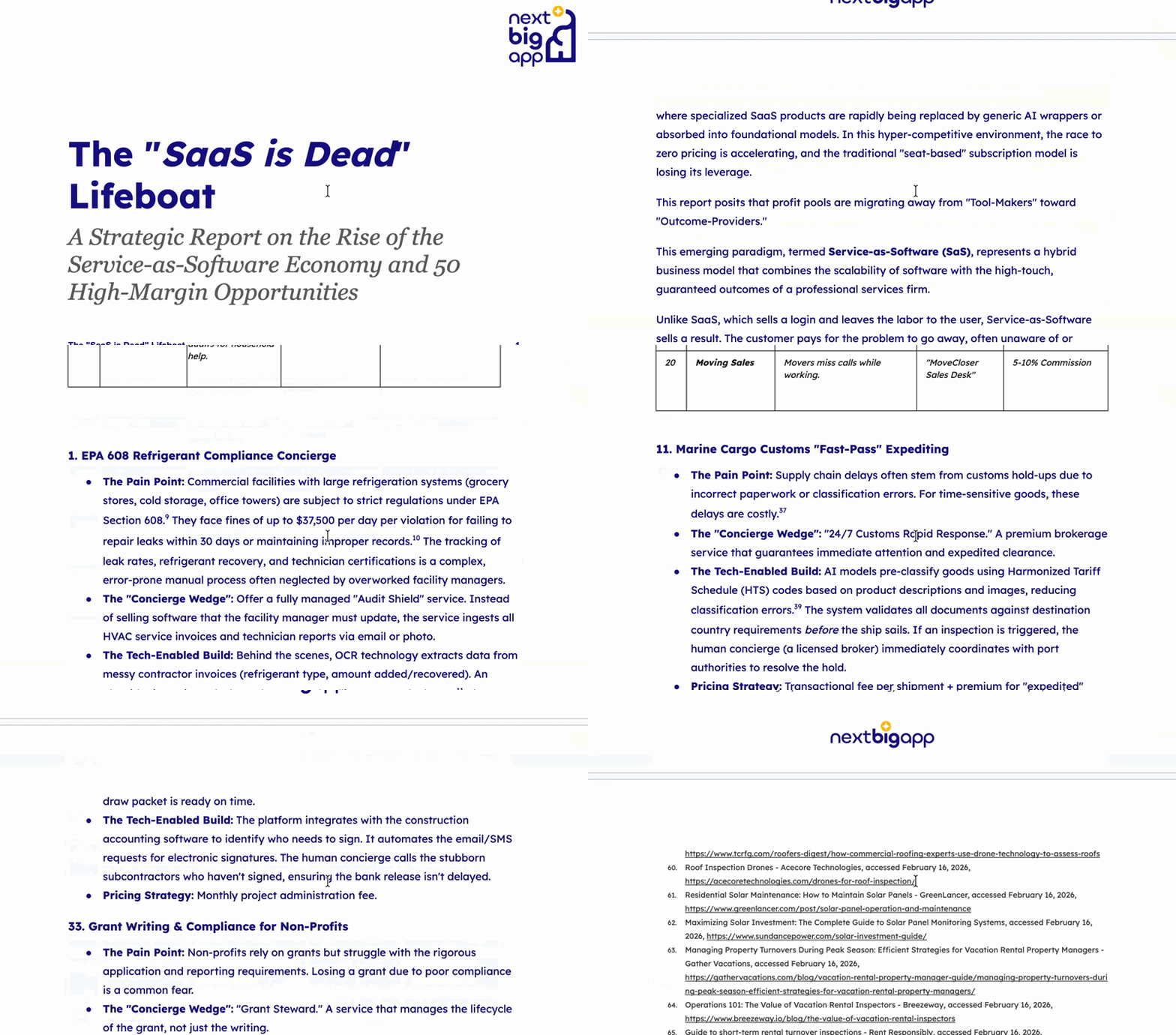
The "SaaS is Dead" Lifeboat:
A Strategic Report on the Rise of the Service-as-Software Economy and 50 High-Margin Opportunities
You’ve read the warning: Pure software is becoming a commodity. The race to $0 is on.
So where does the profit go?
It goes to “Tech-Enabled Concierge” models, businesses that use software to run lean, but sell a guaranteed outcome delivered by humans (or agents), not just a login.
While everyone else is building another generic AI wrapper for marketers, smart founders are looking at “Blue Collar” industries, HVAC, logistics, waste management, compliance where the customers don’t want a tool; they want the problem gone.
We’ve compiled a database of 50 “Blue Collar” Verticals ripe for this model.
These are unsexy, high-ticket markets where you can charge $2k/month retainers or % of spend, not $19/month subscriptions.
Inside the Database:
50 Specific Niches: From elevator maintenance to maritime insurance.
The “Concierge” Wedge: The exact “Do It For Me” offer that replaces their current software.
Pricing Strategy: How to structure high-margin “Service-as-Software” contracts.
The Moat: Why AI can’t kill these businesses (yet).
Stop building tools. Start selling outcomes.