


🎙️ AUDIO DEEP DIVE OF THIS ISSUE:
Sammy & Mila offer in-depth analysis on each newsletter issue. Subscribe to their podcast on Spotify or any other podcast platform.
Apple's WWDC24 event felt like a child playing in the sandbox compared to the groundbreaking work of OpenAI, Nvidia, and even smaller startups.
Given the immense anticipation surrounding the event, many of us had gathered for live watch parties, eager to witness Apple's next big thing.
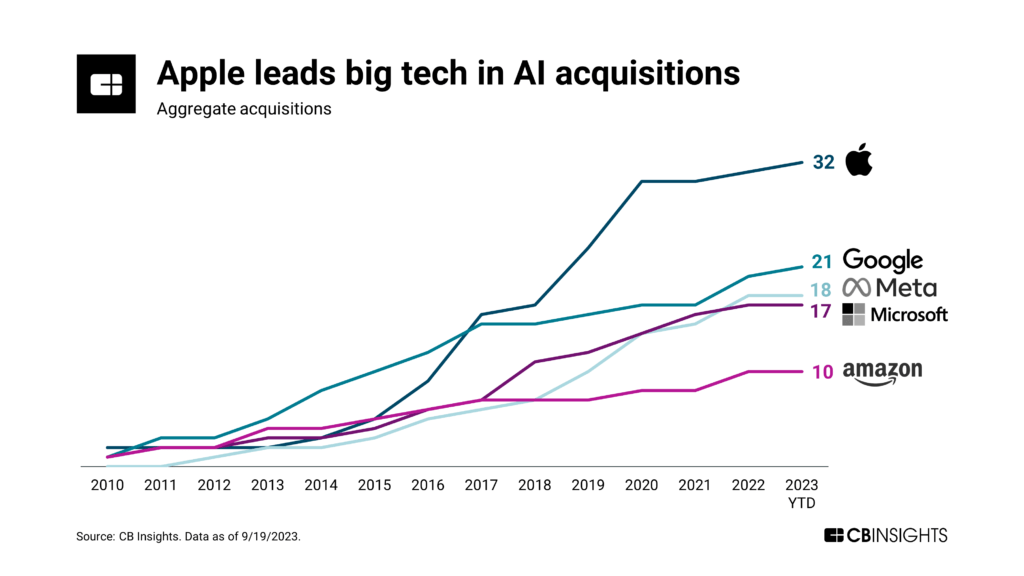
Apple has been unusually quiet about artificial intelligence, despite being a leading acquirer of AI-focused companies since 2010. This secrecy fueled speculation about a revolutionary AI breakthrough.
However, the reality was far from it. WWDC24 offered nothing groundbreaking, paling in comparison to competitors' advancements.
While Nvidia is building virtual universes for simulations, Google is revolutionizing genetics, and OpenAI is developing eerily human-like AI, Apple unveiled minor features like customizable icons, an iPad calculator app, and voice commands. It was a stark contrast to the level of innovation we've come to expect.
Yet, long-time Apple observers and strategy watchers, including myself, weren't as disappointed. We understand that this is part of a larger strategy.
Every tech giant recognizes AI's transformative power, but each has a distinct vision. These visions aren't formed through wishful thinking but by carefully considering strengths and weaknesses.
It's a complex strategic game with countless variables.
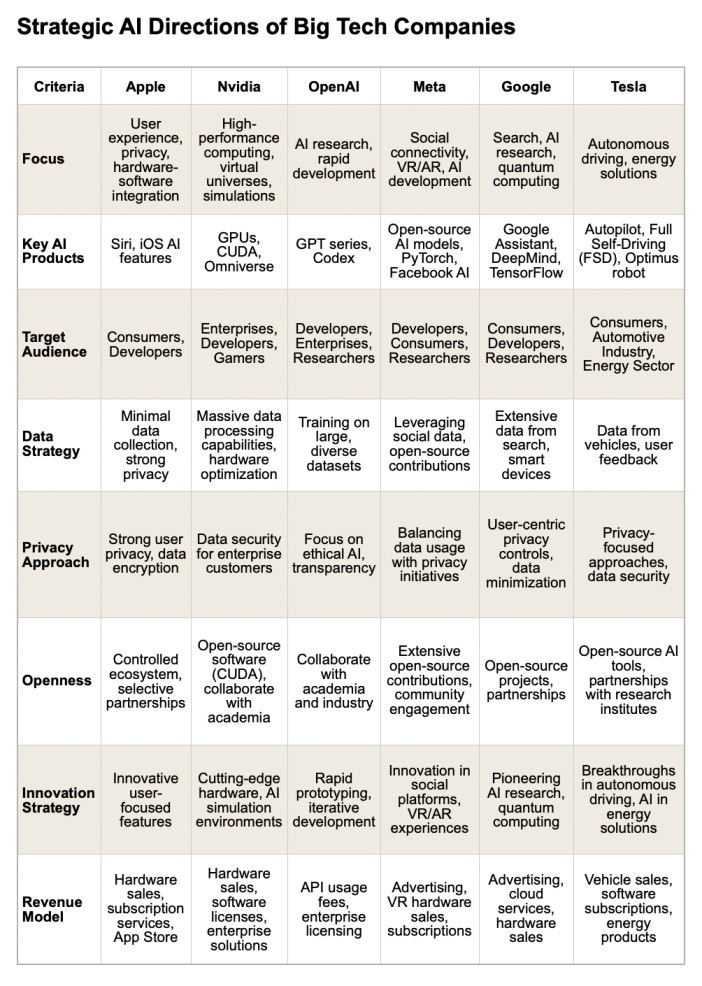
Given this chaotic landscape, it's unrealistic to expect every company to follow the same path or achieve identical results. Direct comparisons are misleading.
I've adapted this from my upcoming book, “Recode Your Future”, mentioned in the 12th issue and launching on June 24 on Amazon. I'll share more details soon.
Apple has long adopted a “wait and see” approach. Rather than chasing the latest tech trends, they obsessively prioritize user experience.
But it goes deeper than that. Apple aims to create truly magical experiences by making devices feel intuitive, almost instinctual.
Let’s look at some examples of how they've achieved this with existing technology:
Graphical User Interface (GUI) (1984): While not the inventors, Apple popularized the GUI with the Macintosh. Icons, windows, and mouse interactions made computers accessible to everyone, transforming personal computing.
The Click Wheel (2004): This simple, tactile circle on the iPod Mini revolutionized music navigation. It was a magical solution to a complex problem.
Magnetic Charging Connector (2006): MagSafe on MacBooks was a brilliant, simple idea. Its magnetic design prevented cable damage and added a touch of elegance.
Multi-Touch (2007): Pinch-to-zoom, swipes, and taps redefined smartphone interaction. Apple’s multi-touch interface felt natural and intuitive.
AirPods (2016): Wireless earbuds weren’t new, but AirPods perfected the experience with seamless pairing, intuitive controls, and features like automatic ear detection.
Apple Vision Pro (2023): VR existed before, but Apple aimed to create a radically different, more immersive experience with Vision Pro.
Apple is applying the same principles today. Instead of rushing to release AI-powered products, they're focused on enhancing everyday user experiences through innovative perspectives, even on seemingly small details.
Apple is studying how people interact with existing products from other companies and looking for opportunities to infuse their “magic” into those experiences.
It's important to remember that many of us, including myself, are immersed in an AI bubble. Since the inception of this newsletter, I've dedicated every issue to discussing AI, creating the impression that everyone understands and uses it. However, this isn't the case.
Apple is acutely aware of this. The majority of people haven't interacted with AI yet. Consider the following chart:
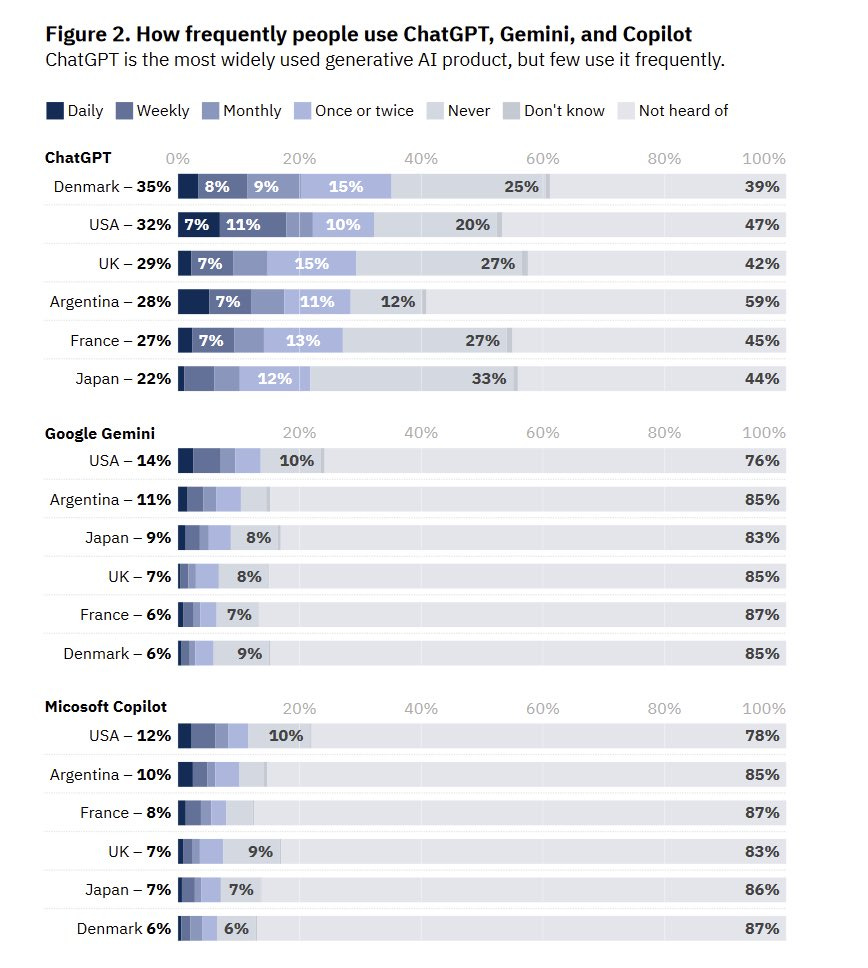
According to a joint Oxford University and Reuters study, daily artificial intelligence chatbot usage is a mere 2-3%. Most people are either unfamiliar with them or have tried and abandoned them after a few attempts.
Apple believes AI's utility lies in seamless integration into our daily lives, requiring no extra effort. Their recent event showcased features designed for everyday use on our constantly-present phones.
However, some of Apple's new features mirrored existing app store applications, sparking accusations of harming developers' livelihoods.
For instance, these nine apps could potentially become redundant. While true, blaming Apple is misguided.
These apps thrived within Apple's ecosystem due to existing gaps. Apple's App Store strategy inherently involves leveraging agile developers to fill these voids, a common practice among platform businesses. Accepting this reality is essential.
It's crucial to remember that no strategy guarantees perpetual success. History is littered with examples of once-dominant companies that faltered.
Nokia, the early 2000s mobile phone king, couldn't adapt to the smartphone era. Their preference for Microsoft's Windows Phone over Android, coupled with insufficient innovation, led to market share collapse.
BlackBerry, a business world staple, was eclipsed by touchscreen smartphones and Android/iOS dominance. Their insistence on a proprietary operating system marginalized them.
Kodak, a photography pioneer, missed the digital revolution. Their focus on film hindered their response to digital cameras, resulting in severe financial losses.
Yahoo, an early internet powerhouse, struggled against Google and Facebook. Their inability to adapt to innovative search and social media platforms eroded their market share.
MySpace, a social media forerunner, failed to innovate as Facebook surged. Neglecting user experience and feature updates caused a rapid user decline.
Apple's “wait and see” approach might falter post-AI revolution, but their strength lies in dictating their own playing field. Only time will tell.
💡 INSPIRING IDEAS:
You're familiar with the Genius Bar, right? Those Apple Store tables staffed by knowledgeable, passionate experts who provide exceptional customer support.
Ever wondered how it came to be?
In the early 2000s, Steve Jobs envisioned a revolutionary retail experience for Apple. Instead of the typical tech store crammed with products, he wanted stores that embodied Apple's brand and values.
This task fell to Ron Johnson, head of retail operations.
Johnson was determined to bring Jobs' vision to life. While experimenting with new store concepts, he focused on creating a transformative customer experience. Inspired by Jobs, he imagined Apple stores as hubs for Apple enthusiasts.
Rather than copying successful competitors like Best Buy or Radio Shack, Johnson sought inspiration elsewhere. He found it in the Ritz-Carlton Hotel Company's concierge stations. Impressed by the empathetic, knowledgeable concierges, he saw an opportunity.
The Genius Bar was born, modeled after the hotel concierge. Staffed by specially trained “Geniuses” it offered technical support, problem-solving, and product information. These experts went beyond sales, building genuine connections with customers.
The Genius Bar quickly became a beloved Apple Store staple. Customers appreciated the friendly, knowledgeable staff who efficiently resolved their issues.
Ron Johnson's simple yet brilliant idea transformed technology retail, setting a new industry standard.
The core of this discussion, and the underlying principle behind Apple's “wait-and-see” strategy, is a fundamental idea championed by Steve Jobs:
“You’ve got to start with the customer experience and work backwards for the technology. You can’t start with the technology and try to figure out where you’re going to try to sell it. And I made this mistake probably more than anybody else in this room. And I got the scar tissue to prove it. And I know that it’s the case”
This approach is aligned with the concept of “tech merchant” that I introduced in the third newsletter issue. It's about strategically leveraging technology to create exceptional user experiences, rather than simply chasing the latest trends.