


🎙️ AUDIO DEEP DIVE OF THIS ISSUE:
Sammy & Mila offer in-depth analysis on each newsletter issue. Subscribe to their podcast on Spotify or any other podcast platform.
📊 TRENDS, RESEARCH & REPORTS:
The Meteoric Rise of Artificial Intelligence
The sudden emergence of ChatGPT has left many of us bewildered. It feels like artificial intelligence (AI) was nonexistent just a couple of years ago, yet today, even our local grocers are discussing the intricacies of writing prompts.
While this rapid ascent may seem unprecedented, AI's journey has been a decades-long evolution, gradually building momentum until it culminated in a powerful avalanche effect.
To understand how this transformative technology simmered for so long before boiling over, let's examine its key milestones:
1950s:
Turing Test (1950): Alan Turing's pioneering question, “Can machines think?”, laid the foundation for AI research. This test established a benchmark for measuring machine intelligence.
Dartmouth Conference (1956): The term “artificial intelligence” was coined at this conference, marking the official birth of the field.
1960s and 1970s:
ELIZA (1966): This early chatbot demonstrated the potential of natural language processing (NLP).
Expert Systems (1970s): AI systems began to replicate the knowledge of human experts in specific domains.
1980s and 1990s:
Artificial Neural Networks (1980s): Inspired by the human brain, these networks laid the groundwork for future advancements.
Deep Blue (1997): IBM's Deep Blue defeated world chess champion Garry Kasparov, signaling a major breakthrough and capturing the world's attention.
2000s and 2010s:
Deep Learning (2010s): Neural networks became more sophisticated, leading to significant progress in areas like image and speech recognition.
AlphaGo (2016): DeepMind's AlphaGo defeated the world champion in Go, marking another pivotal moment in AI's evolution.
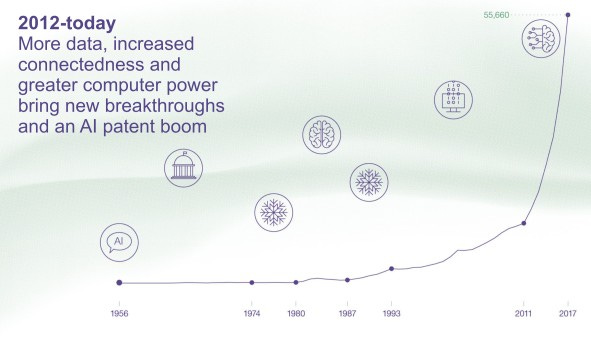
To fully grasp the trajectory of AI development, analyzing patent data is essential. The World Intellectual Property Organization (WIPO) provides valuable insights into this trend.
In my opinion, the perception that we suddenly entered the age of artificial intelligence can be attributed to three primary factors:
The Nvidia Effect: Advancements in computer hardware and cloud technology have dramatically accelerated data processing speeds while simultaneously reducing costs. This technological leap has been instrumental in developing larger and more complex AI models.
The Social Media Phenomenon: AI models require vast amounts of data to function optimally. Mobile devices, social media platforms, and digital services generate petabytes of data daily, providing an invaluable resource for training and refining AI algorithms.
The Open-Source Revolution: Platforms like GitHub and Hugging Face facilitate the sharing of AI projects and code among researchers and developers. This collaborative approach accelerates progress by preventing redundant efforts and building upon existing knowledge. This echoes the concept of "remix culture" discussed in issue 5.
It's interesting to note the inverse relationship between the number of patents filed and the decreasing costs associated with AI development. This suggests that while innovation is rapidly increasing, the barriers to entry for AI technology are simultaneously lowering.

💡 INSPIRING IDEAS:
“Excuse Me, Introvert Entrepreneurs” 🧘🏻
I recently devoured Gözde Atilla’s book, “Excuse Me, Introvert” in one sitting, and I absolutely loved it.
The book brilliantly captures the introverted experience, using deeply personal stories to illuminate what we feel and why. I found myself nodding along in agreement countless times, as the descriptions perfectly mirrored my own life.
I’m a textbook introvert. My friends often describe me as quiet, reserved, and content in my own company. I can easily lose myself in my thoughts for hours. Social gatherings are a drain on my energy, and I usually find myself longing for solitude after a couple of hours.
The book emphasizes that these aren’t flaws. As Atilla puts it, “An introvert's home is within themselves”. It’s essential to understand that.
Introverts make up a quarter of the population, yet we’re often treated as outsiders. From a young age, we’re encouraged to be more like extroverts. But we shouldn’t be seen as failures. In fact, many successful entrepreneurs are introverts, and I believe it’s a significant advantage.
I’m a great listener, which helps me truly understand people’s needs and build empathy. This is invaluable in customer interactions.
I’m also a deep thinker, preferring to analyze situations thoroughly before making decisions. This approach leads to more strategic, long-term planning.
And perhaps most importantly, introverts are often intrinsically motivated. We find our drive from within, which is crucial for overcoming the challenges of entrepreneurship.
Figures like Bill Gates, Mark Zuckerberg, and Elon Musk are prime examples of introverts who’ve made a massive global impact. Their success stories demonstrate the power of quiet determination.
Parents should celebrate their children’s introversion and nurture their unique strengths. It’s a gift, not a weakness. And as for the extroverts who might find us puzzling, I hope this book helps them understand and appreciate us better.
Gözde Atilla’s book is a comforting and insightful read for introverts and those close to us. I wholeheartedly recommend it.
📱 NEXT BIG APP:
My Schubert Obsession and the AI Fix ♪♫
While playing games with my daughter Nil, I let her Spotify playlist fill the room.
Lots of Coldplay and lots of classical pieces, a reflection of her love for ballet.
One track caught my ear: Franz Schubert's Piano Trio No. 2 in E-flat major, Op. 100, D. 929 (Listen here). One of my favorites too.
At first, Nil requested endless repeat. It was a bit nerve-breaking. But then, when she wasn't around, I found myself drawn back to it again and again. It became an obsession. I couldn't escape the melody, humming it even when not actively listening.
I loved the obsession, but the constant loop in my head was getting tiresome. That's when I remembered Suno.ai, the AI that creates music based on your input.
Do you remember the scene in the movie “I, Robot” (2004) where Will Smith sarcastically asks the robot “Can you compose a symphony?”. Well, Suno can definitely write you one (sorry, Will!).
Here is how I did it;
ChatGPT, asking for a one-sentence description of Schubert's work.
Take the answer, and added “Franz Schubert like...” and
Prompt it to Suno: “Franz Schubert like lyrical themes, intricate structures, and emotional depth classical music”
That’s it.
Just under 30 seconds, came out two beautiful pieces, each unique in its own way. While they wouldn't fool anyone for a true Schubert, the ability to generate such “custom-made” music based on a single sentence is mind-blowing.
Movie composers might be getting a little nervous right now...
Give them a listen and see what you think. If you're a Schubert fan, see if it captures even a hint of his style!
String-based Melancholic Version
Rhythmic Piano Hopeful Version
💡 INSPIRING IDEAS:
“The most powerful productivity tool ever invented is simply the word ‘No.’”
— Shane Parrish