


Suppose we had two pictures of a street. One came from a dashcam, the other from GTA. We want to teach a computer where the road ends and the sidewalk begins. Which would you pick?
I'd pick the real one without thinking. A car that's going to share the road with us should learn from a video game?
Then someone hands me a mouse and asks me to mark every bit of sidewalk in the photo. A parked car blocks half of it. There's a sliver just under its mirror. Mark that too. Only a few thousand photos to go.
GTA fans have their own reasons for staring at a few pixels. Before GTA VI arrived after a 13-year wait, one player paused the first trailer to figure out whether a highway sign said 18 or 1B. They were trying to estimate the size of the map from the distance between two exits. The player's analysis
GTA VI, released November 19, follows Lucia and Jason through Vice City, Rockstar's take on Miami. Your eye naturally follows the couple as they get into trouble. Pause for a second and look at what they leave in the background. Everything we'd have to trace by hand in a photo, Rockstar has already drawn. Could we use that? Rockstar Games
The game comes with an answer key
In 2016, researchers at TU Darmstadt and Intel Labs tried exactly that with GTA V. A camera gives us a picture. The game engine has just drawn the street, and the information it sends to the graphics card carries clues about which pieces it used to draw the sidewalk and the parked car.
The researchers could label an object once and carry that label across other frames in which it appeared. They labeled about 25,000 images in 49 hours, or seven seconds per image on average. One of the real-world street datasets they compared against took about 90 minutes per image to label in detail. Playing for Data
Fine, but what happens when the computer sees a real street? The team trained one model on the full real-world training set. They gave another model just a third of that set plus images from GTA. Then they tested both on real street photos. The model that also learned from GTA did a better job telling roads, sidewalks and cars apart. Research results
Rockstar built that city so we could drive around in it. The researchers found an answer key in the same city. If the computer thinks the pixels under the mirror belong to the car, they can see where it went wrong.
At Next Big App, that's the thing I most want when I listen to a sales call. I can hear what the salesperson said. How do I tell whether they understood what the customer really needed?
How much more is the other plan?
Someone calls an internet provider to ask about the price difference between two plans. The salesperson gets both prices right, explains the current offer, and throws in a discount. Stop the recording there and I'd probably call that a decent sales conversation.
Now listen again with one more piece of information. The caller moves on Friday. They have an important meeting at nine on Monday morning and will be joining from home. They can afford either plan. If installation slips to Tuesday, neither plan will help. Now I'm listening for one question. “When do you need the connection working at the new place?”
If the customer never mentions the meeting, it won't be in the recording. We know about it when the caller is our AI mystery shopper, because we put it in the scenario. The AI phones the company. A real salesperson or service rep picks up. Afterwards we can tell which parts of the customer's problem came up and which stayed hidden.
That nine o'clock meeting is our version of the sidewalk in GTA. Once we know what the customer needs, the salesperson can find their own way to it. One asks about the installation deadline. Another checks the address and says, “We can't get anyone to that neighborhood until Tuesday. Is that too late?” They might lose the sale and save the customer's Monday morning. A scorecard that gives points for discounts would miss that.
Now let the same customer call a voice assistant we've just built for the company. We can choose the moment most likely to trip it up and have the caller speak right then.
Have the caller interrupt right there
There's an example I like in Waymo's driving simulator. The car ahead has a piece of furniture strapped to its roof. It looks ready to fall off. How many miles would we need to drive to see how an autonomous car deals with that? It depends on somebody moving house that day and doing a pretty poor job securing the furniture. Waymo can generate the scene and test the driving system there. Waymo's simulation examples
Back to our caller. They ask to disconnect the internet at their old place on Friday. Just as the assistant is about to confirm, they cut in. “Wait, my dad is staying there another week. Keep the old connection on. I meant I need the new place connected on Friday.”
On the page we can see the whole sentence. On the phone the assistant hears the first request before the correction exists. Does it stop when the caller interrupts? Does it apply the change to the right address? At the end of the call there's one very simple question. Is Dad's internet still on?
We have other AI assistants call the new ones by phone. One caller mixes up the addresses from the start. Another corrects them at the last second. A third hands the phone to Dad. Listening to the calls tells us what the assistant misunderstood and where it interrupted. We fix it and run those same calls again. If we've helped the customer who changes their mind but now ask everyone else to confirm three times, we hear that too.
This is the part that surprises companies we work with. In the morning they're walking us through the quirks of their business. By the afternoon they can pick up the phone and talk through a tricky case with the new assistant. When did we find time to try all of that?
That's why I want to ask an experienced service rep a question early that morning. “Which call always trips up a new hire in their first week? Tell me how it goes.” They know where things get messy. We can give those situations to the test callers and have them all dial at once.
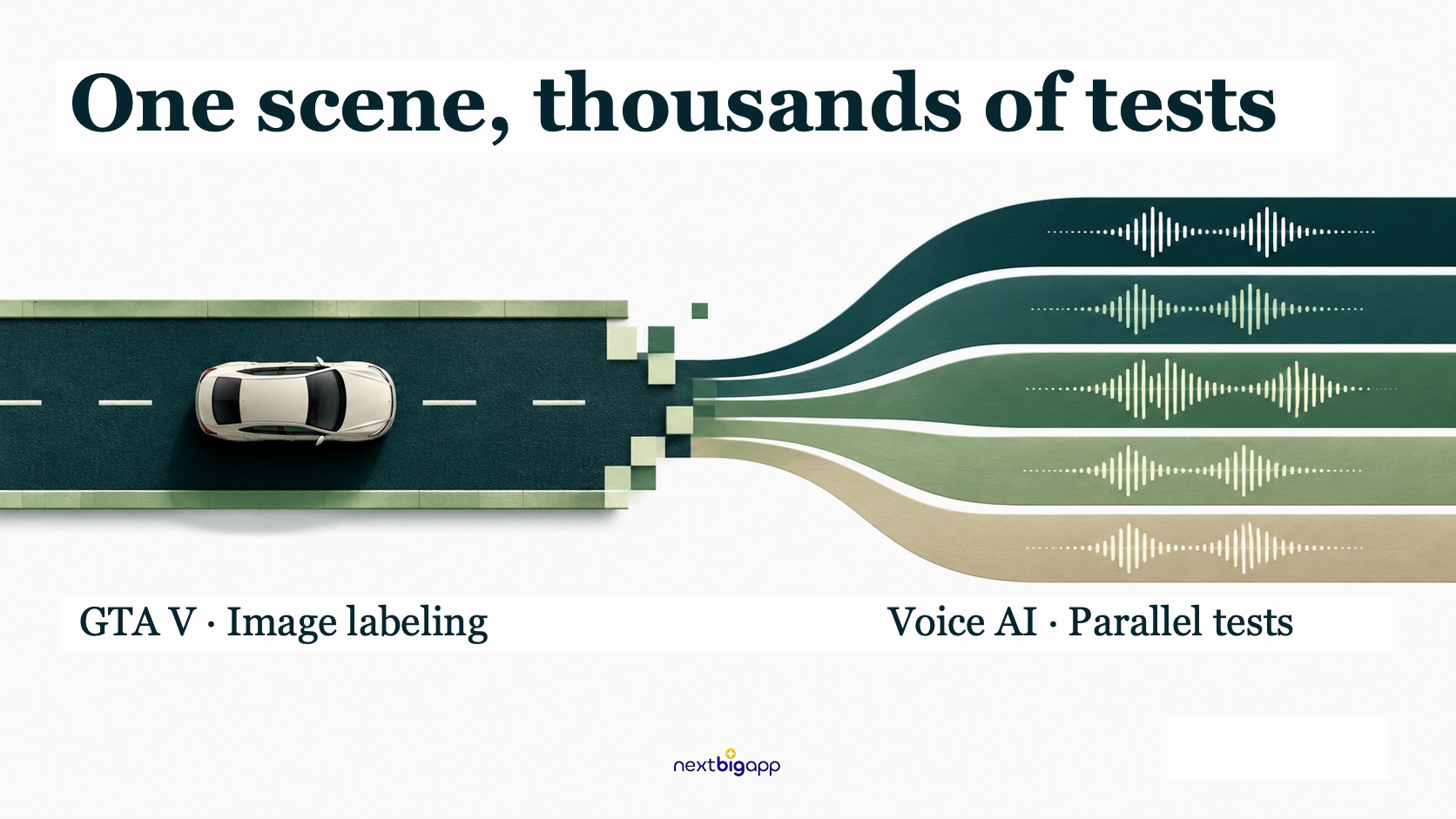
Labeling a real street photo took about 90 minutes in one dataset. With GTA footage the researchers averaged seven seconds. A five-minute phone call still takes us five minutes. We can make thousands of those calls at once, each testing something different. Tests that would take people weeks to run one by one can be done in a few hours.