


IN COLLABORATION WITH COFOUNDER
We are rapidly approaching a reality where the operational overhead of launching a startup drops to near zero.
If you are still managing execution manually, you are burning time. Cofounder is one of the clearest embodiments of this shift, allowing you to automate the entire building process from day one.

Cofounder lets you run an entire company with agents. It assigns work, delegates to specialized subagents, and orchestrates across the entire business.
Cofounder is designed like a real company, with departments, managers, and shared context. Engineering agents ship features, marketing agents write and distribute content, sales agents surface and qualify leads, and design agents build your visual identity and apply it across the entire org.
From the first lines of code to a one billion dollar company, Cofounder will support you.
👉 Deploy your agentic workforce at Cofounder
But here is the catch: when anyone can deploy an army of specialized agents to ship features and distribute content instantly, execution becomes a commodity.
And that is exactly why most people are looking at the future entirely wrong.
Right now, every founder on your timeline is obsessing over the exact same thing: using AI to generate more content, write more code, and build more screens, faster than ever before.
They are fighting the last war.
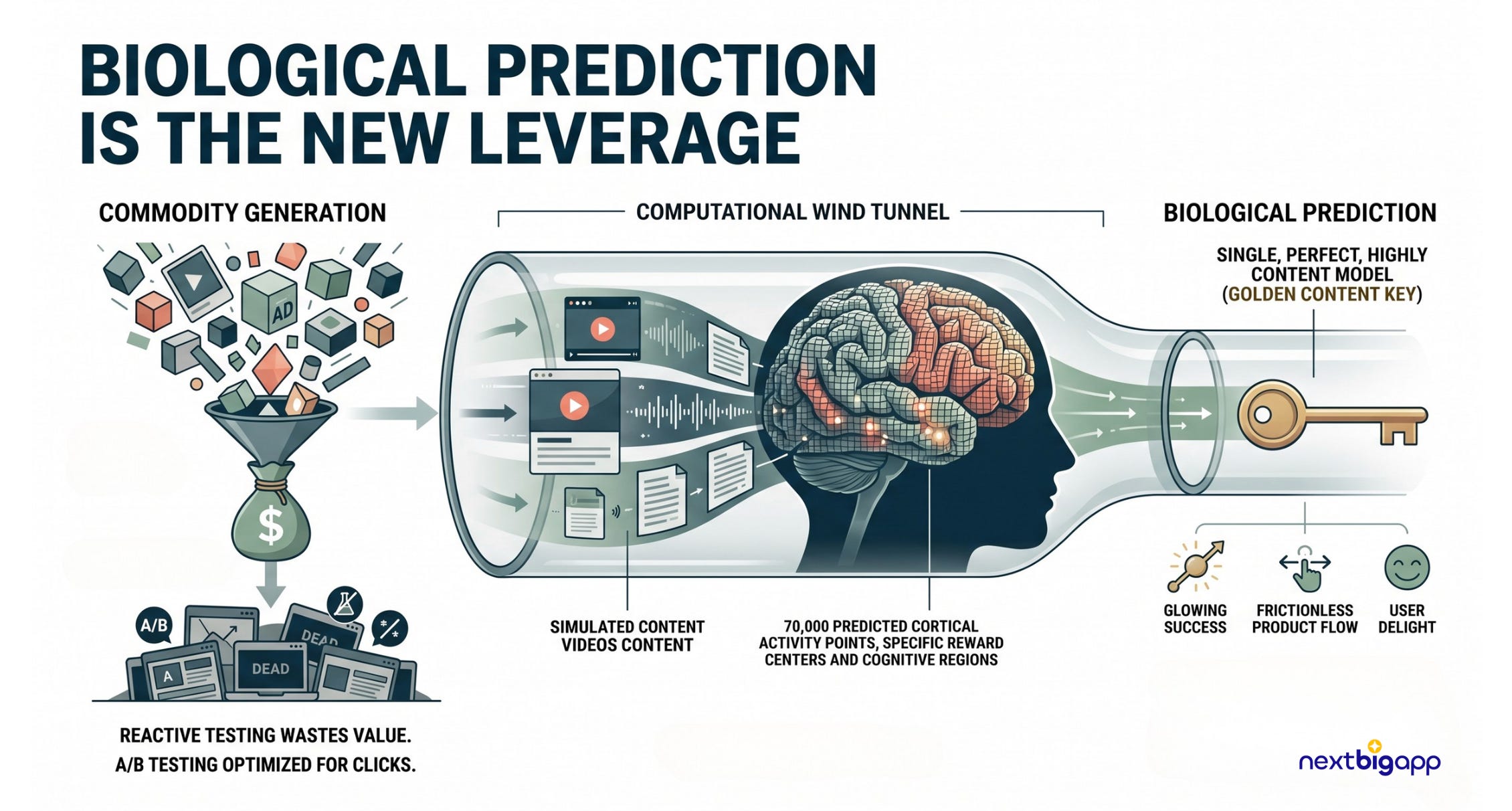
When the marginal cost of creating an ad, a landing page, or an onboarding flow drops to zero, generation becomes a commodity.
If everyone can spin up a thousand variations of a video in an hour, volume is no longer an advantage. It’s just noise.
The real leverage isn’t generating the media. It’s predicting its biological impact before you spend a single dollar on distribution.
Enter the Digital Brain Twin
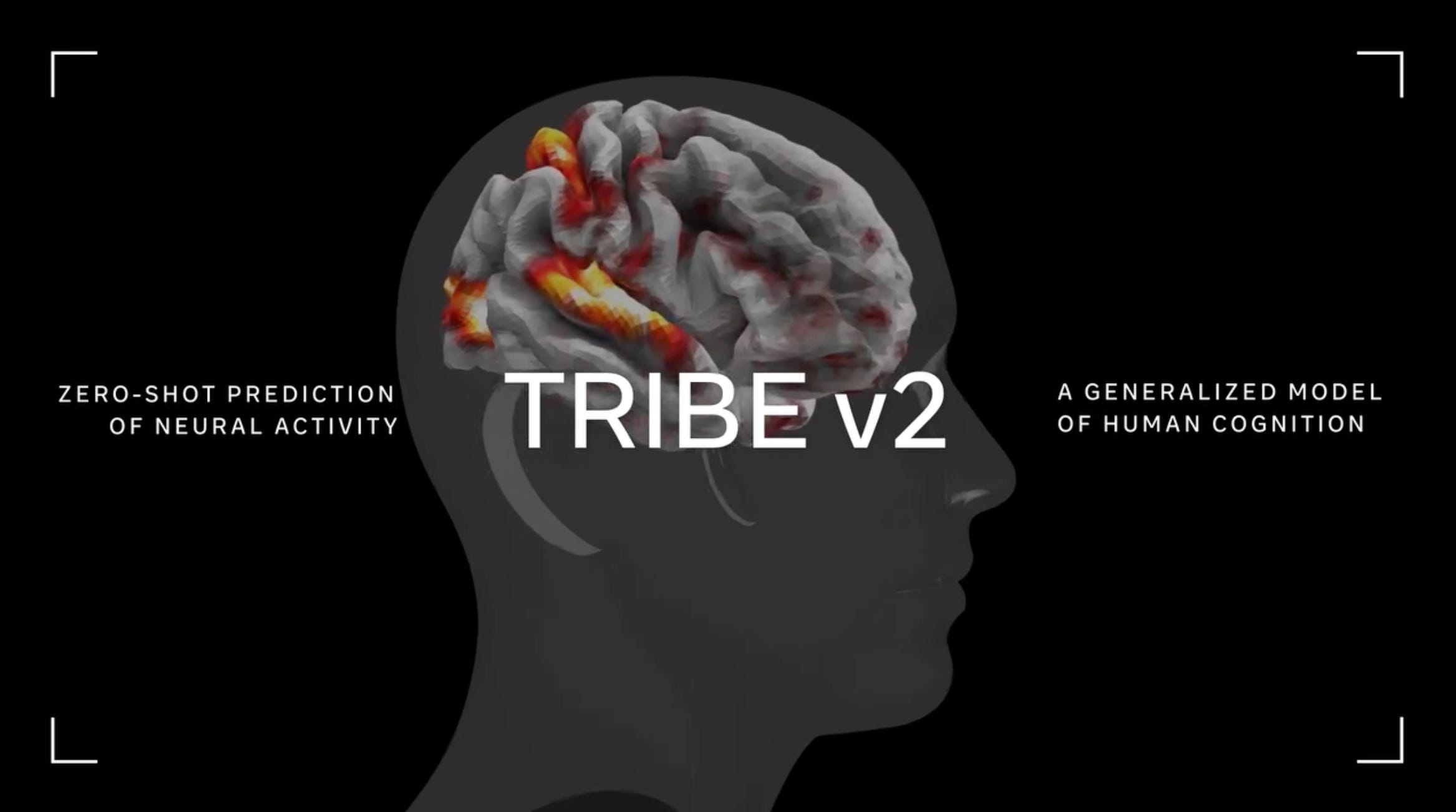
In March 2026, Meta’s FAIR team quietly dropped TRIBE v2 (TRansformer for In-silico Brain Experiments).
If you aren’t paying attention, it sounds like another academic research paper.
It’s not.
It is a computational simulation of human neural activity.
Meta fed a foundation model over 1,000 hours of high-resolution fMRI data from 720 subjects watching videos, listening to audio, and reading text.
The result?
A model that maps multimodal inputs onto 70,000 voxels of predicted cortical activity.
In plain English: You feed it a piece of content, and it tells you exactly how a human brain will light up in response.
Why We Should Care
I’ve been involved in launching over 50 apps and scaling them to the Top 10 across 20+ countries.
Do you know how much money and time we burned on behavioral A/B testing?
We’d build a feature, ship it, spend $10,000 on user acquisition, and stare at drop-off metrics to guess why people churned.
I wrote about this transition recently, arguing that it’s time to burn your focus groups and rely on AI to model user responses.
Humans are notoriously terrible at explaining what they actually want, and traditional research is simply too slow for modern product cycles.
But when I wrote that, we were still just predicting behavior.
TRIBE v2 predicts biology.
Formula 1 engineers don’t build physical cars to see if they are aerodynamic; they use digital wind tunnels. TRIBE v2 is a digital wind tunnel for human attention.
It brings the era of in-silico neuroscience to the masses.
Where the Real Leverage Lives
Generative AI tools are exactly that: tools. They are not a strategy.
The strategy is moving from a system of reaction to a system of prediction.
Here is how this completely breaks the current operational model:
Neuromarketing Without the Scanner: You don’t need to guess if a hook works. You can upload an ad creative and simulate whether it spikes dopamine and bypasses conscious resistance, or if it triggers cognitive overload. You kill the losers before you buy the media.
Frictionless Product Design: Instead of paying for slow, biased UX testing, you can run thousands of synthetic, neurologically accurate tests in seconds to spot exactly where attention collapses inside your app.
Predictive Content Strategy: Virality isn’t magic; it’s biology. Meta already knows what keeps people scrolling. Now, you can optimize your content for specific emotional hooks and pacing styles based on actual predicted brain heatmaps.
The Uncomfortable Truth
There is a slightly dark reality we have to acknowledge here.
Current marketing regulations assume that people can recognize and resist persuasion. But neural-level optimization operates entirely below conscious awareness.
When you can mathematically predict exactly which combination of visuals and audio will trigger a reward response, you are bordering on scalable, cheap behavioral influence.
Meta released the model weights under a non-commercial license (CC BY-NC), meaning you can’t immediately wrap this in a SaaS product and charge for it. But the Pandora’s box is open.
The open-source community is already building viral analyzers and real-time brain watchers based on this architecture. The commercial integrations are inevitably coming.
If your growth strategy relies entirely on pumping out more AI-generated content to see what sticks, you are going to get crushed by teams who are running their creatives through synthetic brains first.
Stop guessing what your users want. Start predicting how they process it.