


In 2025, private AI investment in the United States reached $285.9 billion.
China: $12.4 billion.
That’s a 23x difference.
Now here’s the more interesting number.
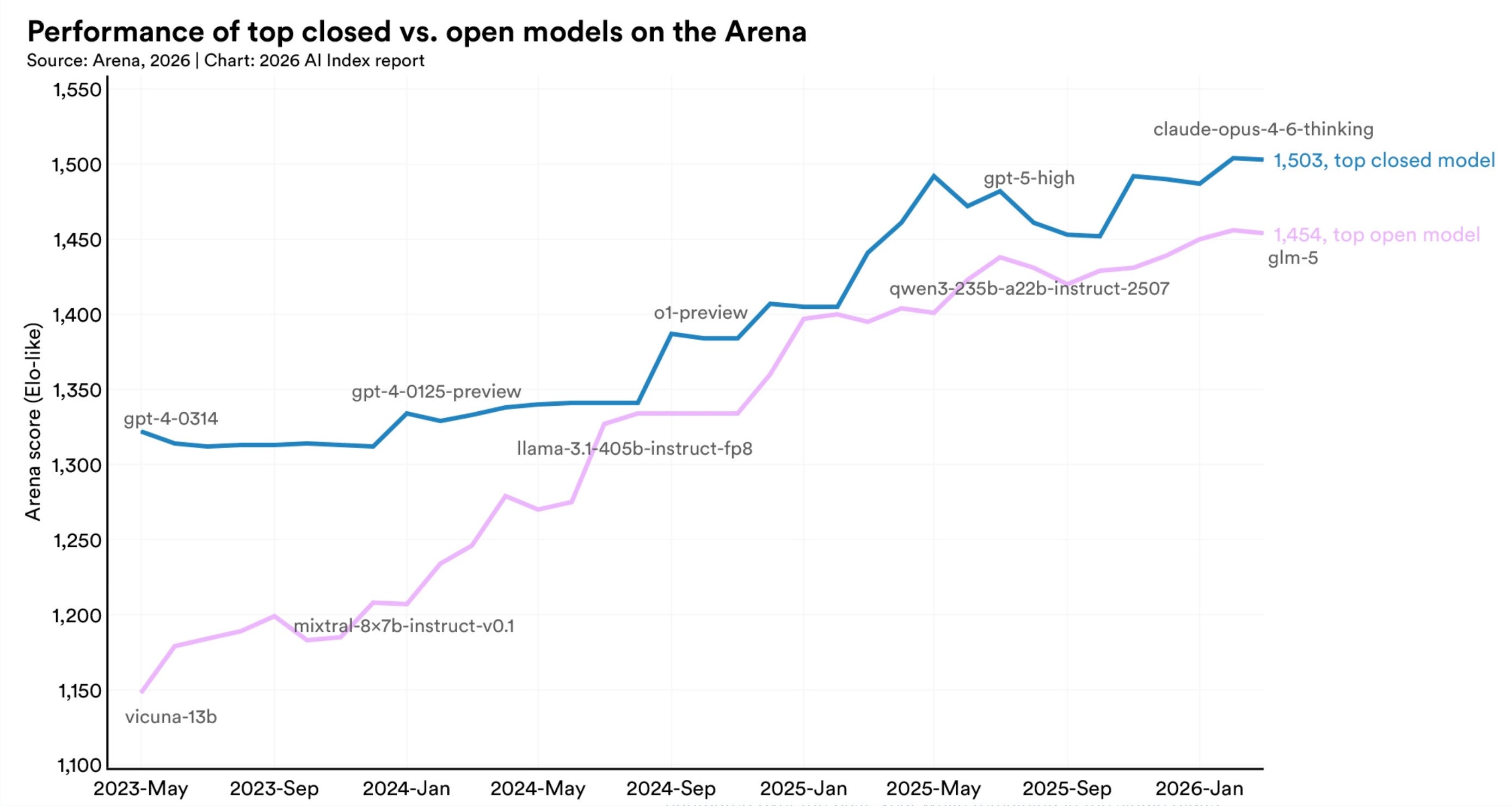
By March 2026, Stanford’s AI Index found that the performance gap between the leading U.S. and Chinese AI models had narrowed to just 2.7%. The two countries had already traded places at the top several times since early 2025.
Read those two numbers together.
23x the private investment.
2.7% the model-performance gap.
That should make a lot of executives in developed markets slightly uncomfortable.
Because there is still a deeply embedded assumption in the U.S. and Europe that goes something like this:
🇺🇸 We build the technology. The rest of the world adopts it later 🇪🇺
Historically, that was mostly true.
With AI, I’m not sure it will stay true for very long.
And if you run a company in New York, London, Berlin or Paris, assuming it will is becoming dangerous.
The Lead is Real, The Moat is Not
Let me be clear.
The United States has an enormous structural advantage in AI.
Capital. Chips. Research universities. Talent. Cloud infrastructure. Frontier labs. Venture capital. Customers willing to pay.
I’m not arguing that these advantages disappeared overnight.
I’m arguing something different.
The technology produced by those advantages is becoming globally accessible at an astonishing speed.
A breakthrough used to take years to diffuse.
Now it can take months.
Sometimes weeks.
Look at DeepSeek.
You don’t need to move to China, negotiate a technology-transfer agreement or build your own data center to use a Chinese reasoning model.
AWS made DeepSeek available as a fully managed model on Amazon Bedrock. Microsoft offers DeepSeek models through Azure AI Foundry. Google added DeepSeek to Vertex AI Model Garden.
Think about how strange that would have sounded a few years ago.
Three of America’s largest technology companies are providing infrastructure through which their customers can deploy Chinese AI models.
That’s not a criticism.
It makes perfect business sense.
But it tells you something important about where competitive advantage is moving.
The model itself is becoming a component.
And components get commoditized.
Open Models Have Changed the Speed of Catch-up
One of the most interesting AI charts I’ve seen recently isn’t about funding.
It’s about usage.
OpenRouter analyzed more than 450 trillion tokens processed on its platform between January and mid-June 2026.
At the beginning of the year, DeepSeek represented roughly 9% of token volume.
By June, it was around 18%.
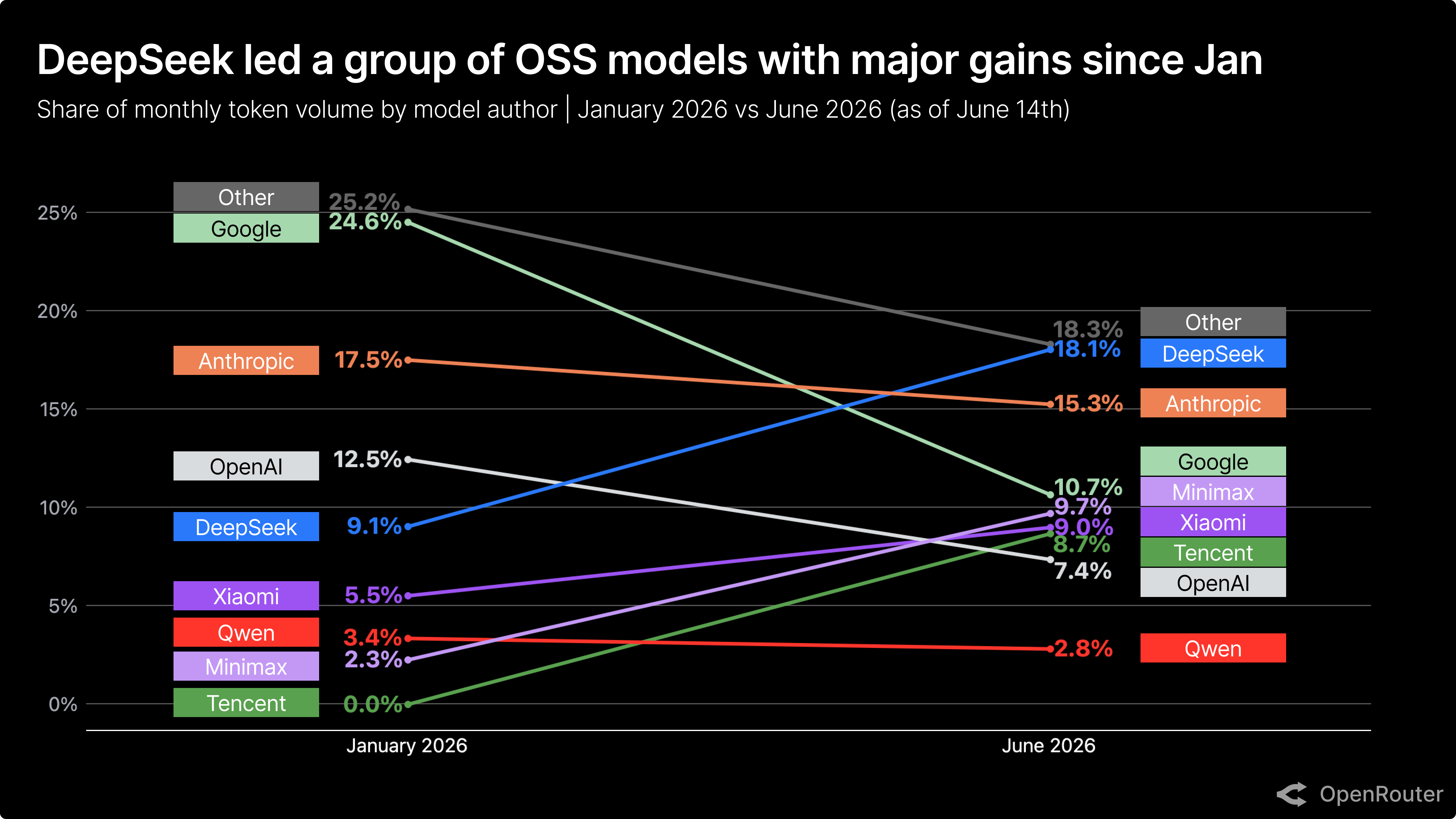
More interestingly, Chinese models collectively surpassed American models in token share on OpenRouter in early June.
Now, OpenRouter is one platform. I wouldn’t confuse its traffic with global AI market share.
But directionally, it tells us something important.
Capability travels.
Fast.
And buyers increasingly have the ability to choose between models based on performance, price, latency and suitability rather than where the model was created.
This changes the economics of catching up.
A company in Istanbul, Bangalore, São Paulo or Jakarta no longer needs to reproduce hundreds of billions of dollars of AI infrastructure before it can benefit from the output of that infrastructure.
It can rent the intelligence.
Use an open model.
Fine-tune it.
Build on top of it.
Combine several models.
And increasingly, swap one for another when the economics change.
That last part matters more than it sounds.
Because if your competitive advantage is:
“We have access to the best AI.”
You may not have much of a competitive advantage.
Your competitor may have access to something almost as good next quarter for a fraction of the cost.
Your Company Does Not Automatically Inherit Silicon Valley’s Lead
This is where I think developed-market companies risk becoming complacent.
The adoption statistics look fantastic.
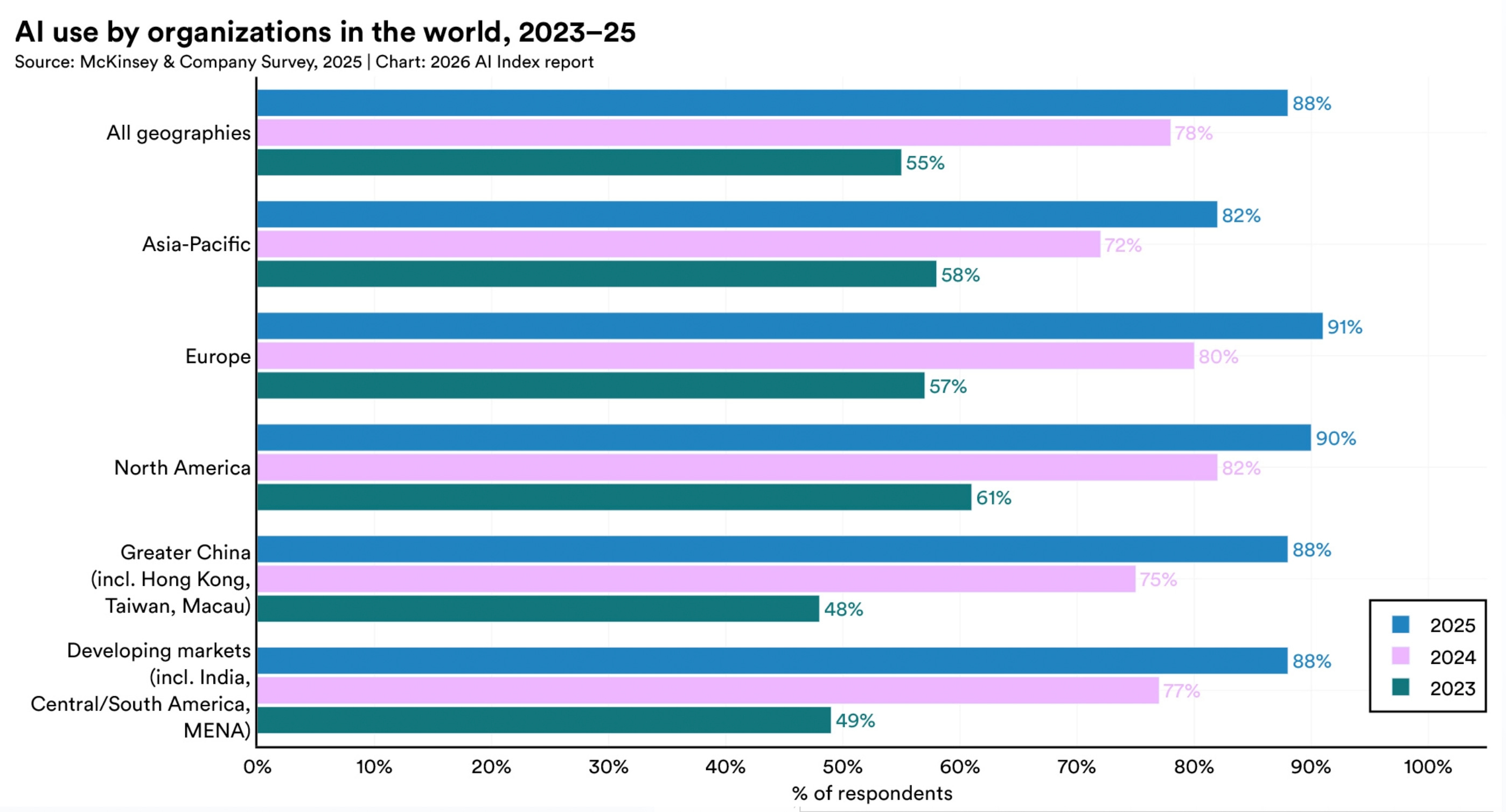
Stanford’s 2026 AI Index says 88% of surveyed organizations were using AI in at least one business function in 2025.
Sounds like the transition is well underway.
It is.
But using AI and reorganizing a company around AI are two completely different things.
McKinsey found that nearly 90% of organizations were at least experimenting with AI, while only 7% said they had scaled it across the enterprise.
That gap is the whole game.
Giving everyone ChatGPT, Claude or Copilot is not AI transformation. It’s access.
Your employees using AI to rewrite emails faster is useful. It is not a moat.
The hard part starts when you ask:
Which workflow changes?
Which decision changes?
Which cost changes?
Which customer experience changes?
Which revenue number changes?
And what can we now do that was economically impossible two years ago?
That is where organizations slow down.
Committees appear. Governance meetings appear. Twenty-seven AI pilots appear.
Everyone has a strategy deck. Nobody can tell you what happened to gross margin. And the latest McKinsey research makes the difference quite visible.
Among its AI “high performers”, nearly three-quarters report fundamentally redesigning workflows because of AI.
Among everyone else?
About one-quarter.
That’s not a tooling difference. It’s an operating-system difference.
The winners aren’t simply using AI more. They’re changing the machine around the AI.
Your Dangerous Competitor May Not Look Dangerous Yet
For decades, a mid-sized company in a developing economy had disadvantages almost everywhere.
Less capital. Smaller talent pools. Worse infrastructure. Less access to technology. More expensive knowledge. Smaller domestic markets.
If you were sitting inside a large American or European company, you could reasonably assume many competitors elsewhere were years behind.
AI doesn’t eliminate those disadvantages. But it attacks several of them at the same time.
A ten-person export company can now perform market research that once required consultants.
A small sales team can personalize communication across hundreds or thousands of accounts.
A customer-service operation can handle dramatically more conversations without scaling headcount linearly.
A developer who has never worked with a particular framework can become productive in it much faster.
A local company can translate, localize, analyze, code, research and create at a level that previously required much more specialized talent.
This is why I think we make a mistake when we talk about AI only as a productivity technology.
Productivity is the obvious part.
The bigger shift is that AI makes capabilities affordable that many companies previously couldn’t afford at all.
And that disproportionately benefits the company that was constrained in the first place.
Imagine you already have 200 analysts. Making every analyst 20% more productive is valuable.
Now imagine your competitor could never afford an analyst team in the first place.
Suddenly, three people with the right AI systems can do a meaningful part of what previously required twenty.
Those two outcomes are not economically equivalent. One is optimization.
The other is capability creation. And capability creation is how gaps close much faster than incumbents expect.
The Real Moat is Becoming Learning Speed
There’s another reason waiting is expensive.
Companies often talk about AI adoption as if it were something they could postpone and then catch up on later.
“We’ll let the technology mature”
“We’ll see which vendors win”
“We’ll implement once the use cases are clearer”
It sounds rational.
The problem is that your competitors aren’t only accumulating software while you wait. They’re accumulating experience.
Suppose a competitor starts redesigning its sales operation around AI today.
Over the next two years, it learns:
Which leads should be contacted first.
Which tasks should stay human.
Which responses can be automated.
Where hallucinations create risk.
What data the system needs.
How customers react.
How salespeople actually use it.
Where automation hurts conversion.
Where it improves conversion.
And how the workflow should change again.
After two years, you can buy the same model.
You cannot buy those two years of organizational learning.
This is the part I think many boards underestimate.
The compounding asset is not the AI. It’s the feedback loop around the AI.
The model can be copied. The API can be replaced.
The workflow knowledge accumulated through thousands of real customer interactions is much harder to reproduce.
That’s where the moat moves.
Don’t Start with an AI Strategy
This is also why I’m skeptical when someone tells me their company is “working on an AI strategy”.
AI is too horizontal for that to be a useful starting point.
I would start somewhere much less exciting: Which business number do you want to move?
Revenue? Conversion? Churn? Customer response time? Cost per ticket? Time to create a proposal? Time from lead to meeting? Customers served per employee?
Pick one.
Then find the workflow constraining that number. Then redesign that workflow using what AI makes possible today. Measure before. Change the system. Measure after.
Did the number move?
If yes, keep going. If not, kill it and attack another bottleneck.
You don’t need an 80-page transformation plan to begin. You need one economically meaningful constraint.
AI is leverage.
Leverage is only useful when you apply it to the right point.
The Comfortable Era is Ending
The West is not about to stop producing the world’s most important AI technology.
That’s not my point.
Something subtler is happening.
Producing the technology and capturing the economic advantage from the technology are becoming two different things.
We’ve seen versions of this story before.
Invention happens in one place. Manufacturing advantage emerges somewhere else. Distribution gets captured somewhere else again.
Eventually, the company or country that created the breakthrough discovers that creation alone did not guarantee value capture.
AI may compress that cycle dramatically. The Stanford numbers are a useful warning.
The U.S. can outspend China more than 23 to 1 in private AI investment while the performance gap between its leading models shrinks to a few percentage points.
Meanwhile, open models and global cloud infrastructure can put advanced capabilities into the hands of companies almost anywhere.
So if you run a company in a developed market, I wouldn’t spend too much time congratulating yourself for being geographically close to the AI revolution.
Your company does not automatically inherit Silicon Valley’s lead.
You still have to earn it.
The question is no longer: Who invented the technology?
Increasingly, it is: Who reorganized around it fastest?
Because the technology advantage you think separates you from the rest of the world is becoming cheaper, more open and more portable every month.
And if someone with fewer resources learns to use it faster than you do, don’t be surprised when they stop looking like the company that was supposed to be behind.
The most interesting part of this debate is that an AI lead may be far less durable than people assume. Models can improve quickly, talent can move, open source research spreads globally, and the infrastructure required to compete is being built outside the West at an extraordinary pace. The real advantage may eventually belong not to whoever creates the best model first, but to whoever can deploy AI most cheaply and broadly across manufacturing, energy, healthcare and everyday businesses. Technological leadership has never been permanent, and AI could compress that cycle dramatically. The question is whether the West is building a lasting ecosystem advantage or simply enjoying a very expensive head start.