


Something strange happened at the U.S. Open this year.
During Naomi Osaka’s first-round match, a group in a hospitality suite started moving around, posing for photos and creating enough distraction that the chair umpire intervened.
Elsewhere, spectators were filmed using ring lights and flash photography during play.
Yes.
Ring lights.
At the U.S. Open.
Organizers eventually reminded spectators not to use lighting that could interfere with matches. The point was simple: if you come to a sporting event, understand the etiquette of the sport.
One detail matters: the people involved in the most discussed Osaka incident were not part of the USTA’s official creator program.
That actually makes the story more interesting.
Because this isn’t really about influencers behaving badly.
It’s about what happens when one system imports the incentives of another.
The Obvious Take Is Too Easy
You can turn this into a generational argument quickly.
Influencers have no manners.
Old tennis fans are snobs.
Social media ruined everything.
None of those explanations are very useful.
The better question is:
Why would someone bring a ring light to a tennis match?
Because inside the creator economy, it makes sense.
You are somewhere interesting. Your audience expects content. Your business rewards visibility. The venue becomes part of the content. The event becomes raw material…
That doesn’t make creators irrational.
It makes them rational inside a different incentive system. And businesses underestimate this all the time.
You Don’t Add a Channel. You Add a Behavior.
The U.S. Open wants younger audiences and more social distribution. Of course it does.
Creators are good at both.
But a distribution channel never arrives alone.
It brings its habits, economics and definition of success.
Traditional media has one incentive structure. Fans have another. Sponsors have another. Creators have another.
A creator is rewarded for capturing something.
A tennis spectator, during a point, creates value partly by doing nothing.
That’s the real conflict.
Not old versus young. Two systems rewarding different behavior.
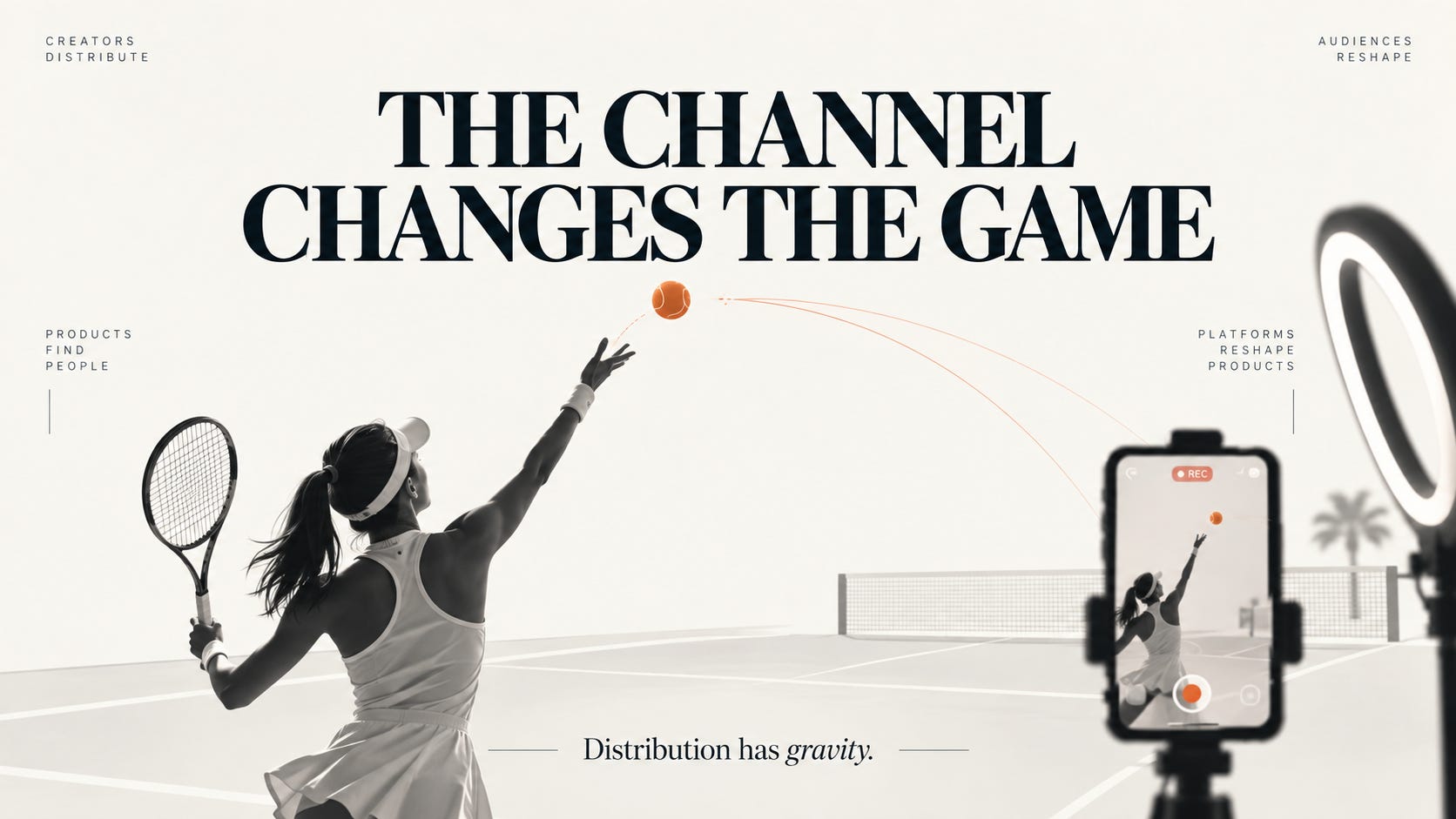
Channels Move Upstream
We’ve seen this pattern before.
Google started as a traffic source; then ranking became the incentive, and SEO tactics became the standard way content was researched, structured and written.
YouTube started as a video platform; then clicks and watch time became the incentive, and reaction videos, repeatable formats, low-cost entertainment and endless cat videos flourished.
Facebook started as a social network; then attention and engagement became the incentive, and relationships slowly turned into content, performance and measurable social currency.
Twitter started as a place to share updates; then replies, retweets and outrage became the incentive, and conflict consistently traveled further than nuance.
Instagram started as photo sharing; then likes, followers and visual status became the incentive, and everyday life turned into a comparison machine for lifestyles, bodies, careers and success.
TikTok started as a short-video platform; then instant retention became the incentive, and video adapted to shorter attention spans: faster hooks, quicker cuts, less patience and almost no room for a slow start.
The pattern is always the same: First, the channel distributes the product. Then its incentives start redesigning the product and eventually the people using it.
Usually nobody announces this.
The incentives do the work.
Growth Channels Have Opinions
This is where companies get caught.
They evaluate channels with questions like: How much traffic can this produce? What’s the CAC? How fast can it scale?
Those questions matter. But there’s another one I’d put next to them:
If this channel becomes 10x more important, what will it make us change?
Imagine paid acquisition becomes 60% of your growth.
Suddenly, customers who convert quickly look better.
Brand investments look harder to justify.
Longer product education looks inefficient.
Retention competes with acquisition experiments that can move this quarter’s numbers.
Nobody says: “We’re redesigning the company around Meta Ads.”
They don’t need to.
The economics start making decisions for them.
The same thing happens with partners.
A partner channel works. Then it works really well. Soon their integration requests enter the roadmap. Their customers influence priorities.
The channel isn’t just distributing the product anymore.
It is helping specify it.
Distribution Has Gravity
A small channel adapts to your product. A large channel eventually asks your product to adapt to it.
That’s distribution gravity.
And it’s why the biggest channel is not always the best channel.
Sometimes you pay for growth with margin. Sometimes with control. Sometimes with customer ownership. Sometimes with product complexity. Sometimes with the product itself.
AI Agents Will Do the Same Thing
I think we’re about to see this again with AI agents.
Today, most products are still designed for humans. Humans search. Humans compare. Humans read landing pages. Humans click.
But if agents begin choosing products, comparing vendors and completing transactions for us, companies will adapt.
Structured product data becomes more important. APIs become more important. Machine-readable reputation matters more. Pricing may change.
Eventually, companies may start building things partly because agents prefer them.
Same pattern. New channel. More distribution. Then the channel starts rewriting the product.
The Agent-Ready Business
AI agents won’t just change how customers discover products. If they become a meaningful distribution layer, they can also change how your company structures pricing, exposes data, handles transactions, and designs the product itself.
So we built The Agent-Ready Business a practical strategic report for founders who want to understand how prepared their business is for agent-mediated discovery, comparison, and purchasing.
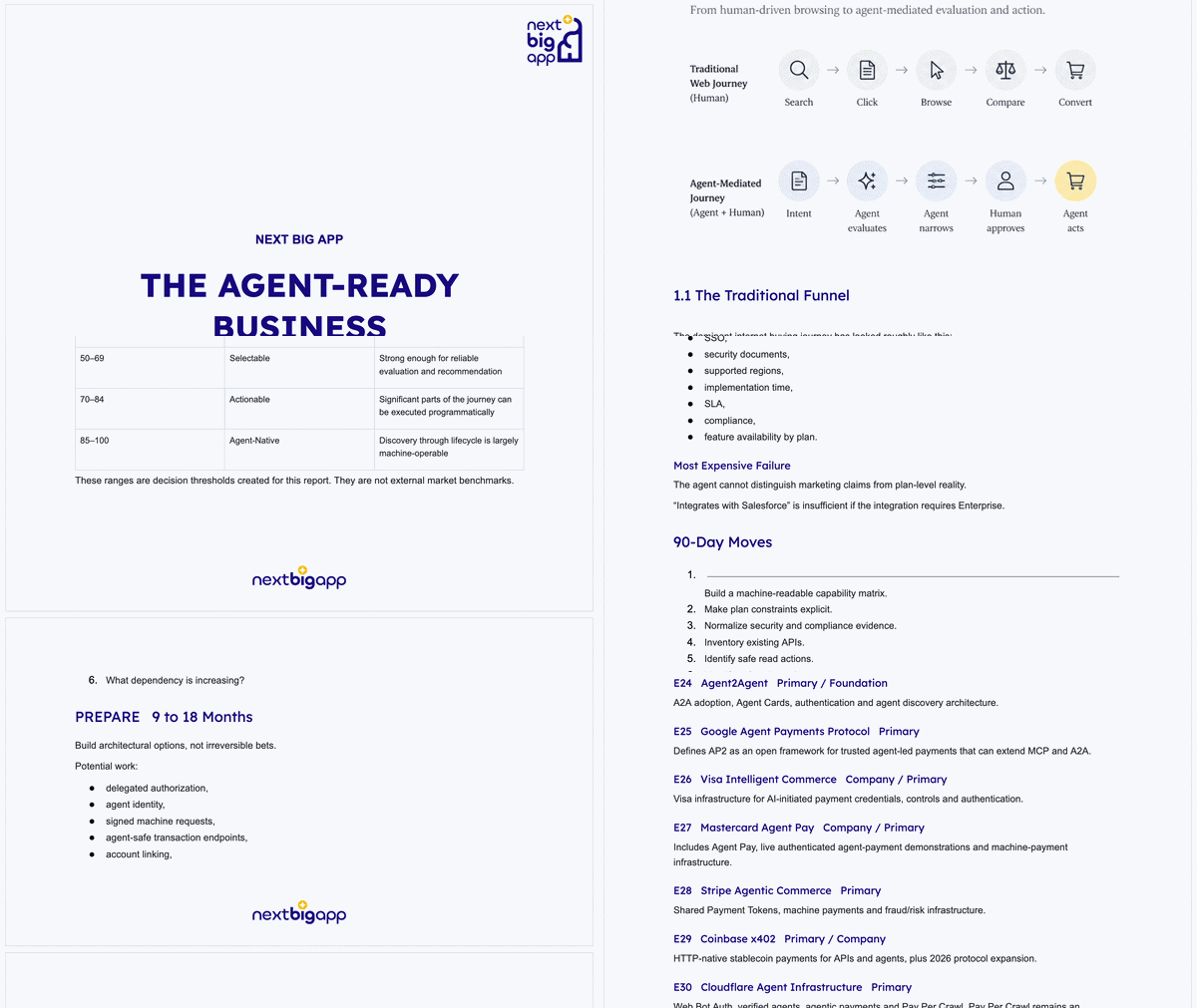
Inside, you’ll get:
The 100-Point Agent Readiness Index; a scoring framework across discoverability, offer legibility, comparability, actionability, transaction readiness, trust, and post-purchase operations.
A 100-Signal Database; real examples from the emerging agent ecosystem, including MCP, A2A, UCP, ACP, AP2, agentic checkout, machine payments, and verified agent identity.
Six Business-Model Playbooks; specific implications for ecommerce, B2B SaaS, marketplaces, consumer apps, travel/booking, and fintech or digital services.
The Agent Preference Matrix; a framework for separating changes that improve the customer experience from changes that merely make your business easier for agents to process.
A 100-Point Implementation Checklist; concrete technical and operational actions divided into what to do now, what to prepare, and what to delay.
Three Adoption Scenarios; from AI remaining mostly advisory to agents operating with bounded transactional autonomy.
A 12–24 Month Roadmap; what to build in the next 90 days, what to test later, and what is still too early to justify.
A Board-Level Dashboard; a one-page template for tracking agent readiness, channel exposure, dependencies, and the next investments to make.
Strategic Red Lines; a framework for deciding what you are unwilling to let a new distribution channel change about your product, pricing, customer ownership, or brand.
You can access the full report via the link below ↓