


Some advertising campaigns disappear within a week.
Others become part of internet culture.
Nearly a year after American Eagle’s Sydney Sweeney campaign first launched, people are still debating it. Not because the ad was technically brilliant. Not because everyone loved it. Quite the opposite.
It started with a simple wordplay.
“Sydney Sweeney has great jeans.”
The ad played on the words genes and jeans, with Sweeney saying, “My genes are blue.”
Within hours, that joke became something much bigger.
Some critics argued it echoed ideas about eugenics, racial superiority, and outdated beauty standards.
Others dismissed the backlash entirely, insisting it was just a clever denim commercial and another example of internet outrage.
Politicians joined the debate.
Marketing experts turned it into a case study.
Millions of people who had no intention of buying jeans suddenly had an opinion about American Eagle.
The company’s stock even climbed as the conversation spread.
The internet kept the campaign alive long after American Eagle stopped paying to promote it.
Whether people loved it or hated it became almost irrelevant.
The conversation itself became the product.
This summer, American Eagle brought Sydney Sweeney back for another campaign.
That decision is more interesting than the campaign itself.
Companies rarely repeat creative.
They repeat outcomes.
American Eagle wasn’t betting on a celebrity.
It was betting on something far more valuable:
A conversation that refused to die.
Most people are asking the wrong question.
“Was it a good campaign?”
The better question is:
What if the campaign wasn’t designed to be watched? What if it was designed to be continued?
That distinction changes almost everything.
The Internet Changed the Rules
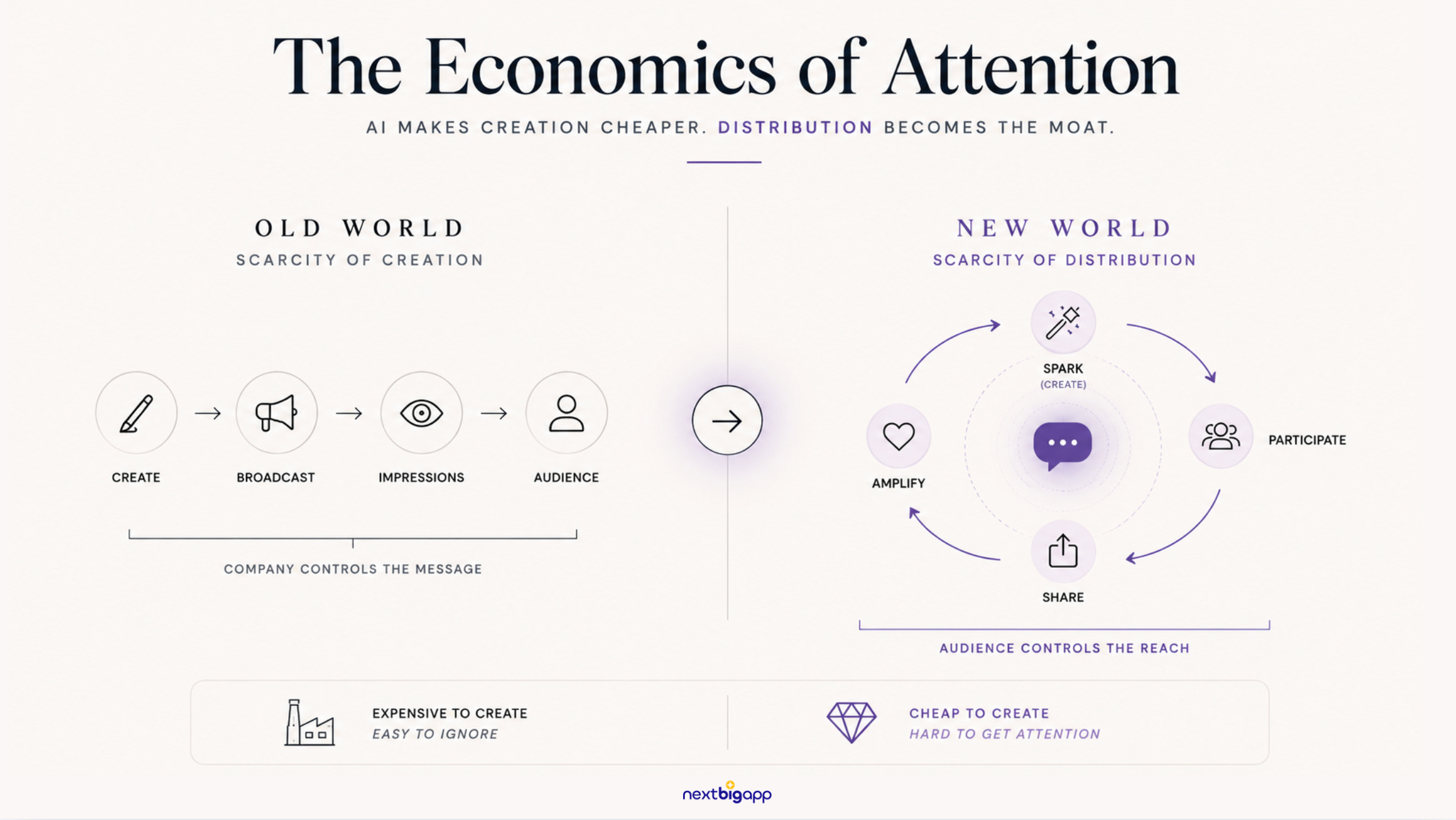
For decades, marketing was about broadcasting messages.
You bought attention.
You delivered a story.
You hoped people remembered it.
The internet no longer works that way.
Today, the most valuable campaigns aren’t consumed.
They’re extended.
Every quote tweet, reaction video, podcast discussion, LinkedIn post, and group chat becomes free distribution.
The audience doesn’t just receive the message.
They become part of the media plan.
The internet has quietly changed the unit of marketing.
It used to be impressions.
Now it’s participation.
You’ve probably noticed this yourself.
The most thoughtful thing you’ve ever written on X or LinkedIn often disappears without a trace.
You spend hours putting together original insights, practical frameworks, or hard-earned lessons.
A few likes.
A handful of comments.
Then it’s gone.
But post something that divides people, even slightly and suddenly the algorithm comes alive.
The comments don’t stop.
People argue.
Others jump in to defend one side or the other.
The post keeps resurfacing for days.
That’s because social platforms don’t optimize for agreement. They optimize for interaction.
And nothing generates interaction more reliably than a conversation people feel compelled to join.
Distribution is no longer something companies own. It’s something audiences decide.
AI Is Changing the Economics
This is where AI enters the picture.
Most people think AI’s biggest impact is making it cheaper to build products.
That’s true.
But it’s only half the story.
The bigger shift is what happens after creation becomes cheap.
When everyone can build faster...
When everyone can generate content...
When everyone can launch products...
Creation stops being the bottleneck.
Distribution becomes the bottleneck.
AI isn’t just commoditizing software.
It’s commoditizing creation itself.
And whenever something becomes abundant, something else becomes scarce.
In this case, what’s becoming scarce is attention.
Not purchased attention. Earned attention.
The kind people voluntarily pass to someone else.
The New Competitive Advantage
The companies that win over the next decade won’t necessarily build the best products.
They’ll build the products that generate the strongest self-reinforcing conversations.
Because every conversation creates more awareness.
More awareness creates more users.
More users create more stories.
More stories create more conversations.
That’s a flywheel.
And flywheels are much harder to compete with than features.
Look at the companies that have defined the last decade.
Figma didn’t become valuable because it made design files.
It became valuable because it changed how teams think together.
People shared workflows.
Templates.
Ideas.
Not because Figma asked them to.
Because using Figma naturally created conversations.
Notion followed the same pattern.
People didn’t recommend it because it stored documents better.
They recommended it because it became part of their identity.
Their dashboards.
Their second brains.
Their productivity systems.
The product became content.
The content became distribution.
Distribution became growth.
ChatGPT followed the same pattern.
Yes, it had an incredible model.
But dozens of companies have built incredible models.
Very few became household names.
People shared prompts.
Screenshots.
Unexpected answers.
Funny mistakes.
Creative use cases.
The product didn’t just solve problems.
It generated stories worth telling.
That’s a very different kind of advantage.
The Question Every Founder Should Ask
This is where many founders still get stuck.
They think distribution begins after the product is finished.
In reality, distribution begins while the product is being designed.
Not with:
“How do we explain this?”
But with:
“What will make someone tell another person about this?”
No advertising budget can manufacture that moment at scale.
Only products and ideas that naturally create conversations can.
This doesn’t mean manufacturing outrage. Or designing fake controversy.
Artificial polarization is obvious. And it rarely lasts.
The lesson isn’t to build controversial products.
The lesson is to build products that are inherently conversational.
So instead of asking:
“How do we explain our product better?”
Ask:
“What conversation does our product make inevitable?”
Because in a world where AI makes creation cheaper every month, creating will no longer be the hard part.
Being talked about will.
And that may become the most valuable competitive advantage of the AI era.