


For decades, astronomers believed the ingredients for life were hiding somewhere in the universe.
Not because they weren’t looking hard enough.
Because they weren’t looking the right way.
That changed.
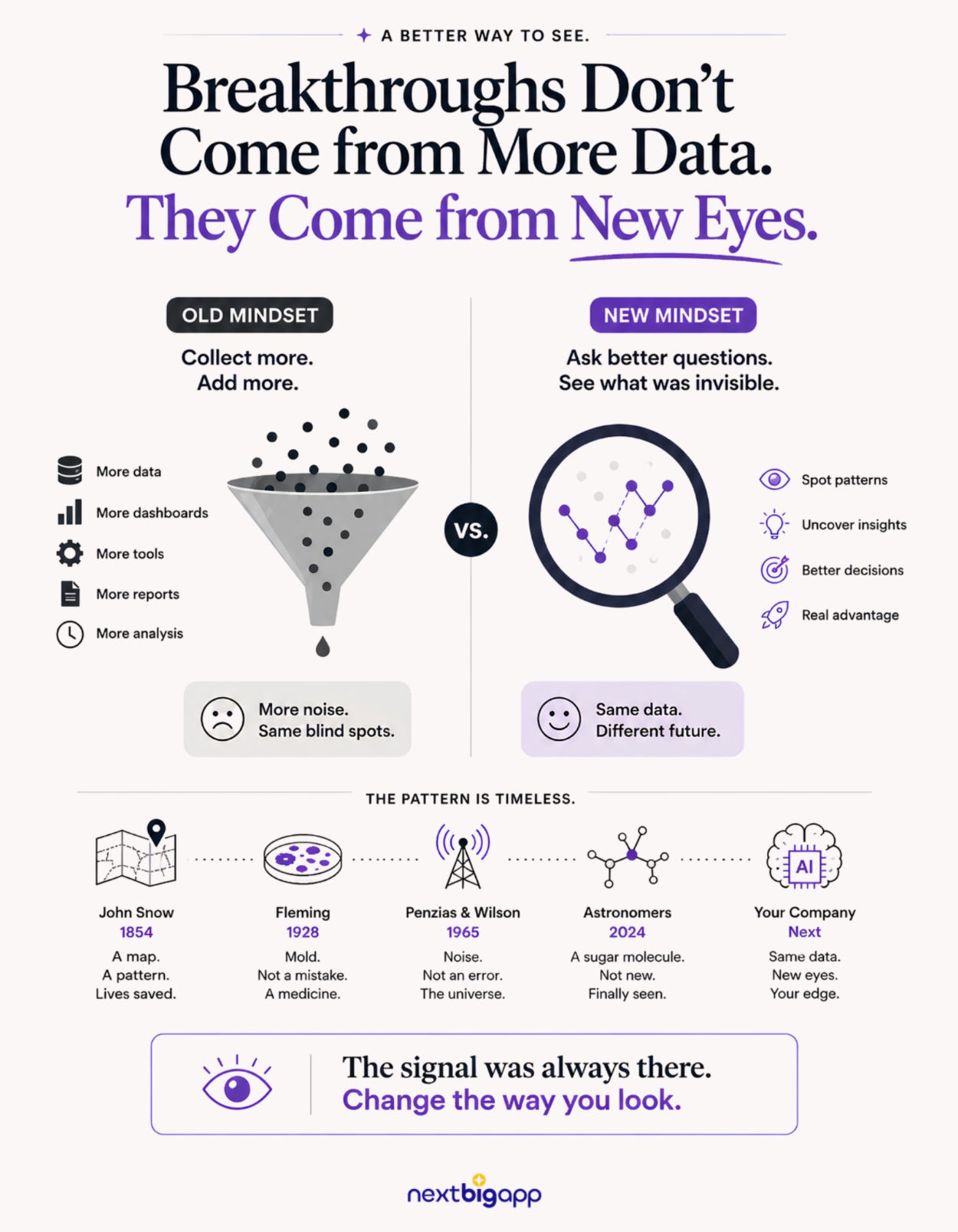
Using the Atacama Large Millimeter / submillimeter Array, researchers detected glycolaldehyde, a simple sugar and one of the molecular building blocks of life, in the gas surrounding a young star system.
The molecules had almost certainly been there long before we noticed them.
The universe didn’t suddenly become sweeter.
Our instruments and more importantly, our ability to interpret weak, noisy signals became better.
The Signal Was Always There
That’s how many of history’s biggest discoveries actually happen.
Penicillin wasn’t invented. It emerged from a contaminated experiment that Alexander Fleming could easily have discarded.
The cosmic microwave background wasn’t discovered because scientists were actively searching for evidence of the Big Bang. Arno Penzias and Robert Wilson were trying to eliminate what they thought was annoying interference from a radio antenna.
John Snow didn’t need to collect an entirely new body of data to identify the source of London’s cholera outbreak. He plotted existing deaths on a map and revealed a pattern no one had seen before.
The data already existed.
The breakthrough came from seeing it differently.
Every breakthrough begins with the realization that the signal was always there.
We had simply mistaken it for noise.
Most Companies Don’t Have a Data Problem
This is also why I think most companies misunderstand AI.
They believe AI creates value by generating new content.
I think its biggest opportunity is somewhere else entirely.
AI is becoming humanity’s best tool for finding patterns that have been hiding in plain sight all along.
Most executives don’t have a data problem.
They have a perception problem.
Every company I meet tells me some version of the same story:
“We need more data.”
Then I ask a simple question:
“What data are you not collecting today that would completely change your business?”
Usually, the room goes quiet.
Because deep down, they already know the answer.
Almost none.
Companies are drowning in information.
Customer support tickets.
Sales call recordings.
CRM notes.
Emails.
Slack conversations.
Meeting transcripts.
Product usage logs.
Feedback forms.
Invoices.
The average company has accumulated years of institutional knowledge.
It just exists as disconnected fragments.
The problem isn’t scarcity.
It’s interpretation.
Productivity Is Not the Real Prize
For years, AI has been marketed as a content machine.
Write emails. Generate proposals. Create presentations. Summarize meetings…
Those are useful capabilities. But they are not transformational. They are productivity gains.
The real shift happens when AI stops producing outputs and starts discovering relationships.
Imagine an AI that listens to every lost sales call from the past three years.
Not to summarize them.
But to uncover the objections that consistently appear six weeks before customers churn.
Or an AI that connects support tickets with feature usage and reveals that your highest-value customers aren’t leaving because of missing features.
They are leaving because onboarding created the wrong expectations months earlier.
No employee could realistically connect all those dots.
Not because people are incapable.
Because the volume exceeds human cognition.
That is where AI becomes more than a faster assistant.
It becomes an instrument of discovery.
The Best Companies Will Ask Better Questions
That’s why I believe the next competitive advantage won’t belong to companies with the biggest models.
Or even the most data.
It will belong to companies that ask better questions.
Not:
“What can AI generate for us?”
But:
“What has our business been trying to tell us for years that we’ve never been able to hear?”
That is a fundamentally different mindset.
One treats AI as a faster employee.
The other treats AI as a new scientific instrument.
History suggests the second group usually wins.
The telescope didn’t create new stars.
The microscope didn’t create new bacteria.
The map didn’t create the cholera pattern.
And AI won’t create the most valuable insights inside your business.
It will reveal the ones that have been quietly waiting there all along.
Your next breakthrough is probably already in the building. It’s buried inside yesterday’s noise.
But this was 100% written by AI according to substack...so not even a snifter of a human behind it...oops..