


Last week, more than 150 people squeezed into a medieval church in Germany to hear a single note change.
They had been waiting more than two years for it.
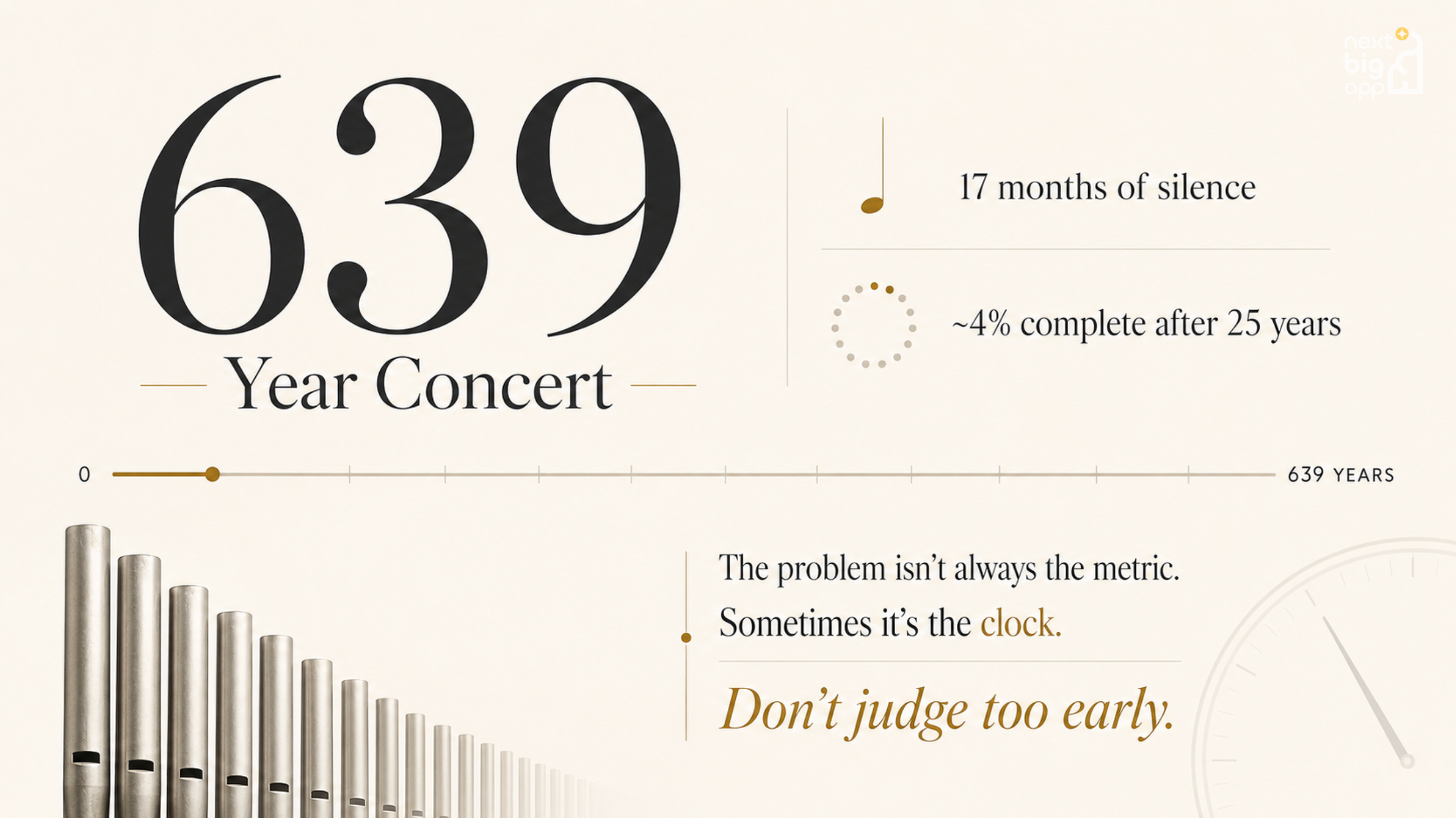
The concert is scheduled to end in 2640.
Yes, 2640.
In Halberstadt, Germany, an organ has been performing John Cage’s ORGAN²/ASLSP — As Slow as Possible since September 5, 2001.
The full performance is designed to last 639 years. On August 5, 2026, organizers added one pipe to the organ, changing the sound from seven notes to eight.
After almost 25 years, the concert is roughly 4% complete.
Even better: the performance began with silence.
For the first 17 months, the piece produced no audible chord at all. That wasn’t a technical problem. That was the performance.
Imagine presenting those results at your next quarterly review.
“We’ve been working on this for 17 months.”
“And what have we produced?”
“Nothing you can hear.”
Good luck with the next job search…
The Problem isn’t Always the Metric
Business culture has become very good at measurement.
Weekly active users. CAC. Conversion. Revenue per employee. Churn. Sales velocity. Tickets closed. Features shipped.
Usually, when the numbers disappoint us, we question the work.
Sometimes we should question the clock.
Because every system has its own natural timescale.
A paid acquisition campaign can tell you something within days.
A pricing change might take weeks.
A sales hire can take months before reaching full productivity.
A new positioning strategy might look worse before it looks better because the old message was optimized for the wrong customers.
A retention improvement can appear almost trivial in the first month and enormous several years later.
The metric can be perfectly accurate while the conclusion is completely wrong.
You’re just looking too early.
Management Has a Sampling-Rate Problem
I’ve seen this pattern many times.
A company makes a change designed to improve the system over six months.
Three weeks later, somebody opens a dashboard.
Nothing dramatic has happened.
So we change something else.
Then something else.
By month three, we’re no longer measuring the original decision. We’re measuring the accumulated noise created by our impatience.
We call this being data-driven.
Sometimes it is just highly instrumented anxiety.
The faster we can measure things, the stronger the temptation to intervene.
That’s an important distinction.
The frequency at which you can observe a system is not necessarily the frequency at which you should manage it.
Imagine checking the temperature of an oven every second and changing the dial every time it moves by half a degree.
More data wouldn’t make you a better cook.
It would prevent the oven from stabilizing.
Companies do the equivalent constantly.
AI is Going to Make This Worse
AI is dramatically shortening the time between idea and action.
You can rewrite the onboarding today. Generate 20 ad variants this afternoon. Change sales messaging tomorrow morning. Build a feature prototype before lunch. Analyze customer feedback in minutes…
This is mostly good.
But faster execution creates a new temptation: faster judgment.
Those are not the same thing.
If an experiment that once took six weeks to launch can now be launched in two days, it doesn’t necessarily mean the customer behavior you’re trying to understand suddenly reveals itself 21 times faster.
The production cycle got shorter.
The feedback loop may not have.
That mismatch matters.
When execution becomes cheap, organizations can easily become addicted to changing things.
And constant change can destroy the very signal they’re trying to observe.
Some Progress is Invisible at First
The John Cage concert is useful precisely because it takes our normal intuition about progress and breaks it.
For 17 months, silence was progress.
For years at a time, the same chord can be progress.
On August 5, adding one pipe was progress.
The next chord change is scheduled for October 5, 2027.
Viewed hourly, almost nothing happens.
Viewed across decades, the piece is moving exactly as intended.
The system hasn’t changed.
Only your observation window has.
Businesses have versions of this everywhere.
A customer-success process may create very little visible revenue this quarter while quietly changing next year’s renewal curve.
Hiring someone excellent can initially reduce team output because good people ask uncomfortable questions before improving the system.
Removing low-quality customers can make revenue growth look weaker while making the company healthier.
Refactoring infrastructure can produce weeks of apparently zero customer value while removing a constraint that would have become expensive at 10x scale.
This isn’t an argument for patience as a virtue.
“Just give it more time” is one of the oldest excuses for bad strategy.
It’s an argument for something more precise:
Decide the clock before you look at the result.
Match the Measurement Window to the Mechanism
Before starting an initiative, there are three different questions worth separating.
What should move?
How much should it move?
And when should we reasonably expect to see it?
Companies are usually reasonably good at the first two.
The third one is strangely neglected.
We define a success metric without defining its natural feedback period.
Then management cadence fills the vacuum.
If leadership meets weekly, everything starts feeling like a weekly problem.
If investors care about quarters, every investment starts getting evaluated quarterly.
If the dashboard refreshes every morning, yesterday suddenly feels meaningful.
The clock silently becomes part of the strategy.
And that’s dangerous.
Because the wrong clock can make a smart decision look stupid.
It can also make a bad decision look good.
Some problems take years to appear.
A brand can be weakened slowly while short-term conversion stays healthy.
Technical debt can accumulate while shipping velocity initially improves.
A team can burn out while quarterly targets continue being hit.
Just as measuring too early creates false negatives, measuring too narrowly can create false positives.
Time changes what you can see.
The Question I’d Ask
When something in your company appears to be underperforming, don’t immediately ask:
“Should we change it?”
Ask:
“How long does the mechanism behind this decision actually need before we can judge it?”
Not how often the dashboard refreshes. Not when the next board meeting happens. Not when the quarter ends.
How long does cause need to become effect?
Sometimes the answer will be three days.
Sometimes three months.
Occasionally three years.
And apparently, sometimes 639.
The people running the John Cage concert have one enormous advantage over the rest of us: Nobody can pretend the project should be judged by next quarter.
In business, the mismatch is harder to see.
Which is why we often kill good systems not because they failed, but because our clock ran out before their feedback loop did.
The advice to decide the clock before you look assumes the clock is yours. Retail never gave me that. A reset calendar hands you 26 weeks, the buyer's dashboard doesn't care that your product needs a year to find its customer, and nobody moves the review date. So the skill inverts and you compress the mechanism. Demos, off-shelf placement, anything that pulls trial into the window you were handed.