


Most small businesses are thinking about AI the wrong way.
They see large companies hiring Chief AI Officers, building internal AI teams, running innovation workshops, buying enterprise platforms, and creating 73-slide transformation decks with words like “enablement”, “alignment”, “governance”, and “future-ready”.
Which is usually corporate language for:
“We bought software and nobody knows what to do with it yet”
Small businesses look at this and think AI is probably not for them yet.
Too complex.
Too expensive.
Too technical.
Too early.
I think that’s completely wrong.
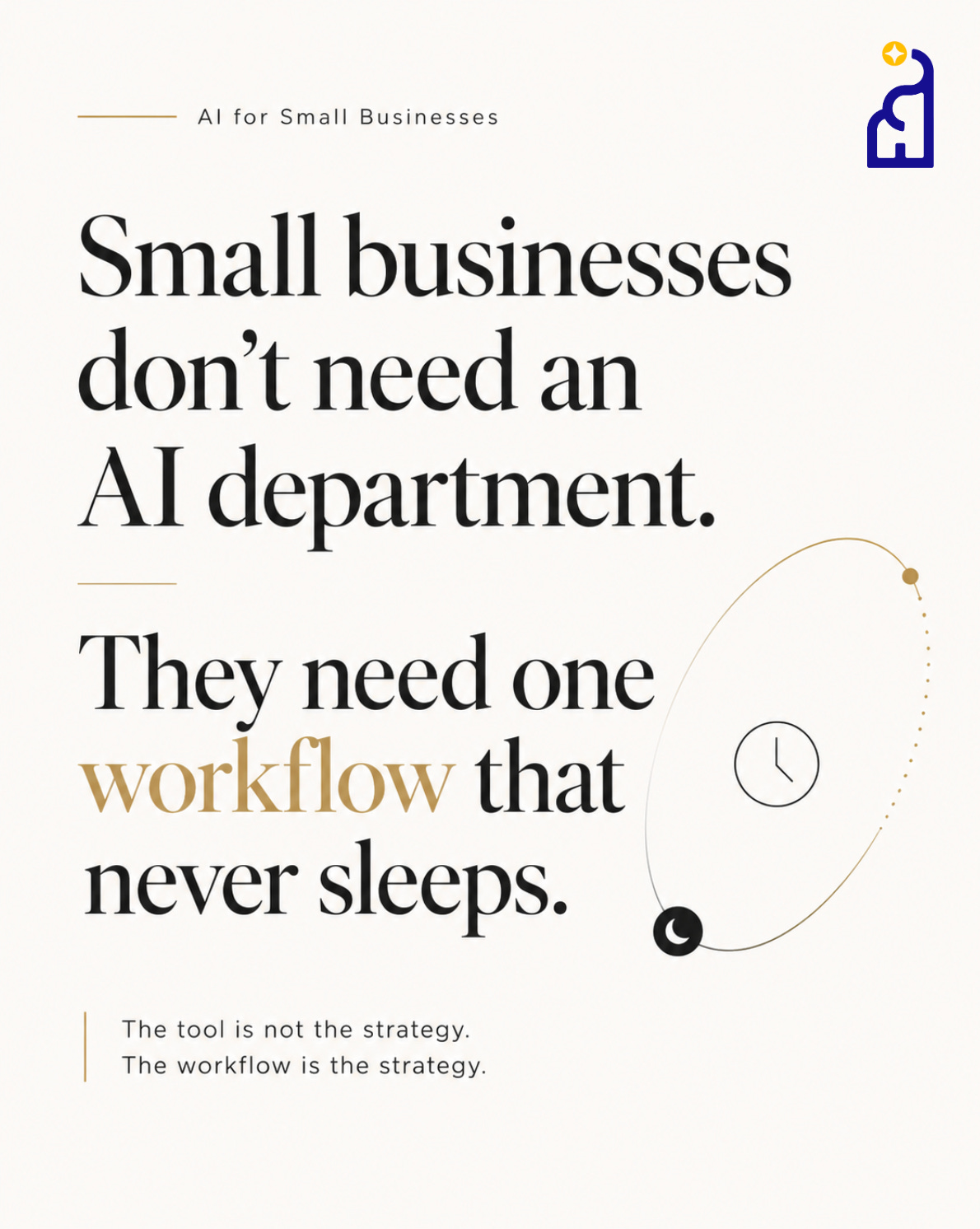
The AI opportunity for small businesses is not building an AI department.
It is building one workflow that never sleeps.
And this distinction matters more than it sounds.
Because most businesses don’t lose money because they lack strategy decks.
They lose money in much uglier, more boring places.
A lead comes in and nobody calls fast enough.
A customer asks a question and waits too long.
A cart is abandoned and nobody follows up.
A sales call contains a buying signal and nobody notices.
A customer says, “Your competitor is cheaper” and that sentence dies inside a call recording forever.
This is where money leaks.
Not in the cinematic business moments.
Not in the strategy offsite.
Not in the “we need to become an AI-first company” slide.
In the broken loops.
And this is where AI becomes useful.
Not as magic.
Not as a toy.
Not as another subscription your team tries for two weeks and then silently abandons.
As a worker inside a workflow.
That distinction is everything.
AI Looks Expensive When You Copy How Large Companies Adopt It
Small businesses should not copy large companies.
Small businesses have a different advantage: speed.
No committees.
No internal politics.
No 18-month transformation project.
No one needs to schedule a meeting to decide whether another meeting is needed.
A small business can do something much better:
Find one painful workflow.
Put AI inside it.
Measure the result.
Improve the loop.
Then move to the next one.
That is not an AI department.
That is leverage.
Where Small Businesses Actually Lose Money
Most businesses do not lose money because they lack ambition.
They lose money because important things happen only sometimes.
Sometimes new leads get called quickly.
Sometimes missed calls get returned.
Sometimes abandoned carts get followed up.
Sometimes customer feedback gets reviewed.
Sometimes the CRM gets updated.
Sometimes old customers get reactivated.
Sometimes sales calls are analyzed.
Sometimes the team notices a pattern before it becomes a problem.
“Sometimes” is expensive.
And the smaller the business, the more dangerous “sometimes” becomes.
Because small businesses usually do not have extra people sitting around waiting to catch what falls through the cracks.
The founder is busy.
The sales team is busy.
The support person is busy.
The agency is busy.
Everyone is busy.
And when everyone is busy, the boring but valuable work gets delayed.
Follow-up.
Reminders.
Call summaries.
Lead qualification.
Customer check-ins.
Objection tagging.
Review analysis.
Reactivation.
None of this sounds exciting.
That is exactly why it matters.
Boring work compounds when it is done consistently.
Boring work leaks money when it depends on human memory.
The First AI Employee Will Be Boring
I don’t think the first AI employee for most small businesses will be a strategist.
It will not be a genius analyst.
It will not be a brand visionary.
It will not sit in a digital corner wearing a tiny Patagonia vest and telling you to “rethink the customer journey”.
The first AI employee will probably be much more boring.
The person who answers the phone.
The person who calls back leads.
The person who follows up after a form submission.
The person who reminds customers.
The person who asks for feedback.
The person who summarizes calls.
The person who updates the CRM.
The person who notices when ten customers complain about the same thing.
Very glamorous, I know.
But this is how leverage usually looks in real life.
Less Iron Man suit.
More “we stopped losing leads because someone now replies in 30 seconds”.
Your first AI employee should not be impressive.
It should be useful.
The Tool Is Not the Strategy
A lot of companies will waste a lot of money on AI over the next few years.
Not because AI is weak.
Because their thinking is weak.
They will subscribe to one tool for writing.
One tool for meetings.
One tool for research.
One tool for images.
One tool for automation.
One tool for customer support.
One tool someone saw on LinkedIn and bought before lunch.
Then they will wonder why nothing changed.
A long AI tool list is not a strategy.
It is usually a very expensive junk drawer.
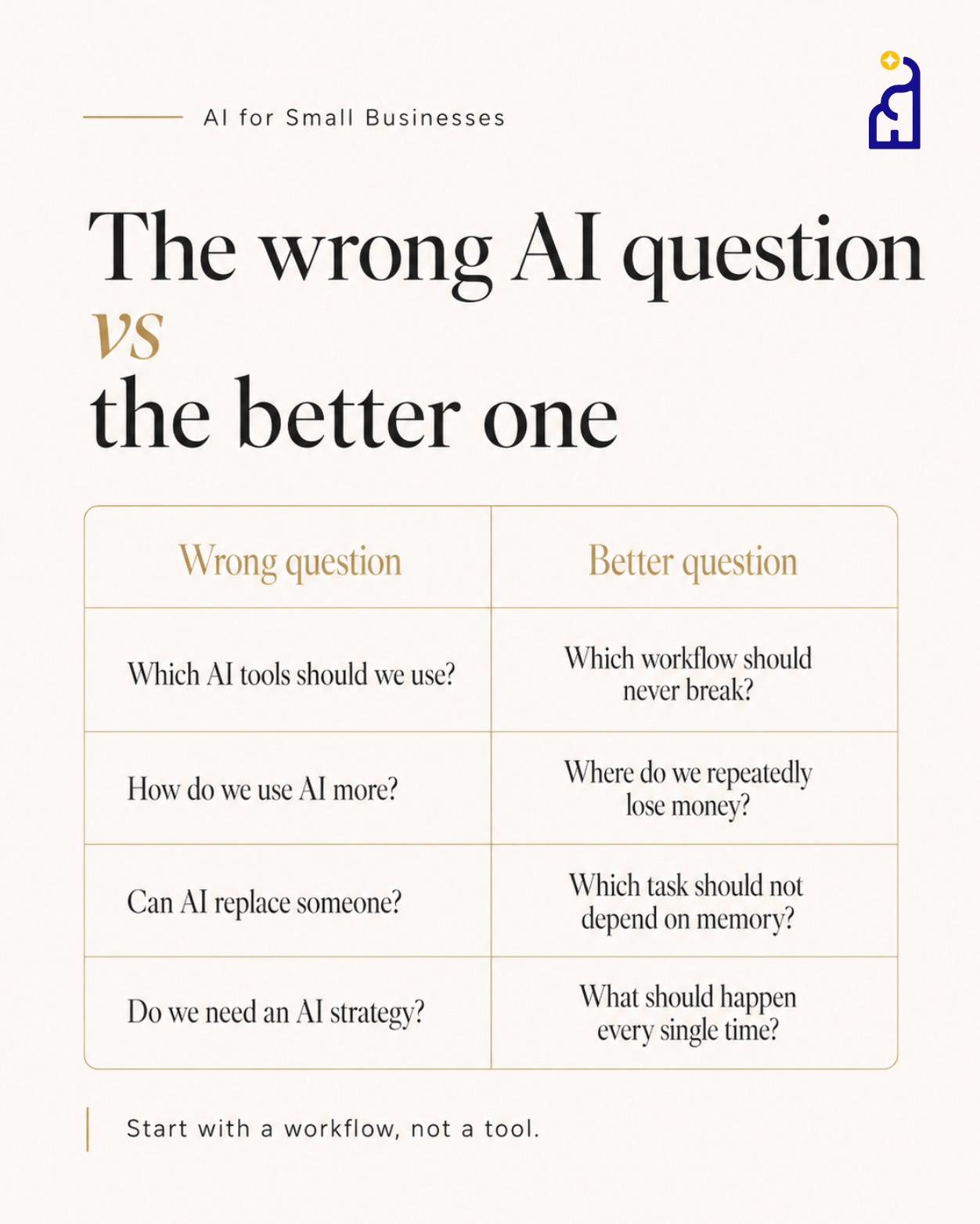
The tool is not the strategy.
The workflow is the strategy.
AI becomes valuable when it makes something important happen every time.
Not when it sounds smart.
Not when it generates a clever paragraph.
Not when it creates a cute image of a dog wearing sunglasses on a skateboard.
Although, to be fair, that has its place in civilization.
AI becomes valuable when it changes the operating rhythm of the business.
The Never-Sleeping Workflow
Here is the concept I think every small business should understand:
A Never-Sleeping Workflow is a business process where AI makes sure an important action happens every time, not just when your team remembers to do it.
That is the unlock.
Not more tools.
Not more dashboards.
Not more “AI experiments”.
One workflow that never sleeps.
For example:
Every new lead gets called within 60 seconds.
Every missed call gets an automatic callback.
Every abandoned cart gets a voice follow-up.
Every old customer gets reactivated after 60 days.
Every sales call gets summarized and scored.
Every customer objection gets classified.
Every negative review triggers a recovery flow.
Every support conversation becomes product insight.
Every qualified buyer gets routed to the right person.
Every repeated complaint becomes visible before it becomes expensive.
This is not science fiction.
This is not a 2032 thing.
This is the practical frontier of AI right now.
Small.
Specific.
Boring enough to be real.
Valuable enough to matter.
The E-Commerce Example
Take a simple e-commerce business.
They spend money on ads. People visit the site. Some add products to cart. Many don’t finish checkout.
Classic problem.
The usual response is predictable:
Spend more on ads. Send more emails. Add another pop-up. Change the discount. Redesign the checkout. Blame the agency.
Sometimes those things help.
But often the business is missing something simpler.
What if the customer just needed a nudge?
What if they had a question?
What if they were comparing options?
What if they were ready to buy but got distracted?
Now imagine an AI voice agent that calls selected abandoned cart users within minutes.
Not tomorrow.
Not when someone has time.
Not after a spreadsheet is exported, forgotten, reopened, assigned, and half-followed.
Immediately.
It calls.
It understands the customer.
It answers questions.
It offers help.
It sends a payment link.
It books a callback if needed.
It updates the CRM.
It summarizes what happened.
Then it runs again tomorrow.
That is not “using an AI tool”.
That is installing a workflow that never sleeps.
Big difference.
The Second-Order Effect
At first, you think AI saves time.
Then you realize it changes what your business can afford to pay attention to.
That is the real shift.
Before AI, many businesses ignored most customer conversations because listening to all of them was impossible.
Before AI, many old leads were never followed up because the economics did not work.
Before AI, many sales calls were never analyzed because managers could only listen to a tiny sample.
Before AI, many small tasks stayed manual because automation was too expensive, too technical, or too annoying.
Now the math changes.
And when the math changes, strategy changes.
AI does not just make existing work cheaper.
It makes previously unreasonable work reasonable.
Calling every abandoned cart customer used to sound ridiculous. Now it can be a workflow.
Analyzing every customer conversation used to be impossible. Now it can be a dashboard.
Creating personalized follow-up for every lead used to require a team. Now it can be a system.
This is where small businesses can build an unfair advantage.
Not by pretending to be large companies.
But by using AI to do the consistent operational work that large companies are often too slow, political, or overcomplicated to implement.
What AI Exposes
There is one uncomfortable part.
When you put AI inside a workflow, it does not only automate the work.
It exposes the business.
If your sales process is vague, AI will expose it.
If your lead qualification is messy, AI will expose it.
If your CRM is chaos with a login screen, AI will expose it.
If your follow-up depends on someone remembering something, AI will expose it.
If your offer is unclear, AI will expose it.
If your team does not agree on what a good customer looks like, AI will expose it.
This is uncomfortable.
But useful.
Because most businesses do not only need automation.
They need clarity. AI forces clarity. It forces you to define the script.
The trigger.
The handoff.
The success metric.
The fallback.
The next action.
The owner.
The outcome.
This is why “just add AI” rarely works.
If the workflow is broken, AI will not magically fix it.
It will show you exactly where it breaks.
That is not a bug.
That is the work.
The 5-Step AI Workflow Test
If you want to use AI in a way that actually matters, don’t start with tools.
Start with this test.
1. Find the leak
Where does money, attention, speed, or customer intent disappear?
Examples:
New leads are not contacted fast enough.
Missed calls are not returned.
Abandoned carts are ignored.
Customer complaints are not analyzed.
Sales calls are not reviewed.
Old customers are not reactivated.
The leak should be specific.
“Improve sales” is not specific.
“Call every qualified lead within 60 seconds” is specific.
2. Define the repeated action
What should happen every time, but currently happens only sometimes?
This is the most important question.
Because “sometimes” is where AI can create leverage.
If the answer depends on someone remembering, checking, copying, pasting, listening, tagging, or following up manually, you probably found something.
3. Remove human memory from the loop
Human judgment is valuable.
Human memory is overrated.
Do not build critical business processes around someone remembering to check a spreadsheet.
Or follow up tomorrow.
Or listen to a call later.
Or update the CRM after lunch.
That is not a process.
That is a hope with a calendar invite.
4. Put AI inside the workflow
Now decide what the AI worker should actually do.
Should it call? Answer? Summarize? Classify? Route? Remind? Score? Draft? Trigger? Update?
The goal is not to make AI look smart.
The goal is to make the workflow run.
5. Measure one business outcome
Do not measure vibes.
Measure one outcome.
Revenue recovered. Calls answered. Leads converted. Response time reduced. Manual hours saved. Churn reduced. Customer complaints detected. Sales objections classified.
If you cannot connect the workflow to a business outcome, you may still have something interesting.
But you probably do not have leverage yet.
The Practical Starting Point
So where should a small business start?
Not with:
“How do we use AI?”
That question is too broad.
It creates tool shopping, internal confusion, and long conversations that somehow end with someone suggesting a Notion template.
Start with this instead:
What is the most valuable thing in our business that should happen every time, but currently happens only sometimes?
That answer is your first AI employee.
Maybe it is a follow-up agent. Maybe it is a missed-call recovery agent. Maybe it is an abandoned-cart voice agent. Maybe it is a customer feedback analyst. Maybe it is a review mining workflow. Maybe it is a sales call scoring system.
It does not need to be impressive.
It needs to work.
At Next Big App, this is how we think about building AI products.
Not more tools for the sake of tools.
Practical AI workflows that help businesses recover revenue, reduce manual work, and understand customers faster.
Because AI is not the advantage by itself.
The advantage is what AI makes happen consistently.
Even when your team is busy.
Even when it is after hours.
Even when the lead came in at the wrong moment.
Even when nobody feels like updating the spreadsheet.
Even when the customer signal is buried inside the 847th call recording of the month.
That is the real promise.
Not an AI department.
Not another dashboard.
Not a bigger tool stack.
One workflow that never sleeps.
Start there.
This lands because it treats attention as a scarce asset. Every meeting, offer, feature, and campaign competes for the same finite mind.
This is the right take and more people need to hear it. Small businesses don't have a strategy problem with AI, they have a translation problem. The question isn't "how do we build an AI department" but "which specific thing takes 3 hours a week that a well-prompted tool could handle in 20 minutes." Most owners I talk to already know what those things are, they just haven't been given permission to start small.