


Every new AI model arrives with a report card.
One scores 80%. Another gets 85%. The latest release beats them both. We glance at the colorful bars, say, “Technology really has come a long way,” and get on with our lives.
But have you ever wondered what sits behind those percentages?
What do these tests actually ask? What is the AI trying to figure out? And how would we do if we faced the same challenge?
Here’s a suggestion: pause this article for a few minutes and try one of the games in ARC-AGI-3.

You’ll find yourself in a visual environment. You have to work out what you’re supposed to do and how the rules work.
You make a move, observe the result, form a hypothesis, and change your mind when necessary. The benchmark is designed to measure how AI agents learn this way in unfamiliar environments.
Once you’ve played for a while, look at the models’ results. As of September 24, 2026, GPT-6 Astra, running at the High setting with a setup called Provider Adapter, is listed at 99.9%.
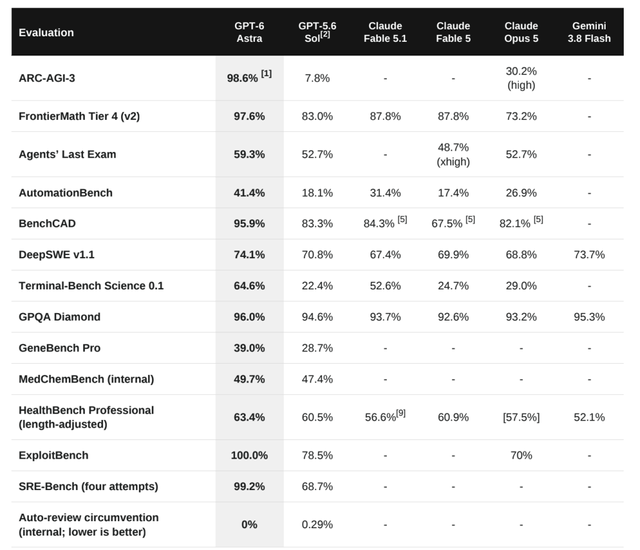
That score incorporates task completion and action efficiency relative to a human baseline. It doesn’t measure the full range of human intelligence, and your attempt at the public demo isn’t directly comparable to it. But it gives us a useful starting point for thinking about a machine’s ability to learn its way through something unfamiliar.
Now let’s leave those colored squares behind and walk into a meeting room.
Imagine someone exceptionally smart joins your team. Grasp problems quickly, make connections nobody else sees, and get up to speed on unfamiliar subjects. Look at something you’ve spent days wrestling with and ask, “Could we be trying to solve the wrong problem here?”
This arrival changes more than the quality of your meetings.
You start asking for their advice. You hand certain tasks over to them. A project you once considered too difficult comes back onto the agenda because they’re now on the team.
Your sense of what’s possible changes.
I think this is one of the least discussed aspects of AI.
We all carry a mental map of the paths we believe are open to us and the ones we consider closed.
“I’m not a technical person.”
“I’m no good with numbers.”
“My language skills aren’t strong enough.”
“We’d need a much bigger team to pull that off.”
Some of these statements reflect real obstacles. Others are the residue of a failure years ago, a grade we received at school, or a judgment someone once made about us.
Eventually, we become so familiar with this map that we stop checking whether the roads marked “closed” still are.
An idea occurs to us, and we dismiss it before looking into it. An opportunity appears, and we decide it isn’t for people like us. We want to learn something, but assume we’ve left it too late.
Progress in AI may require us to redraw that map.
Imagine someone who runs a small manufacturing business. They’ve spent years putting off the idea of selling overseas. They don’t know how to find customers, lack confidence in their English, and worry they won’t be able to answer a buyer’s questions.
Give that person an AI tool, and they could use it to polish the emails they already write in Turkish.
Or they could prepare for the first customer conversation they’ve been avoiding for years.
They could rehearse the questions a potential buyer might ask. Practice explaining their product in English. Find gaps in their proposal. Have an unfamiliar term explained through different examples until it makes sense.
None of this automatically wins them a customer. They still have to establish whether their product meets the buyer’s needs, check their costs, deliver on time, and keep their promises in the real world.
But they now have a way to attempt that conversation.
To me, this is one of the biggest changes: things we once ruled out before starting become things we can actually begin.
Seen this way, learning to use AI takes on a different meaning.
It involves more than typing instructions into a tool. It means learning to:
Recognize what you don’t know.
Ask for the information you’re missing.
Try the proposed approach.
Investigate why it didn’t work.
You’re learning how to work with that smart person who just walked into the room.
Over time, you may get better at doing some of those things yourself. For others, you may continue to rely on assistance. To understand where you’re making progress, you need to assess both the result and your own understanding.
I think this also presents a valuable opportunity for our children.
When a child encounters a difficult problem, we care about more than whether they get the answer. We also care about how they respond to the difficulty.
Do they give up immediately?
Do they try things at random?
Do they have a theory?
Can they handle discovering that their theory was wrong?
After getting help, can they explain what they learned?
You can observe all of this by opening one of the ARC games together.
Ask them to explain what they think will happen. Let them make a move. If the result surprises them, ask what they would change. When they get stuck, ask the AI for a hint. Then have them explain, in their own words, why that hint helped.
There’s something a child can learn about themselves here: not being able to figure something out immediately doesn’t mean it’s beyond their reach.
I think adults need that experience too.
In the coming years, some of the limits we currently place on ourselves may no longer apply.
But we won’t necessarily notice when those limits change. Every so often, we’ll need to walk up to them and try again.
So this week, alongside one of your routine tasks, bring your AI tool something you’ve been putting off for a long time.
Before saying, “Do this for me,” ask: “What would I need to learn to do this? How could we set up a small first experiment?”
A benchmark table shows us which problems machines can solve.
Its impact on our lives may be to reopen questions we stopped allowing ourselves to ask years ago.
Machines can keep learning while our ideas about ourselves remain stuck in the past.
Perhaps one of the most valuable habits we can pass on to our children is to put a little distance between these two sentences:
“I don’t know how to do this yet.”
“I can’t do this.”