


Hollywood has spent the last decade worrying about TikTok destroying our attention spans.
Then something strange happened.
People started watching television shows made of 45-second to two-minute episodes.
Not clips.
Not trailers.
Actual serialized dramas.
They’re called microdramas, and the numbers are becoming difficult to dismiss.
The U.S. audience more than doubled last year, from 26 million to 66 million monthly active users. The category is expected to generate around $1.5 billion in U.S. revenue this year and nearly $2 billion next year.
And here is the number I find much more interesting.
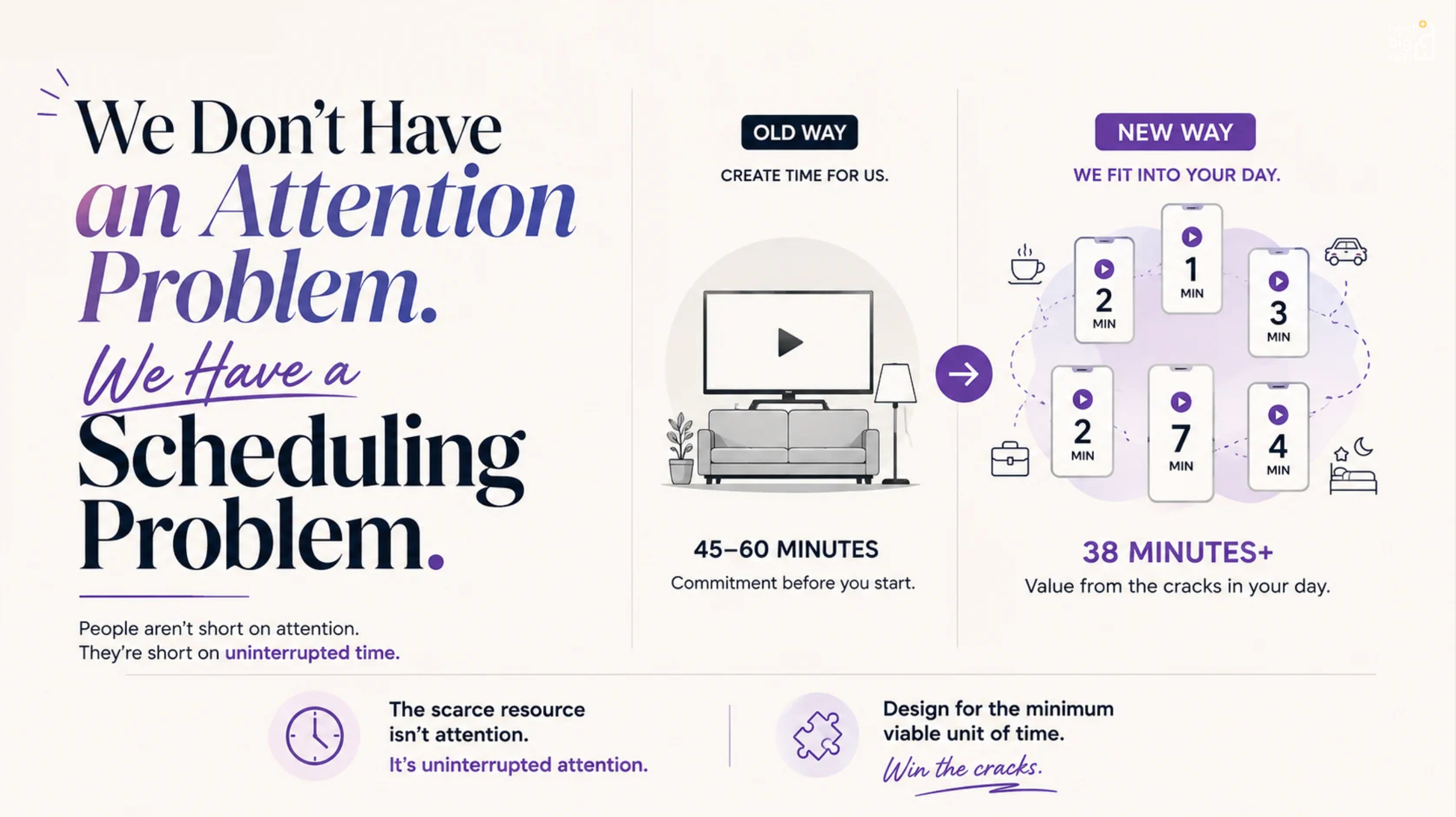
ReelShort, one of the largest microdrama apps, recently reached roughly 38 minutes of daily mobile viewing per user.
That’s more daily mobile viewing time than Netflix, Amazon Prime Video or Disney+ on mobile.
Think about the contradiction.
The episodes are two minutes long.
The viewing time, in aggregate, can be nearly 40.
Maybe our attention spans aren’t the problem. Maybe our calendars are.
We Keep Blaming Attention
“People have no attention span anymore” has become one of those explanations that feels true because we repeat it so often.
Nobody reads. Nobody watches long videos. Nobody finishes anything. Everything needs to be shorter.
But microdramas suggest something more interesting.
People apparently have enough attention to spend 38 minutes watching melodramatic stories about billionaires, forbidden romances and improbable family secrets.
What they may not have is a clean, predictable 38-minute block.
That is a very different problem.
A 45-minute Netflix episode asks you to make a commitment before you start.
A two-minute microdrama asks almost nothing.
You can watch one while waiting for coffee. Three in an Uber. Two before the meeting starts. Seven while your kid is finishing practice. Another four in bed.
By the end of the day, you may have consumed half an hour of story without ever deciding to “watch TV”.
That distinction matters.
The scarce resource may no longer be attention.
It may be uninterrupted attention.
Time is Becoming Granular
For most of the industrial era, products were designed around relatively large blocks of time.
A newspaper expected a morning ritual.
Television expected a 30- or 60-minute slot.
A movie expected two hours.
A bank expected you to visit a branch.
Enterprise software often still assumes you will sit down, open the application, understand where you are and complete a workflow.
The internet removed some of those constraints.
Mobile removed even more.
But many products kept the old assumption hidden inside the new interface:
The user will create time for us.
That assumption is getting expensive.
Microdramas reverse it.
They don’t ask the user to create a viewing session. They fit themselves into the cracks that already exist. That is why calling them “short-form Netflix” misses the point.
The important innovation isn’t the duration.
It’s the minimum viable unit of time required to receive value.
That unit has collapsed.
Gaming Figured This Out Years Ago
Microdramas are not the first product category built around fragmented time.
Hyper-casual mobile games made essentially the same bet years earlier.
The best of them require almost no setup, almost no learning curve and almost no commitment.
Open the app. Tap. Swipe. Avoid the obstacle. Try again…
AppsFlyer describes hyper-casual games as simple, mechanic-driven products designed for broad accessibility, with some puzzles intended to be completed in a minute or less. The category became a major force in mobile downloads precisely because the commitment required to start playing was so low.
The business model evolved. Hyper-casual increasingly blended into hybrid-casual as studios looked for stronger retention and monetization.
But the behavioral insight underneath it was already there. You didn’t need to convince someone: “I am now going to play a video game.”
You only needed a spare 45 seconds.
Standing in line. Waiting for someone. Sitting in the back of a taxi. Pretending to listen on a conference call. We’ve all been there.
The game could enter time that previously wasn’t considered usable gaming time.
That is a bigger innovation than making games shorter.
It created inventory out of fragments.
Microdramas are now doing something remarkably similar to television.
And I suspect many other categories will follow.
This Changes How I Think About Product Design
There is a metric I think more companies should care about: Time to useful completion.
Not time spent. Not session length. Not even time to value in the conventional onboarding sense.
I mean:
What is the smallest unit of uninterrupted attention a customer must give you to accomplish something meaningful?
Five years ago, maybe your customer could reliably give you 20 minutes.
Today, perhaps they can still give you 20 minutes in total.
But you get it as: 4 minutes + 90 seconds + 6 minutes + 3 minutes + 5 minutes.
Mathematically similar. Operationally completely different.
A product designed for the first world can fail badly in the second.
This is especially important because companies frequently interpret the failure incorrectly.
Users abandon a workflow, so we assume the interface is confusing.
They don’t complete onboarding, so we simplify the copy.
They stop using a dashboard, so we add notifications.
They don’t watch the training, so we make the video more entertaining.
Sometimes those are the right fixes.
But sometimes the product is simply asking for a unit of time the customer no longer has.
You are optimizing the experience inside the session.
The real problem is the requirement to have the session at all.
The Microdrama People Understood This
A traditional television episode needs setup.
Characters enter. Context develops. Tension builds.
A microdrama doesn’t have that luxury.
You arrive late to the party and someone is already sleeping with the billionaire.
Reuters describes these series as fast-paced and built around immediate hooks and cliffhangers; some run for 50 to 75 tiny episodes.
It sounds ridiculous until you realize how carefully the product matches the environment.
Every episode creates a small unit of completion.
Every cliffhanger creates a restart point.
Every restart requires almost zero context reconstruction.
The content is not simply shorter. The architecture is interruption-tolerant.
That is the useful idea. A lot of software isn’t.
Stop halfway through a complex enterprise workflow and come back tomorrow.
Where were you? What had you already checked? Why did you make that selection? Which tab had the information you needed?
Before you can continue the work, your brain has to reload the save file.
You reconstruct the state. Reopen the tabs. Remember the decisions. Rebuild the mental model.
And the more complex the workflow, the heavier that reload becomes.
Some products don’t lose users because the task is difficult. They lose them because resuming the task is difficult.
That distinction is easy to miss.
AI Makes This More Interesting, Not Less
The obvious AI product strategy right now is to make existing tasks faster.
Take a 20-minute workflow and make it 12. Then eight. Then five…
Useful.
But there is a larger opportunity.
What if the workflow no longer needed to be a session?
Instead of helping me operate the software faster, the product could hold the context while I disappear.
I do one small thing.
The system continues.
It asks me for a decision only when necessary.
I answer from my phone in 20 seconds.
It continues again.
I return later without reconstructing everything that happened.
That is not just automation. That is a different relationship with time.
The software absorbs fragmentation so the human doesn’t have to.
This is where AI becomes particularly powerful. Not because it can generate another paragraph or summarize another document. Because it can maintain context across gaps that humans find expensive.
The product remembers. The workflow persists. The user comes and goes.
This is Also Why Some “Engagement” Metrics are Becoming Dangerous
If you run a SaaS company, you may instinctively want customers spending more time inside your product.
More sessions. Longer sessions. More screens visited.
For some products, that makes sense.
For others, it may increasingly be evidence that you are consuming a scarce customer resource.
Imagine two products that create the same business outcome.
Product A needs a focused 40-minute session every Tuesday.
Product B needs four two-minute decisions spread across the week.
Which one is easier to keep using when the company gets busy?
Which one survives a chaotic month?
Which one does the executive actually adopt?
Product B might show dramatically less “engagement”. And have dramatically better retention.
That is the kind of metric inversion worth paying attention to.
Locally, less time in product looks worse. Systemically, requiring less uninterrupted time may make the product far harder to remove.
The Question I Would Ask
Look at one important workflow in your business.
Don’t ask:
How do we make this faster?
Ask:
How much uninterrupted attention does this workflow require from the customer?
Then make the question more uncomfortable:
What would we build if we could only ask for 90 seconds at a time?
You may end up with a shorter workflow.
But you may also end up with a completely different product.
Different notifications. Different state management. Different defaults. Different automation. Different pricing. Different definition of engagement.
That is what new constraints do.
They don’t merely change features. They change architecture.
Hyper-casual games looked trivial.
Microdramas look like disposable soap operas shot vertically for a phone.
It would be easy to dismiss both as evidence that people can no longer concentrate.
I think that gets the lesson almost exactly backwards.
People still have time. They still have attention.
They can apparently spend 38 minutes a day finding out whether the billionaire finally marries the woman he pretended not to love.
What they increasingly lack is the ability or willingness to hand one product a large, uninterrupted piece of their day.
The next generation of products won’t only save people time. They’ll stop requiring time to arrive in one piece.