


When you build a company, every piece of software you buy promises a little more control.
You get a CRM to track sales, an analytics tool to understand customers, project management software to manage your team, and an automation platform for marketing.
Before long, you have dozens of tools and a subscription bill that grows every month.
Yet at the end of the day, you're still left with the same questions:
Did we make more sales? Are our customers happier? Are things getting done faster?
Software gives you data to answer those questions. But looking at that data, deciding what to do, and achieving the outcome are still your team's responsibility.
Until now, we've accepted that as natural. After all, we bought a tool; it was up to us to create value with it.
AI is starting to change that expectation.
As a founder, why should I pay separately for every seat on my sales team? I don't need more CRM users. I need to reach better prospects, avoid missing opportunities, and make more sales.
Why should I pay for customer support software based on the number of agents? What I want is for my customers' problems to be resolved quickly and correctly.
That's why I think the way companies look at software is about to change:
We'll want to pay closer to the outcome software produces, rather than simply for access to it.
Pricing may move in that direction too. Instead of charging per user, more products may charge per resolved support request, completed task, or sale.
Of course, it's difficult to give one piece of software all the credit for an outcome. Your product, pricing, and team all affect sales. Whether outcome-based pricing is more economical will vary from company to company.
But the founder's question is becoming clearer:
Instead of “How many people log in to this tool?”, it's “What work does this tool get done for my company?”
I think that's the question software companies will have to answer in the AI era.
A sleep headband I came across recently made me think about how we'll experience this shift outside our companies, in everyday life.
Measuring sleep or sleeping better?
Most sleep technology gives us a report in the morning: how long we slept, how often we woke up, and how much deep sleep we got.
That data can be useful. But when we wake up, what we really want isn't a better-looking chart. It's to feel rested.
A startup called Somnee has positioned its product around that need.
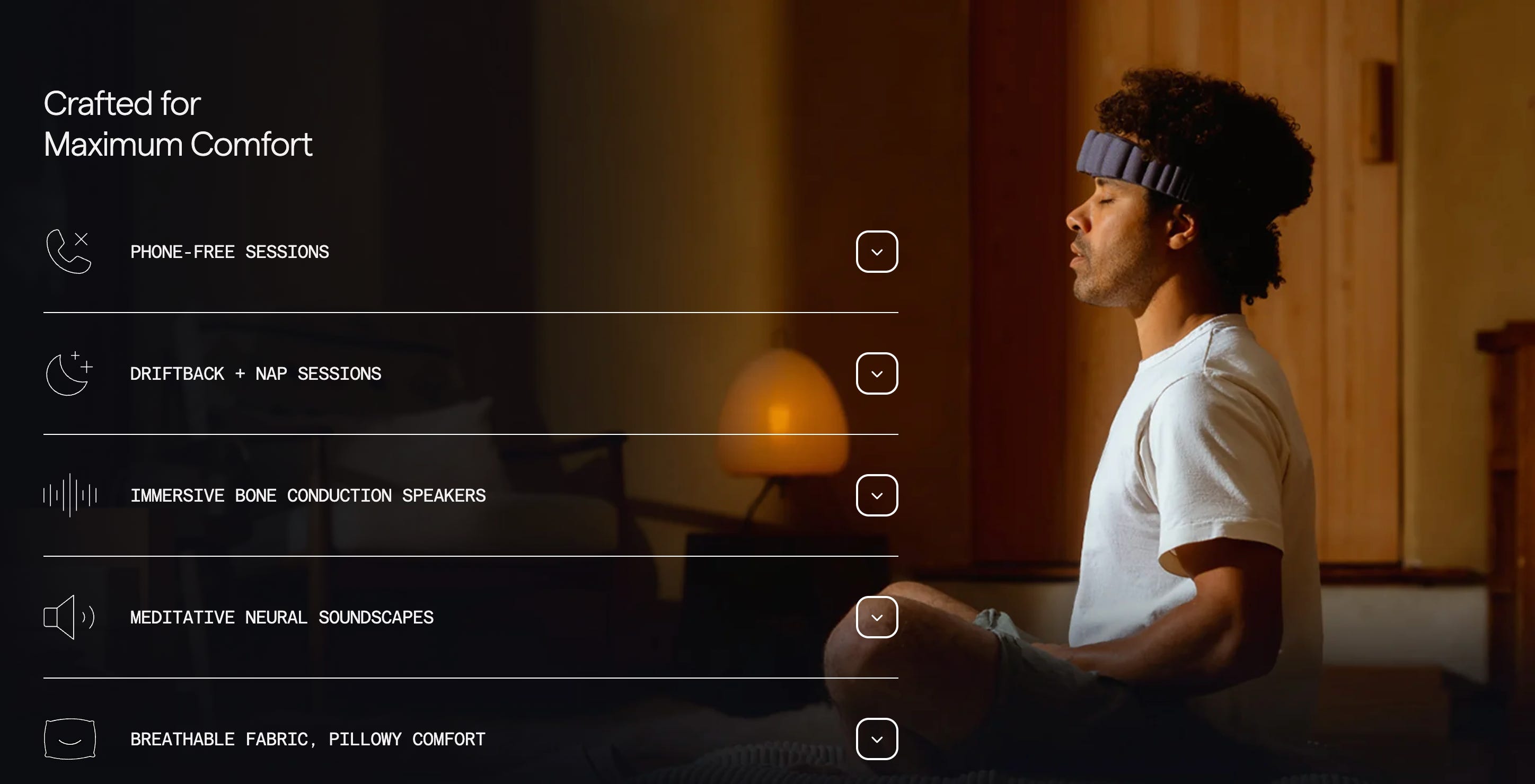
Its headband uses EEG sensors to measure brain activity and delivers electrical stimulation during a session of about 15 minutes. According to the company, it analyzes the user's response to personalize later sessions; Source
Thirty-two people took part in Somnee's six-week pilot through an NBA program. According to the company's reported results, participants slept an average of 37 minutes longer and experienced roughly 15% fewer wake-ups; Source
It's a small pilot, and the company's reported results don't mean everyone will see the same benefit. What I find interesting is the product's ambition: it doesn't stop at displaying sleep data; it aims to help improve sleep.
That's the same difference as showing a business owner a sales chart versus helping them with the sales process.
In one case, you provide information. In the other, you take a step toward the outcome the user wants.
The path from data to outcomes
A product doesn't always need to do work on the user's behalf. Sometimes the most valuable outcome is being able to make a better decision.
As a business owner, I don't want to study hundreds of metrics every morning. If sales are falling, I want to know. More importantly, I want to understand what deserves my attention and what decision I need to make.
The same is true for our customers.
People don't necessarily want to spend as much time as possible inside our products. Often they have a question and want an answer.
One place I noticed this in my own life was the NBA.
Why I built The 48 Index
Following the NBA from Istanbul means many games happen while we're asleep. When I wake up, I want to know how Alperen Şengün and the other players I follow performed.
But it's not always possible to spend hours on every game.
First, I want to know:
Which games were played overnight?
Who stood out?
How did the player I follow perform?
What was noteworthy about the game?
Which game is worth a closer look or a highlights video?
The score answers only the first question. A box score tells me more, but understanding several games and players quickly still means navigating a lot of data.
I built The 48 Index to help with that need.

My goal wasn't simply to produce more basketball data. It was to present the data that already exists in a way that helps fans answer their questions faster.
The site brings together games, player performances, and movement around the league. Offensive, Defensive, and Overall indexes scale recorded player statistics to a common 48-minute basis, offering another way to look at performance. Methodology
Of course, one index can't capture everything a player does on the court. Off-ball movement, screens, and positioning aren't fully reflected in the box score. Rates scaled to 48 minutes also need care, especially for players who played only a short time.

I don't see The 48 Index as a definitive judge that replaces watching the game. Its value to me is finding what I want to look at more closely, faster.
A three-hour game, one question
Sometimes it's enough to know the result and who stood out.
Sometimes I want to understand a little more, then watch the key moments.
And sometimes I want to know whether the full game is worth my time.
The 48 Index's Watch Score is designed to help with that last question. It combines signals including late-game tension, overall competitiveness, standout performances, and comebacks. How it's calculated
A score can't tell us that everyone will enjoy a game. But it can provide a starting point for deciding which overnight matchup to look at.
There's also 2-Min Replay: an animated replay built from the game's play-by-play data. It isn't a video highlight reel; it's another way to follow how the game unfolded in a short time.

Afterward, I can look for a video of the key plays, explore the game details, or watch the full matchup.
The outcome here doesn't have to be “spend less time watching basketball”. Sometimes it's the opposite: spending my time on the game that actually interests me.
What outcome does your customer expect?
Somnee and The 48 Index are very different products. One aims to help people sleep better; the other makes it easier to understand basketball data and choose where to spend time.
But for me, both lead to the same product question:
What is the user actually trying to achieve?
That question matters to founders. The shift in customer expectations will affect not only companies building software, but also companies using it.
Does your customer really want another dashboard, or do they want to know which opportunity deserves their attention?
Do they want another automation tool, or do they want confidence that a job has been completed?
Do they want more reports, or the ability to make a better decision?
The answer won't always be a fully autonomous AI agent. Sometimes a recommendation, better-organized information, or a product that helps people make their own decisions is enough.
But a product's value will increasingly be measured less by the number of features it offers and more by how close it brings users to the outcome they want.
As founders, perhaps we should ask not only “What can we build?” but also:
“Which outcome are we prepared to take responsibility for on our customer's behalf?”
Explore the basketball example at The 48 Index.