


Everyone is laughing at the pen.
Seriously, go look at Twitter (or X, whatever). The jokes are writing themselves.
“OpenAI spent $6.5 billion buying Jony Ive’s startup just to build... a stylus?”
It sounds ridiculous. It sounds like Silicon Valley has finally run out of ideas and started raiding the stationary cupboard.
But here’s the thing: They laughed at the AirPods, too. They looked like broken toothbrushes. Now they generate more revenue than Spotify.
I’ve built over 50 apps in my career. I’ve obsessed over pixels, retention rates, and keeping users glued to a screen. And I’m telling you right now: OpenAI isn’t building a pen to sell you hardware.
They are building a pen to solve the single biggest problem in AI. A problem that is currently throttling the entire industry.
If you think this is just about taking notes, you’re missing the main point.
The News: “Gumdrop” and the Audio Pivot
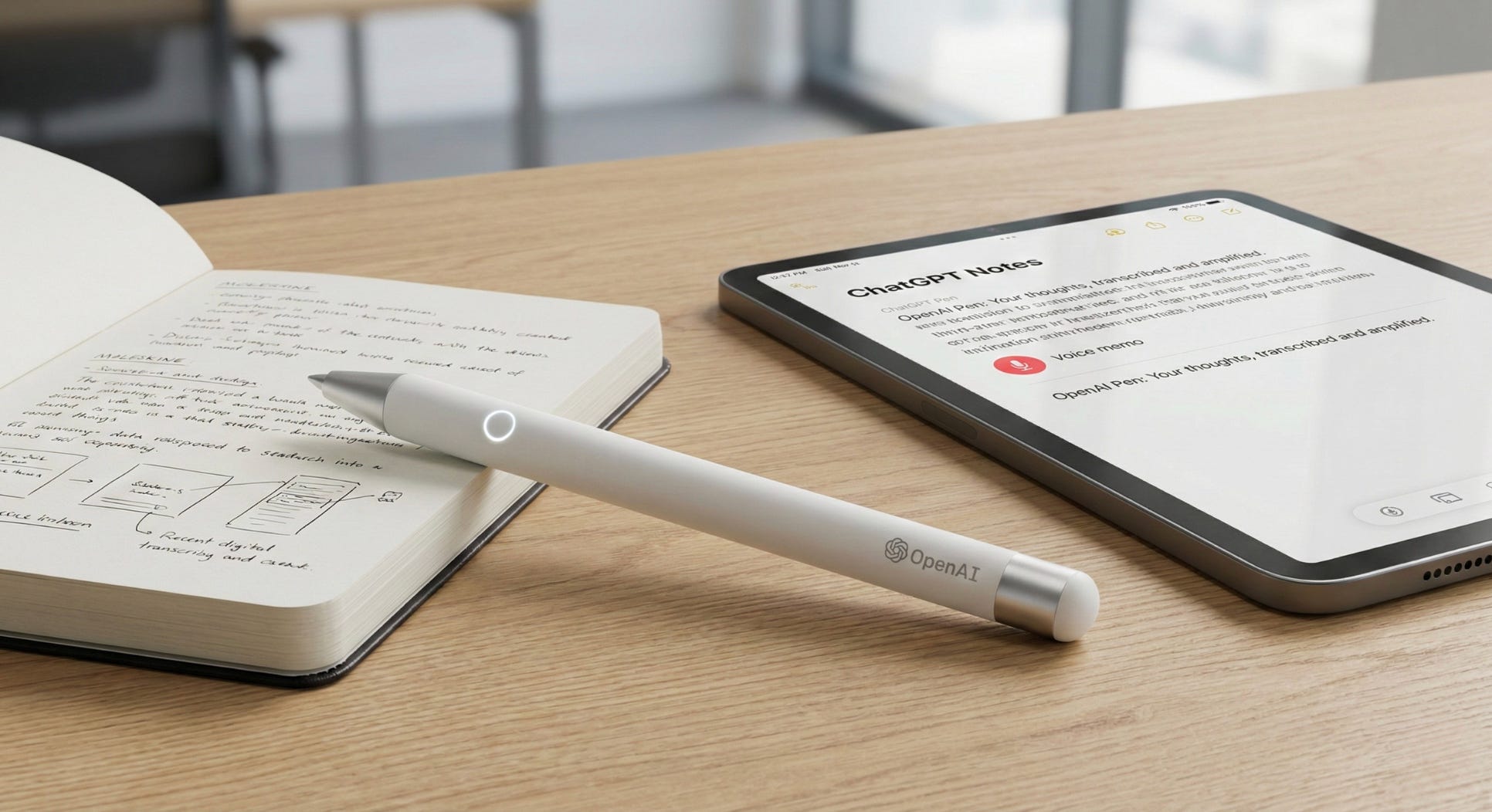
Let’s quickly rip through the leaks so we’re on the same page:
The Hardware: OpenAI is building two devices. One is an AI-powered pen (codenamed “Gumdrop”) that digitizes handwriting and chats with you. The second is a portable “to-go” audio device.
The Designer: This is a Jony Ive joint. OpenAI bought his startup,
io, for ~$6.5B.The Philosophy: These are “Third Core Devices”. They sit alongside your phone and laptop, not replacing them, but offering a “calmer”, screen-free interface.
The Engine: OpenAI is rebuilding their audio model from scratch (launching Q1 2026) to fix latency and handle interruptions like a real human.
Okay, standard tech news. Now, let’s look at the money.
The “Input Bottleneck” Thesis
Here is the insight that most founders are missing: The keyboard is the bottleneck of human intelligence.
Think about it. You can think at incredibly high speeds. You can speak reasonably fast. But typing? Typing on a glass slab with your thumbs?
It’s a primitive, low-bandwidth data stream. It acts as a dam, holding back 90% of your creativity, context, and intent.
OpenAI doesn’t care about the hardware margins on a pen. They care about throughput.
Currently, AI models are “starving” for your real-time thoughts. They only get what you deliberately type into a prompt box. That’s high-friction.
The Pen: Captures the unstructured, free-flowing creativity of diagrams and marginalia.
The Audio Device: Captures the stream-of-consciousness thought that happens while you’re driving, walking, or washing dishes.
The main point is this: OpenAI is moving from “Destination AI” (going to an app to do a task) to “Ambient Capture”. They are building the infrastructure to capture the process of your work, not just the output.
Why This Matters for Your Business
If you are building an AI wrapper that relies on a user sitting down, opening a laptop, and typing a prompt, you are building for the past.
The “Death of the Middle” is happening again.
On one end: High-intensity, visual work (Laptop/VR).
On the other end: Ambient, invisible work (Voice/Pen).
The Middle: The Smartphone screen; the place where most “productivity” apps currently live is about to get squeezed.
The Tactical Opportunity (What You Build Next)
So, how do you make money from this before the device even launches in 2026?
Pivot to “Voice-First” Workflows: Stop treating voice as a secondary feature. With OpenAI’s new low-latency audio model coming in Q1 2026, Voice UI (VUI) will finally be usable. Start building apps where the primary input is voice.
Idea: A CRM that listens to your sales calls and updates the database automatically, so you never have to “type” data entry again.
The “Paper” Bridge: If the pen is coming, the “handwriting-to-code” or “sketch-to-UI” pipeline is about to explode.
Idea: Build a tool that takes a photo of a napkin sketch and converts it into a fully functional React component. Train it now. When the Gumdrop API drops, you’ll be first in line.
Ambient Context Apps: Move away from “Chat” interfaces. Chat is tedious. Build “Listen” interfaces.
Idea: An executive coaching app that runs in the background of your meetings (audio only) and emails you a critique of your negotiation skills after the call.
Final Word
Jony Ive isn’t designing a pen. He’s designing a key to unlock the data inside your head that a keyboard can’t reach.
The question isn’t “Will I buy a $300 pen”. The question is “Is my business ready for a world where typing is optional?”
Next Step for You: Look at your current product roadmap. Circle every feature that requires a user to “fill out a form” or “type a description”. Ask yourself: How can I replace this with a buttonless, ambient input?