


🎙️ AUDIO DEEP DIVE OF THIS ISSUE:
Sammy & Mila offer in-depth analysis on each newsletter issue. Subscribe to their podcast.
📊 TRENDS, RESEARCH & REPORTS:
The New Currency of Success: How Quickly Can You Build New Skills?
In the 17th issue of my newsletter, I mentioned a study by Daron Acemoğlu, where he examined how technological innovations have reshaped the value of the hourly labor force over time.
Today, I want to dive deeper into this topic and explore how his insights apply to the rapidly changing world we live in.
But first, let’s take a moment to recognize a great achievement. Daron Acemoğlu, along with Simon Johnson and James Robinson, was awarded the 2024 Nobel Prize in Economic Sciences.
Their research revealed how political and economic institutions shape development and prosperity, with a particular focus on how inclusive systems drive growth while extractive ones hold nations back.
This work, spanning over 500 years of historical data, has been pivotal in understanding global inequalities.
Now, you might be asking: what does this have to do with the everyday challenges of running a business?
The answer lies in one key concept—adaptability.
In the past, having a single skill could sustain you for a lifetime.
If you were a farmer, a blacksmith, or a lawyer, that one area of expertise was enough to keep you employed and successful. But the world has changed.
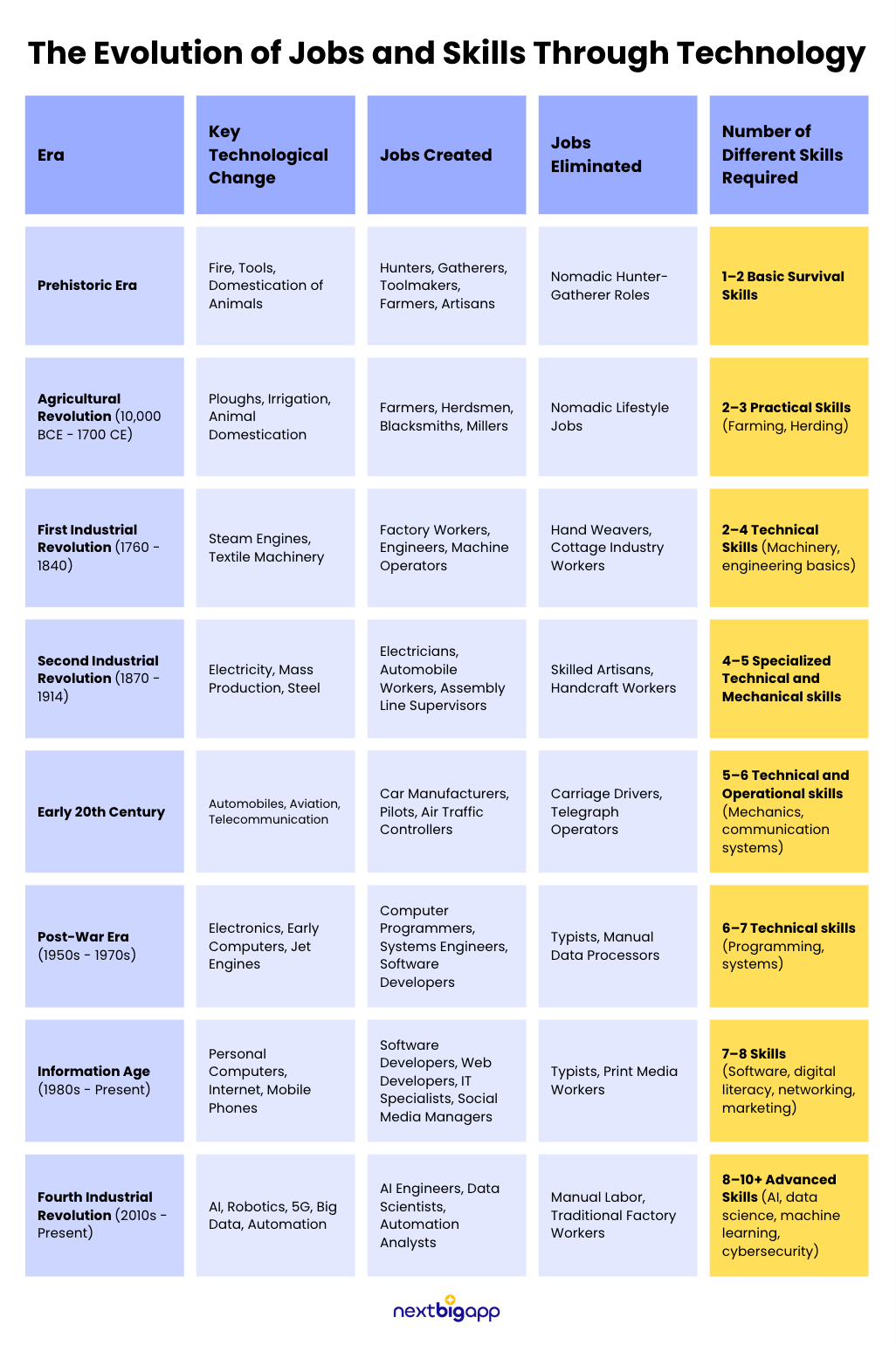
This table highlights how technological shifts have created new jobs, eliminated others, and increased the number of skills needed to earn above-average income over the past century.
As industries evolve—from the Industrial Revolution to today's AI-driven world—workers and businesses need to continuously adapt.
As technology advances, the demands placed on both individuals and businesses are evolving at a faster rate than ever before.
The success of today is no longer about mastering one skill but about how quickly you can build new ones—and how effectively you can adapt them to new realities.
The ability to learn quickly is important, but it’s not enough by itself. What really sets successful individuals and businesses apart is their ability to take action on those new skills and, perhaps most critically, their capacity to adapt.
Learning for the sake of learning won’t drive success—it’s how quickly you can translate that knowledge into practice and pivot when necessary that truly makes the difference.
Consider small businesses. In this increasingly competitive landscape, simply having the right product or service is no longer enough.
Success comes down to how quickly they can develop new skills, implement them effectively, and adapt their strategies in real time.
Think of it this way: the ability to learn is the foundation, but execution and adaptability are the walls and roof that make the house.
To illustrate this, let’s return to Acemoğlu’s work. Just as his research showed that inclusive institutions—those that evolve to support broad-based growth—are vital for economic success, the same logic applies to businesses today. It’s no longer just about having expertise in one area.
Small businesses need to continuously develop a range of skills across multiple domains—marketing, technology, leadership, finance—and be ready to act on them swiftly. That adaptability becomes the single most critical factor in long-term success.
So how does this translate to the day-to-day life of an entrepreneur or business leader?
Build a Learning Culture: Don’t focus on learning for the sake of learning. Make sure that every new skill you acquire or teach within your team has a clear pathway to action. Implement what you learn quickly and refine it as you go.
Action is Everything: Learning is just the start. The businesses that move the needle are the ones that don’t get stuck in the "research" phase. They take what they’ve learned, test it in the real world, and adjust based on results. Speed of execution is just as important as speed of learning.
Embrace Adaptability: The skills that matter most today might not be as valuable tomorrow. The ability to pivot—whether that’s changing a marketing approach, adopting a new technology, or rethinking your business model—is the real differentiator in today’s fast-changing environment.
Skill Diversity: Businesses, especially small ones, no longer have the luxury of specialization alone. If your team is strong in one area but weak in others, you’re vulnerable. The key is to build a broad skill base across your entire organization and create processes that encourage cross-functional learning.
In today’s world, success depends on how quickly you can build new skills and apply them in a meaningful way.
The winners will be those who understand that learning is just the beginning—the real key lies in execution and adaptability.
So the question you should ask yourself isn’t just, "How fast can I learn?", but also, "How fast can I act on what I’ve learned and adapt when needed?"

🦾 AI AUTOMATION HACKS:
How to Automate Your Everyday Tasks as a B2B Salesperson
Let’s be real, when you hear the word “automation” you often feel like it’s some scary robot coming to take over. You feel a mix of excitement and panic? You’re not alone.
Most people wonder: Where do I even start? What if I mess it up? Will it make things more complicated than they already are?
Here’s the secret—automation isn’t about doing everything perfectly. It’s about finding simple ways to save time and cut out the busywork that’s slowing you down.
The trick? Start with the tasks you’re already tired of doing every day.
Think about it: if you’re a B2B salesperson, chances are you’re buried under invoices, chasing signatures on contracts, and putting together endless presentations.
These are exactly the kinds of things AI can handle for you—and give you back hours in your day.
Imagine being able to focus more on growing your business, instead of being buried under invoices, contracts, and endless presentations. Sounds good, right?
Here’s a breakdown of common tasks you’re probably spending too much time on, and how you can automate them with AI—starting today.
1. Invoicing:
B2B salespeople spend so much time on invoices. It’s repetitive and needs to be 100% accurate, or you’ll have clients calling about missing charges or incorrect billing.
How to Automate:
Use AI-powered invoicing tools like Zoho Invoice or QuickBooks. They automatically generate invoices once a sale is made, track payments, and even send reminders to clients about overdue payments. All you need to do is set up the system and watch it work.
2. Contract Generation:
Drafting contracts is essential, but also tedious. Each contract requires unique details, but the bulk of the content is often the same.
How to Automate:
There are tools like DocuSign and PandaDoc that use templates and AI to generate contracts based on your specific data inputs. You just select a few variables, and boom—a professional, client-ready contract is ready in seconds. And with AI, it learns your preferences over time, making each new contract even faster.
3. Lead Management and Follow-Ups:
Following up on leads can feel endless—emails, calls, scheduling meetings. But lead nurturing is key to success in B2B sales.
How to Automate:
With AI-driven CRMs like HubSpot or Salesforce, you can automate follow-ups. AI can track when someone opens your email or visits your website and trigger personalized follow-up emails automatically. You can also set up AI tools like Calendly to automate meeting scheduling without endless back-and-forth emails. Imagine AI reminding you when a prospect hasn’t responded, without you lifting a finger!
4. Proposal Writing:
Tailoring a proposal for each client can be draining. But there’s a faster way to get it done without sacrificing quality.
How to Automate:
AI writing tools like Jasper or ChatGPT (you know I had to mention it!) can help draft initial proposals. You feed it details about the client and the product/service, and the AI will generate a detailed proposal. All you need to do is tweak it to match your tone. This saves hours of manual writing and editing.
5. Sales Presentations:
Customizing sales presentations can take hours, especially when you’re targeting different industries or clients.
How to Automate:
Tools like Beautiful.ai or Tome use AI to build visually appealing presentations in minutes. These platforms offer smart templates that adapt based on your content and audience. They even suggest data visualizations, making your pitch even more compelling without you having to do the heavy lifting.
6. Email Management:
Your inbox is probably a war zone of unread messages, and figuring out which emails to prioritize can feel overwhelming.
How to Automate:
Use AI tools like SaneBox or Superhuman. These apps use AI to categorize your emails, highlight high-priority ones, and snooze the less important ones. You can also set rules to auto-reply to common inquiries or even have your AI draft responses to emails based on the content. Less manual typing, more productivity.
7. Data Entry and CRM Updates:
Manually updating your CRM with details from every call or meeting is time-consuming and easy to forget.
How to Automate:
AI-powered tools like Gong or Chorus automatically track your sales calls, record key takeaways, and even update your CRM based on the conversation. These tools understand the context of your meetings and log details like potential objections or competitor mentions. You’ll never have to worry about missing crucial info or wasting time typing out notes.
8. Market Research:
Staying on top of industry trends and understanding what your competitors are up to takes time, but it’s necessary for success.
How to Automate:
Tools like Crayon or Owler use AI to track competitors’ moves and industry shifts, sending you real-time alerts when something relevant happens. You’ll always be in the know, without spending hours Googling your competition.
Why Should You Care?
If you’re still hesitating, ask yourself this: what would your life look like with an extra 10 hours a week? Because that’s what automation promises—not by taking over your job, but by doing the boring parts so you can focus on closing deals, building relationships, and thinking strategically.
Automation doesn’t mean “goodbye human touch”; it means “hello efficiency”. Start small—pick one task, automate it, and see the difference.
Once you do, you’ll wonder how you ever worked without it.
Next Steps:
Start today. Identify the top 2-3 tasks that eat up your time and experiment with the tools mentioned. You'll see a significant boost in your productivity and probably even your sanity.
🧙♂️ TIPS & TRICKS:
The Secret Formula: Yaro Celis's Growth Recipe
In this issue, I’m excited to introduce Yaro Celis, the mind behind the newsletter "Yaro on Ai and Tech Trends".
Yaro is passionate about making cutting-edge tech trends accessible and actionable, particularly for small businesses.
His newsletter is packed with bite-sized briefings on everything from AI tools to web3, offering expert perspectives that go beyond the headlines.
It's an essential resource for anyone wanting to stay ahead of the curve in today's fast-moving tech landscape. You can even get access to 800+ AI tools for free by subscribing.
Now, let’s dive into Yaro's insights on the future of AI and its impact on businesses:
Industry Evolution:
Emerging AI trends are transforming how we do business. What excites me most is the rapid rise of automation, robotics to replace tedious tasks, and the evolution of personal AI agents that can assist with everything from customer interactions to deep market analysis.
We're seeing AI move from complex systems to something as accessible as a smartphone app, allowing even the smallest businesses to leverage technology once reserved for large corporations.
Plus, the growing trend of nearshoring presents incredible opportunities for local businesses, impacting real estate, jobs, and infrastructure in ways we’re only beginning to understand.
Wisdom Share:
Don't be afraid to experiment. Dive in and start tinkering with these new tools to see how they can benefit your business and life.
AI is here to stay; it's becoming faster, easier to use, and more ubiquitous every day. You won't lose your business to AI, but you could lose it to someone who understands how to use it effectively. Be that person.
I wish someone had told me sooner to stay ahead of these technologies—not just for operational benefits but for early adoption and investment opportunities too.
💡 INSPIRING IDEAS:
“The bad news is time flies. The good news is you’re the pilot.”
— Michael Altshuler