


🎙️ AUDIO DEEP DIVE OF THIS ISSUE:
Sammy & Mila offer in-depth analysis on each newsletter issue. Subscribe to their podcast.
🧙♂️ TIPS & TRICKS:
3 Must-Try AI Marketing Strategies for Small Business Growth
If you're like most of us, you're probably wearing multiple hats and trying to make every marketing dollar count.
Well, guess what? AI tools are no longer just for big corporations with massive budgets. Let's talk about how you can use AI to compete with the big players without breaking the bank.
Why should you care about AI marketing?
Look, I get it - when you're juggling inventory, customer service, and everything else, the last thing you want is another tech tool to figure out.
But here's the thing: AI can actually take work OFF your plate. And who doesn't want that?
1. Let's Start With the Good Stuff: Personalization
Remember when personalization meant just adding someone's first name to an email? Now you can do so much more, even with a small customer base:
Automatically send product recommendations based on what customers bought before
Create emails that feel personal, even when you're sending them to your whole list
Show different website content to different visitors based on their interests
So, start with personalizing your email marketing - it's usually the easiest and most affordable way to see quick results.
2. Automation (AKA Your New Virtual Employee)
When you're running a small business, time is literally money. Here's how AI can give you some of that time back:
Schedule social media posts automatically
Answer common customer questions 24/7
Sort through customer emails and route them to the right person
Track which customers haven't engaged lately and send them win-back campaigns
Begin with automating your most time-consuming task. For most small businesses, that's usually customer service or email marketing.
3. Content Creation Made Easy
Creating content regularly is tough when you're busy running a business. Here's how AI can help:
Generate ideas for social media posts
Write first drafts of your blog posts
Create email newsletters
Come up with product descriptions
Use AI to create rough drafts, then add your personal touch. Your unique voice and experience are what make your business special!
📱 NEXT BIG APPS:
Budget-Friendly AI Tools You Can Start With
Let's talk about some tools that won't cost you an arm and a leg:
Klaviyo - Great for email marketing automation. They have plans starting at reasonable prices for small businesses.
Claude - Helps with writing content. You can start small and scale up as needed.
Tap Grow - Think about how much time you'll save on customer service. It can handle basic customer questions while you focus on growing your business.
Capcut - Turn your long-form content into snackable social media gold, complete with all the bells and whistles.
HeyGen - Perfect for creating personalized videos to thank customers or announce sales. One template, many personalized videos!
Real Talk: What You Actually Need vs. What's Nice to Have
For small businesses just starting with AI, here's what I recommend:
Start With These:
An AI-powered email marketing tool
Simple to setup ai phone call agent
A basic chatbot for your website
A content generation tool for your social media
Save These for Later:
Advanced video personalization
Complex automation sequences
Premium analytics tools
Making It Work on a Small Business Budget
Start Small: Pick one area of your marketing to automate first
Use Free Trials: Most AI tools offer free trials - use them!
Calculate ROI: Track how much time you're saving and what that's worth to your business
Scale Gradually: Add more tools as your business grows
Common Small Business Concerns (and Why You Shouldn't Worry)
"But I'm not tech-savvy!" - Most modern AI tools are designed to be user-friendly. If you can use social media, you can use these tools.
"What if it makes mistakes?" - You're still in control! AI is your assistant, not your replacement.
"It's too expensive!" - Start with basic features and upgrade only when you see results.
Next Steps: Your Action Plan
Pick ONE area of your marketing that takes up too much time
Try a free trial of ONE tool that could help with that
Start small - maybe just automate your welcome emails or social media posts
Track your results and time saved
Scale up what works for YOUR business
The Bottom Line
You don't need a big budget or a tech degree to use AI in your marketing. Start small, focus on what will save you the most time, and grow from there. Remember, every big business started somewhere - AI just helps you compete more effectively with fewer resources.
Got questions about using AI in your small business? Drop them in the comments! And hey, if you've already tried some AI tools, we'd love to hear what worked (or didn't work) for you.

🧙♂️ TIPS & TRICKS:
Prompt Engineering: The Art of Effective AI Instructions 🦾
Is prompt engineering a truly transformative technique that unlocks the hidden potential of AI models, or is it merely a buzzword, an overhyped concept with minimal impact on the actual output of AI systems?
The skepticism surrounding prompt engineering largely stems from inexperienced, opportunistic marketers peddling courses with exaggerated promises of quick riches.
Their claims that a few prompt techniques will lead to instant financial success understandably raise concerns.
What truly matters, however, is not the term “engineering” itself, but the tangible benefits it provides.
Effective prompt methods save valuable time by streamlining trial-and-error processes, leading to faster and more consistent results.
Whether it's labeled as engineering or not, the efficiency gained from refined prompt techniques remains undeniable.
For me; Prompt engineering is the skill of designing precise and informative prompts to guide Large Language Models (LLMs) towards generating the desired results. It's a crucial element in unlocking the full potential of AI tools and ensuring they align with your specific goals.
Why Prompt Engineering Matters
Accuracy and Relevance: Well-crafted prompts minimize ambiguity and help AI models deliver outputs that directly address your needs.
Efficiency: Clear prompts save time by reducing the need for extensive back-and-forth communication with the AI.
Control and Predictability: Specific instructions give you greater influence over the AI's responses, leading to more consistent results.
Innovation: Prompt engineering opens the door to unique and creative applications of LLMs beyond their standard capabilities.
Key Components of Effective Prompts
Context: Provide background information, surrounding details, and scenarios to help the AI understand the situation and generate relevant responses.
Example: Instead of “What is SEO?”, try “As a blogger focused on tech products, how can I optimize my content for search engines?”
Clear Instructions: Direct the AI with specific actions or requests. Avoid vague or open-ended language.
Example: Instead of “Talk about the importance of AI”, try “Summarize the key ethical considerations surrounding the use of AI in healthcare”
Desired Output Format: Indicate how you want the response structured (list, essay, code snippet, etc.) and the desired tone (formal, humorous, etc.).
Example: “Create a catchy Twitter-length tagline for a new eco-friendly cleaning product”
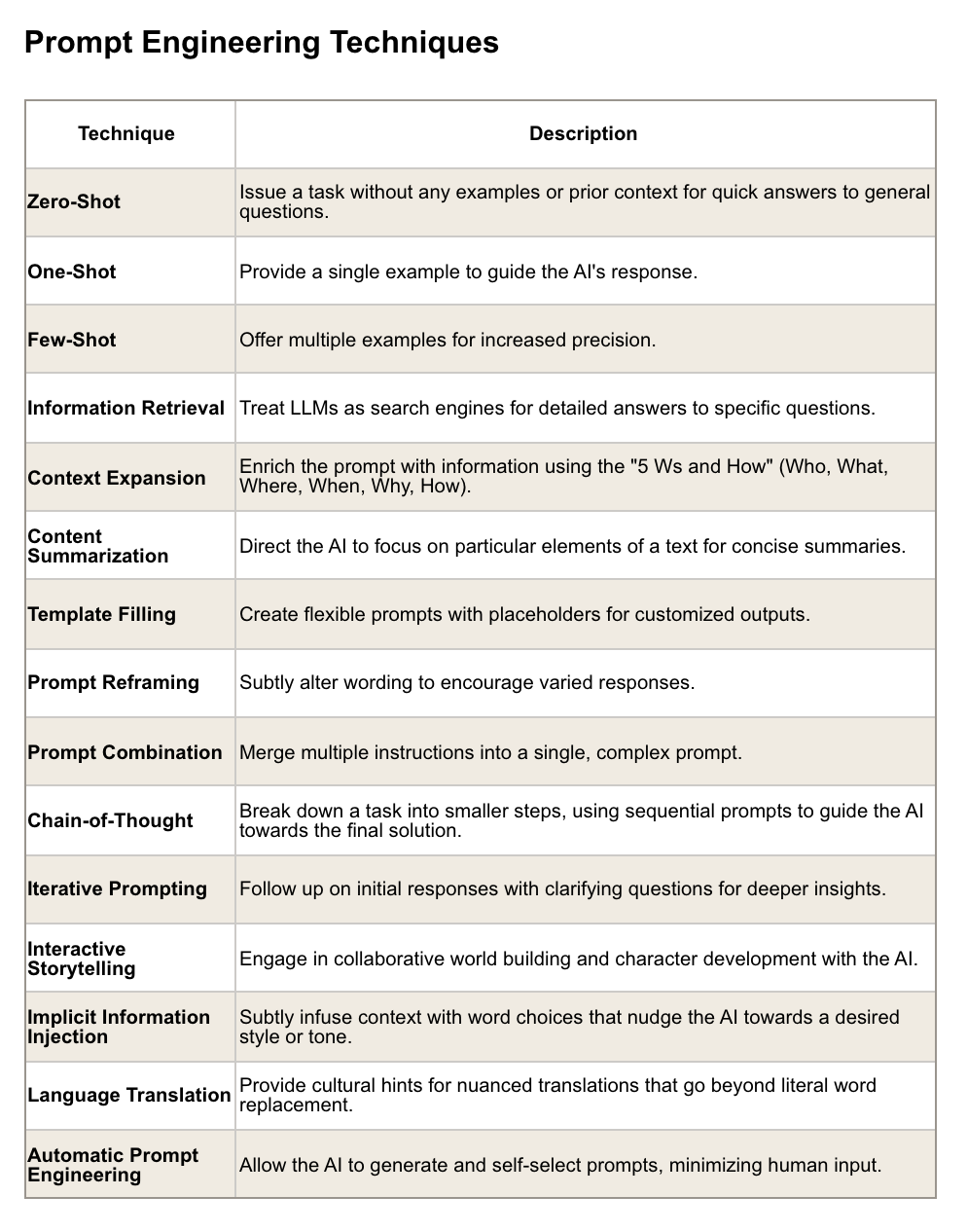
Dive Deep on The Techniques
Zero-Shot Prompting: Used for quick, general answers or tasks that require no specific knowledge or context.
Example: “Translate 'hello' into Spanish”
One-Shot Prompting: Provides a single example to guide the AI's response toward a desired format or topic.
Example: “Write a poem about the ocean. [Example Poem]”
Few-Shot Prompting: Utilizes several examples to fine-tune the AI's output, providing a richer context within which the AI can work.
Example: “Rate the sentiment of these customer reviews as positive, negative, or neutral. [Several reviews labeled with their sentiment]"
Information-Focused Techniques
Information Retrieval: Frames prompts as highly specific questions, often leveraging LLMs with access to up-to-date information.
Example: “What was the closing stock price of Apple yesterday?”
Context Expansion: Involves enriching the prompt with a “who, what, where, when, why, how” analysis.
Example: “As a marketing manager for a software company, how can I best leverage social media to target enterprise-level clients?”
Content Summarization: Directs the AI to hone in on specific sections of a larger text while summarizing.
Example: “Summarize this article about cloud computing, focusing on the security challenges”
Customization and Creativity
Template Filling: Creates versatile prompts with placeholders that can be filled with varying information to produce tailored outputs.
Example: “Write a product description for [product name] that highlights features like [feature 1] and [feature 2]. Target audience: [demographic]”
Prompt Reframing: Carefully adjusts the wording within a query without altering its core intent, encouraging diverse responses from the LLM.
Example: Instead of “What are the benefits of meditation?”, try “How can meditation improve mental well-being?”
Interactive Storytelling: Engages in collaborative storytelling where both you and the AI contribute to a dynamic, evolving narrative.
Example: “Let's write a fantasy adventure. You'll describe the scene, and I'll decide what my character does next”
Advanced Techniques
Prompt Combination: Merges multiple instructions for complex, multifaceted outputs.
Example: “Write a blog post explaining blockchain technology to a non-technical audience. Include real-world examples and finish with a call to action”
Chain-of-Thought: Breaks down complex tasks into smaller, sequential steps, allowing the AI to reason through the problem for improved accuracy.
Example: “The number 352 is divisible by 4. Explain why, step by step”
Iterative Prompting: Builds on previous AI responses with follow-up questions to drill down, discover additional insights, or refine outputs.
Example: [AI generates a marketing tagline] “Can you make it shorter and more memorable?”
Implicit Information Injection: Subtly embeds context through word choices that guide the AI towards a desired style, tone, or outcome.
Example: Instead of “Write in a formal tone”, use words like “analyze”, “assess”, and “evaluate”.
Language Translation: Provides cultural or situational context alongside the literal translation request to produce accurate, nuanced outputs.
Example: “Translate the idiom 'It's raining cats and dogs' into French, ensuring the translated phrase carries the same meaning of heavy rainfall”
Cutting-Edge: Automatic Prompt Engineering
Automatic Prompt Engineering (APE): LLMs learn to generate and self-select prompts, gradually reducing human input. This advanced capability streamlines workflows in various fields and allows AI to work more independently.
Some Scenarios
Scenario 1: Generating Engaging Product Descriptions
Context Expansion: “I'm selling a vintage leather backpack aimed at stylish young professionals who value durability and craftsmanship”
Template Filling: “Write a product description for [product name] that emphasizes [feature 1] and [feature 2]. Use a persuasive tone and target audience: [demographic]”
Implicit Information Injection: “Craft an evocative product description for a handcrafted wool scarf. Highlight its warmth, softness, and timeless appeal”
Scenario 2: Debugging Code (Let's use Python)
Zero-Shot (Simple Issue): “Fix the error in this code: print('Hello world!”
Information Retrieval: “What are common causes of runtime errors in Python, and how can I troubleshoot them effectively?”
Iterative Prompting: [Provide a code snippet] “This code is meant to calculate the area of a circle but produces incorrect results. Can you help me identify and fix the error?” (Follow up with additional code snippets as the AI guides you).
Scenario 3: Content Creation for a Blog
Context Expansion: “I'm writing an article about the rise of remote work for a business audience. Focus on productivity tips and management strategies”
Chain-of-Thought: “Generate a catchy title for a blog post about the benefits of remote work. Now, provide an outline for the post, including at least three key points and a conclusion”
Content Summarization: “Summarize this research paper on remote team communication challenges, but only focus on the section regarding cross-cultural teams”
Scenario 4: Customer Service Chatbot
One-Shot Prompt: “A customer says: 'My order hasn't arrived yet.' Provide a helpful chatbot response”
Prompt Combination: “A customer needs help choosing a product from a furniture website. Provide a chatbot greeting that asks about their style preferences and price range”
Interactive Storytelling (For training): “Let's practice a chatbot interaction where I'm a frustrated customer with a billing issue. You'll try to resolve the situation professionally”
Last Tips for Success:
Specificity: The more specific your instructions, the better the results.
Clarity: Avoid ambiguous or open-ended wording.
Experimentation: Try different techniques and phrasing to see what works best with the LLM you're using.
Feedback: Most LLMs allow you to rate their response quality; this helps them improve over time.
Analyze Responses: Learn how the LLM reacts to different prompts.
Stay Updated: Track model updates and new features to tailor your prompts.
Collaborate: Share ideas and techniques with the prompt engineering community.
The examples and information provided here represent a substantial portion of the fundamental knowledge about prompt engineering that some opportunistic marketers attempt to sell for exorbitant prices.
Be wary of those who claim to possess secret knowledge beyond what's presented here, as their intentions may not be genuine.
With the basic information provided, coupled with experimentation and practice, you have the power to unlock the high-quality AI outputs you desire.
💡 INSPIRING IDEAS:
“A new day: Be open enough to see opportunities. Be wise enough to be grateful. Be courageous enough to be happy.”
— Steve Maraboli
The prompt techniques and the provided examples were very helpful to me, thank you.