


🎙️ AUDIO DEEP DIVE OF THIS ISSUE:
Sammy & Mila offer in-depth analysis on each newsletter issue. Subscribe to their podcast.
🧙♂️ TIPS & TRICKS:
Productivity Without Breaking the Bank
We all love tools that make our jobs easier, right? Whether it’s organizing projects, designing graphics, or staying in touch with the team, there are tons of platforms out there that help us get stuff done faster.
But let’s be real—some of these tools come with a pretty steep price tag.
Here’s the thing, though: you don’t always have to pay big bucks to work smarter.
Thanks to the open-source community, there are tons of free tools that can do the job just as well, if not better.
Richard Stallman, the godfather of open source, started a revolution in the early 1980s. Tired of the proprietary software lock-in, he envisioned a world where software was as free as speech.
Stallman’s GNU Project and Free Software Foundation ignited a movement that has shaped the digital landscape.
Today, countless open-source projects —from Linux to Firefox— stand as testaments to his vision of a collaborative and open world of software.
Statistical Significance
Market Share: As of recent reports, open-source software accounts for approximately 60% of all web servers.
Community Growth: Over 1 million developers actively contribute to open-source projects worldwide.
Economic Impact: The open-source ecosystem is a hidden economic powerhouse, generating an estimated $60 billion annually.
To put that into perspective, that's roughly the same annual revenue as tech giants like Nvidia, pharmaceutical companies like Pfizer or Delta Air Lines.
It's a staggering figure that highlights the immense impact of open-source software on our world.
So, where do you find these awesome free tools today?
A great starting point is Open Source Alternative. It’s a site that helps you discover open-source options for popular paid software.

You’ll be surprised at how much you can save without sacrificing quality!
If you’re looking to get more productive without the heavy price tag, diving into the world of open source is a smart move.
Newsletter Recommendation:
Why Try AI - Get hands-on tips and inspiration to get more out of generative AI. Stay updated on AI news, tools, and model releases without the hype.
📊 TRENDS, RESEARCH & REPORTS:
The Rise of Handcrafted Imperfection in an AI-Driven World
While this newsletter often dives deep into the world of artificial intelligence, let's take a detour for a moment.
From personalized recommendations on streaming platforms to AI-powered chatbots that can answer our questions, artificial intelligence is rapidly becoming an integral part of our daily lives.
While AI offers incredible efficiency, it can also lead to a sense of sameness and a lack of authenticity.
Sure, a counter-movement will emerge - one that celebrates the quirky, the imperfect, and the undeniably human.
As we increasingly rely on AI to streamline our work, focusing on the human touch in our interactions with customers could be a game-changer. Let's not miss this opportunity to stand out in a world that's becoming increasingly automated.
Now, I want to introduce you to Judero, a game that's a shining example of this counter-movement.
Imagine a game crafted not from pixels and polygons, but from clay, cardboard, and repurposed action figures. That's Judero, a distinctly Scottish adventure that has captured hearts with its stop-motion animation and heartfelt writing.
Created by the two-person team of Talha Kaya and Jack King-Spooner, Judero is more than just a game - it's a handmade masterpiece that showcases what happens when human creativity is unleashed without the constraints of algorithmic perfection.
What makes Judero special?
Handcrafted Visuals: Every character, from the protagonist to the NPCs, is lovingly crafted from modeling clay and old action figures. The result? A world that's unsettling yet charming, with characters that are "ugly-cute" in the best possible way.
Stop-Motion Magic: While gameplay uses sprites in 3D environments, cutscenes feature full stop-motion animation, creating a unique visual experience that no AI could replicate.
Heartfelt Writing: As Talha Kaya puts it, they “hid a bit of humanity around every corner“. Every NPC has a story to tell, often touching on deep, philosophical themes or offering unexpected humor.
Acoustic Soundtrack: The game's folk tunes, driven by acoustic guitar, set a nostalgic mood that perfectly complements its earthy, pagan influences.
Lessons from Judero for Businesses
How can your business capture this same spirit of human-driven creativity? Here are some ideas inspired by Judero:
Imperfection: Don't hide your "rough edges" - celebrate them! Like Judero's characters with their bulging eyes and cratered flesh, your products' quirks can become their most endearing features.
Tell Your Story: Every product should have a tale behind it. Whether it's a struggle in the creation process or an inspiration that struck at 3 AM, share these stories with your customers.
Mix Old and New: Judero combines old-school stop-motion with modern 3D environments. How can you blend traditional craftsmanship with contemporary techniques in your business?
Infuse Personality: From Judero's "Men from Carlisle" who shout their city name like Pokémon to the talking ape friend, unexpected elements of humor and personality can make your products unforgettable.
Create Immersive Experiences: Judero shifts art styles when players enter houses, using dreamy watercolors. How can you create moments of surprise and delight for your customers?
Anti-AI Marketing Promises That Pop
Instead of the usual corporate speak, try these Judero-inspired taglines:
"Algorithms are cool, but have you tried talking to a human?"
"Warning: Our products may contain traces of laughter, love, and occasional coffee spills"
“No AI were harmed in the making of this product (mainly because we don't use any)”
"Handmade with love... and sometimes a bit of frustration, but mostly love"
"Made by humans, for humans, with all our beautiful flaws"
"Our customer service reps don't just pass the Turing test, they ace the Human test"
In a world striving for digital perfection, perhaps your humanity is your greatest strength. Your wobbly lines, your unexpected color choices, your products that look like they might have been made by a very talented child - these are the things that make you real, relatable, and irreplaceable.
In a sea of AI-generated sameness, be the clay figurine with the slightly lopsided smile. After all, AI might be able to generate a million perfect images, but it can't capture the soul of a single handmade creation. And isn't that what we're all really looking for?
📊 TRENDS, RESEARCH & REPORTS:
Looking at the World Map with Different Eyes
When most people glance at a world map, they see vast continents, sprawling oceans, and countries of varying physical size.
However, for business owners, there's a more meaningful map to consider—the economic map. It’s not about how big a country looks, but how much wealth, opportunity, and market potential it holds.
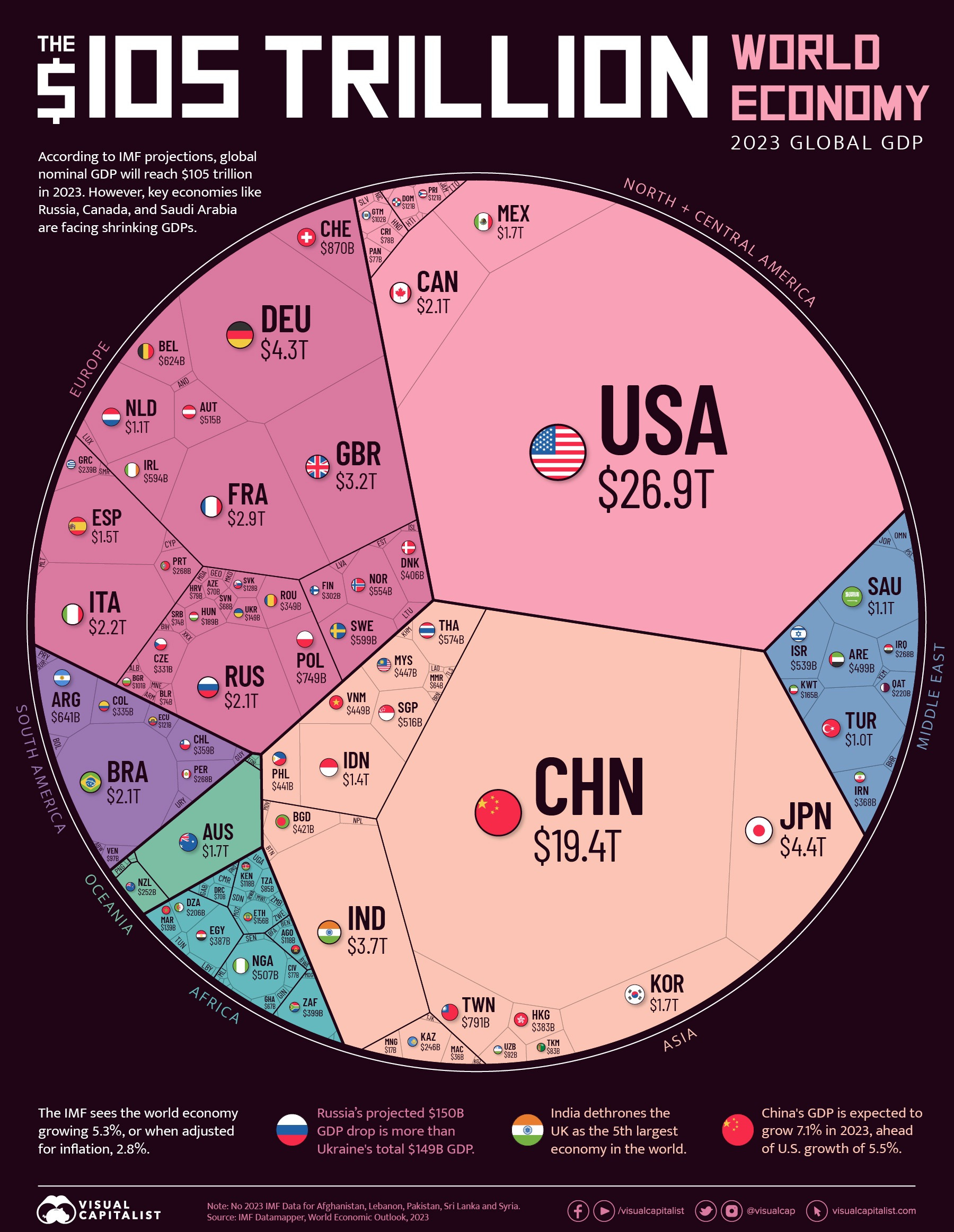
When you break down the global GDP number by country, you start to see the world in a whole new light. Forget about borders and landmass—economic size is where the real opportunities lie.
The True Giants of the Map
Take the United States. It might not be the largest country physically, but its economy towers over the rest of the world, boasting a $26.9 trillion GDP. That means if you’re looking to expand, innovate, or reach a wealthier customer base, the U.S. should be on your radar.
Then there’s China. At $19.4 trillion, it’s a behemoth of manufacturing and consumer demand. While China’s physical presence is prominent on any map, its economic power is what makes it one of the most important global players for businesses looking to scale.
And don’t overlook countries like Japan, Germany, and India. Though their land size may not compare to the vast territories of Russia or Canada, their economic output is far more significant—$4.4 trillion, $4.3 trillion, and $3.7 trillion, respectively.
For your business, this shift in perspective is vital. The real opportunity isn’t necessarily where the most land is but where the most money flows.
Economic Size: A Blueprint for Opportunity
When you examine the world through the lens of economic size rather than geography, new markets and strategies come into focus.
Consider Germany, for example. With its $4.3 trillion GDP, the country punches above its weight, offering robust opportunities in industries like manufacturing, automotive, and technology.
And India, though much smaller than Russia in physical terms, has recently overtaken the UK as the world’s fifth-largest economy—a promising signal for businesses interested in reaching an expanding, tech-savvy consumer base.
Instead of focusing on where countries are located or how big they seem, think of the wealth they generate.
Even smaller countries like Singapore, with a GDP of $1.6 trillion, pack a punch in terms of economic influence. If you’re operating in sectors like finance, tech, or logistics, a city-state like Singapore could offer outsized opportunities that far exceed its physical footprint.
Shift Your Business Mindset
For small businesses, this shift in mindset is more than just theoretical—it’s practical.
The countries with the largest economies also often offer the best infrastructure, a wealthier customer base, and a well-developed tech ecosystem that small businesses can tap into.
This perspective can also reveal hidden gems. For example, Mexico and South Korea may not be at the top of everyone’s list, but with GDPs of $1.7 trillion each, they are key players in global trade, offering opportunities in everything from manufacturing to e-commerce.
The takeaway? Size matters, but it’s the size of an economy, not landmass, that should guide your business strategy.
How to Approach New Opportunities
So, what does this mean for your business? How can you take this economic map and use it to drive growth?
Target Wealth Concentrations: Instead of simply expanding to the nearest country, look for markets with the highest potential based on economic activity. The U.S., China, and Germany, for example, might provide access to wealthier consumers or better infrastructure for tech or manufacturing.
Don’t Overlook Smaller Countries: Countries with smaller landmasses but strong economies, like Switzerland or South Korea, can offer huge opportunities for niche industries like pharmaceuticals, fintech, or specialized manufacturing.
Adapt to Local Economies: Just because a country has a large economy doesn’t mean you can use a one-size-fits-all approach. Pay attention to the unique needs, cultures, and trends in each market. The economic size tells you there’s money to be made, but how you capture that depends on your ability to adapt.
A New Way of Navigating the World
Looking at the world through economic size rather than geography is like flipping the map upside down—it gives you a fresh perspective on where the real opportunities lie.
For businesses, the lesson is clear: follow the money, not the landmass.
As you navigate your business's growth path, remember that the countries that hold the greatest opportunities for you might not be the ones that physically dominate the map. Instead, they're the ones where economic activity thrives, consumers are eager, and industries are growing.
Whether it’s the U.S. leading in tech, China in manufacturing, or Germany in engineering, the world’s largest economies are ready for you to tap into their potential.
In the $105 trillion global economy, businesses like yours have a chance to think big—bigger than borders, bigger than land size, and bigger than ever before.
💡 INSPIRING IDEAS:
“We don't stop playing because we grow old; we grow old because we stop playing.”
— George Bernard Shaw