


IN COLLABORATION WITH STACY’S BRAIN

How Startups Grow with a $0 Marketing Budget
A tiny marketing budget is not a death sentence. Stacy’s Brain digs through the latest studies and reports to find growth tactics that still work at $0, from founder-led content to partnerships. Free weekly read for founders who want to build on evidence.
Sometimes the line between life and death is very thin. You only notice it afterward…
A heart operation lasting several hours is over. A small child is about to be moved to intensive care.
You want to think, “The hardest part is behind us.”
But a lot has to change hands between the operating room and the ICU. Equipment, connections, information about the patient, responsibility for their care…
The team at Great Ormond Street Hospital in London wanted to reduce the risks of that transition.
Where would you start?
More training? More detailed checklists? New equipment? A look at how other hospitals do it?
All reasonable possibilities.
But one of the team’s sources of inspiration was rather surprising.
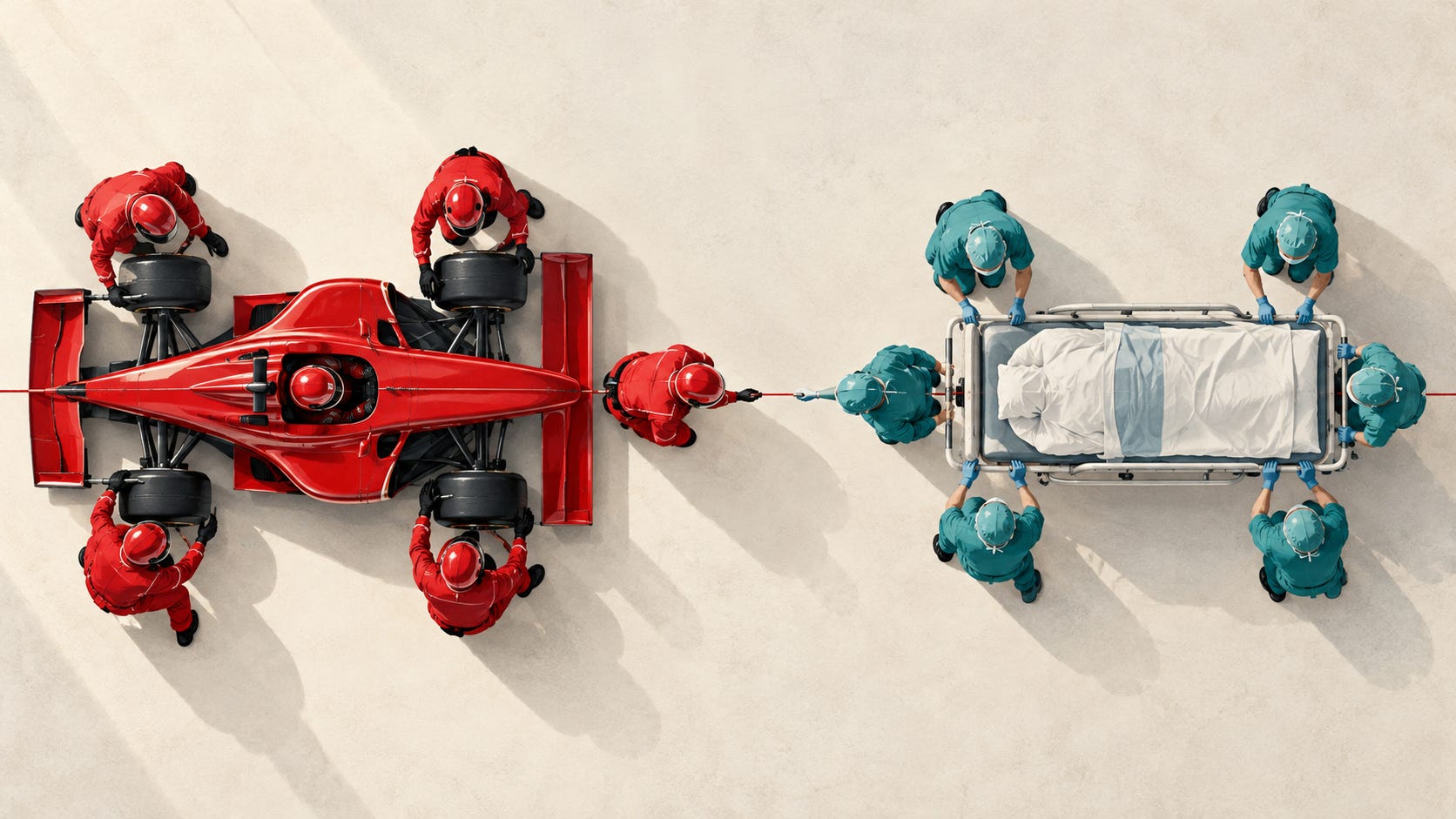
The story goes that two doctors were resting after long operations when Formula 1 came on television. Watching a pit stop, they noticed a similarity to their own work.
A car stops. Several people get to work at once. A series of connected tasks is completed. Then the car is on its way again.
So they went to meet the team.
Ferrari; Case study
What Were the Doctors Looking for at Ferrari?
Speed is the first answer that comes to mind.
But think about what the hospital actually needed. They weren’t trying to complete an ICU handover in a few seconds.
They wanted people working simultaneously to finish their tasks without getting in each other’s way or missing something important.
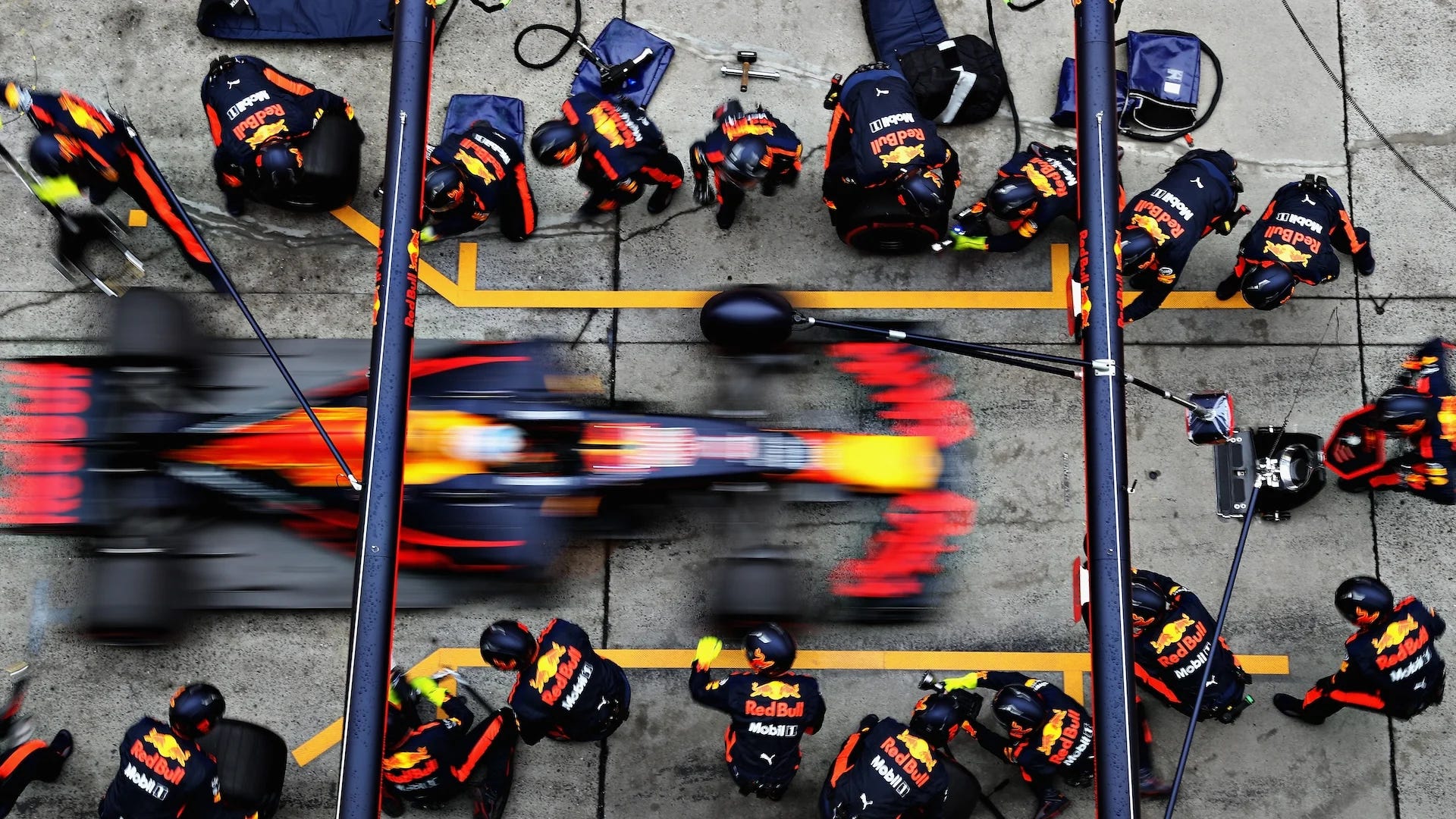
From the outside, a pit stop looks like people moving incredibly fast.
It’s easy to miss something else inside all that speed: everyone knows where to stand, what to wait for, and when to move out of the way.
Making room for someone else to do their job matters as much as doing your own.
The hospital team recorded its handover process for review. A choreographer even became involved, helping people work out how to move without obstructing one another.
A children’s hospital, Ferrari, and choreography.
Not things you expect to find in the same sentence.
They also assigned someone to coordinate the whole transition. The anesthetist held that responsibility until the handover was complete, after which it passed to the intensive care doctor.
Another idea they took from Ferrari was to discuss possible problems in advance: what could go wrong, what would we do if it did, and how serious would it be?
I think there’s a valuable distinction here.
Everyone knowing their own job isn’t the same as everyone knowing how the whole job will move forward.
You can put excellent specialists in the same room. The transitions between them still need to be designed.
Understanding More by Talking Less
Under the new protocol, the equipment transfer and checks came first. Patient information followed. Questions and the care plan came afterward.
People weren’t all trying to explain things at once. Those who needed to listen weren’t occupied with another task at the same time.
Read that and it’s hard not to think about your own meetings.
Someone is explaining something important. Someone else is trying to share their screen. A third person is messaging about the previous topic.
Afterward, we say, “But we discussed this.”
We may have. Whether the other person actually received the information is a separate question.
The hospital’s new approach combined ideas from Formula 1 and aviation. A study published in 2007 observed 50 patient handovers before and after the change.
The average number of technical errors per handover fell from 5.42 to 3.15. Information omissions fell from 2.09 to 1.07. Handover time fell from 10.8 minutes to 9.4 minutes.
It was a small before-and-after study. We can’t draw conclusions about mortality from it. But it offers concrete evidence that the same transition could be performed with fewer errors and less lost information; Study
Think about that. You haven’t changed anyone’s profession. You’ve organized what happens between them more carefully.
How Does This Transition Work in Our Companies?
Someone speaks with a customer.
They understand the need. Take notes. Send them to the relevant team.
Then the customer waits.
Ask the person who took the call, and the job is done. The notes have been sent.
Ask the person who received them, and a piece of information is missing. They’re waiting for it.
The person who could supply it doesn’t know anyone is expecting something from them.
Everyone in the company is working. The customer’s request isn’t moving.
Sometimes a person fills this gap. They remember who is waiting for what. They message, call, and remind people.
When that person takes a few days off, we discover how important their job really was.
Now Add AI
AI summarizes the call. Extracts the customer’s request. Creates a task. Notifies the relevant person.
Preparation that used to take half an hour now takes a few minutes.
That’s a useful gain.
But if the next person still takes over the work in the same way, we may simply be producing tasks much faster.
More summaries. More notifications. More waiting work.
And everything looks beautifully organized on screen.
“Call completed.”
“Request analyzed.”
“Forwarded to the relevant team.”
The customer’s question may still be unanswered.
I think this is one of the places to look in an AI project. When an operation finishes, what do we expect to happen next? How will we know it happened?
What Can We Borrow from Ferrari Tomorrow?
In today’s pit stops, completion signals from the mechanics are part of the decision to release the car. The person in charge also checks the space around the car and the pit lane. Finishing one part doesn’t, by itself, establish that the whole system is ready to go; Formula 1’s explanation
You can try a small experiment in your own company.
Choose a recurring piece of work that passes between two people. Preparing a quote, processing a refund, or booking an appointment, perhaps.
Look at the last ten examples. What happened between the moment the work was sent and the moment someone actually took it over?
Then clarify four things:
What information does the next person need?
Who will take over, and how will they acknowledge it?
What outcome will tell us the work is complete?
What happens if something is missing or an operation fails?
Suppose a customer wants Friday delivery, but stock availability can’t be confirmed.
You could write “Forwarded to sales” and move on.
Or you could identify who will check stock, when the check is due, and who will get back to the customer. You could also specify who gets notified if the information doesn’t arrive in time.
In the second case, a temporary system problem can be caught before it turns into a forgotten customer.
The jobs you might give AI become more concrete, too. Flag missing information. Route work to the right person. Follow up on a waiting step. Perform an authorized operation. Record the outcome.
This is what we look at when designing an AI workflow at Next Big App: how will the work move forward after the conversation or analysis? How will it connect to existing systems? Who will follow through on the result?
Some of the results that surprise even us with enterprise clients come from these details. When we combine AI with user experience engineering, work that has depended on someone remembering to chase it for years starts moving on its own. Customers have less to explain again. Employees spend less time gathering missing information from different places.
That’s also one of the things our clients appreciate most: the small daily frictions their teams no longer have to deal with. Individually, these changes can look minor. Together, especially in larger organizations, their effect can be much greater than initially expected.
Sometimes what’s needed is a new assistant. Sometimes it’s a few missing steps between tools you already use.
To find them, how busy people are may not be the first thing to examine.
Look for where the work loses its owner.
The question Ferrari helped the hospital ask is a useful starting point for us, too: while everyone is doing their own job, who’s managing the transition between them?