


In baseball, when a ball lands in the stands, the person who catches it gets to take home a souvenir.
At the World Cup, you have to give it back. The obvious reason is that the game needs to continue. The less obvious reason is that what you are holding is no longer just a football.
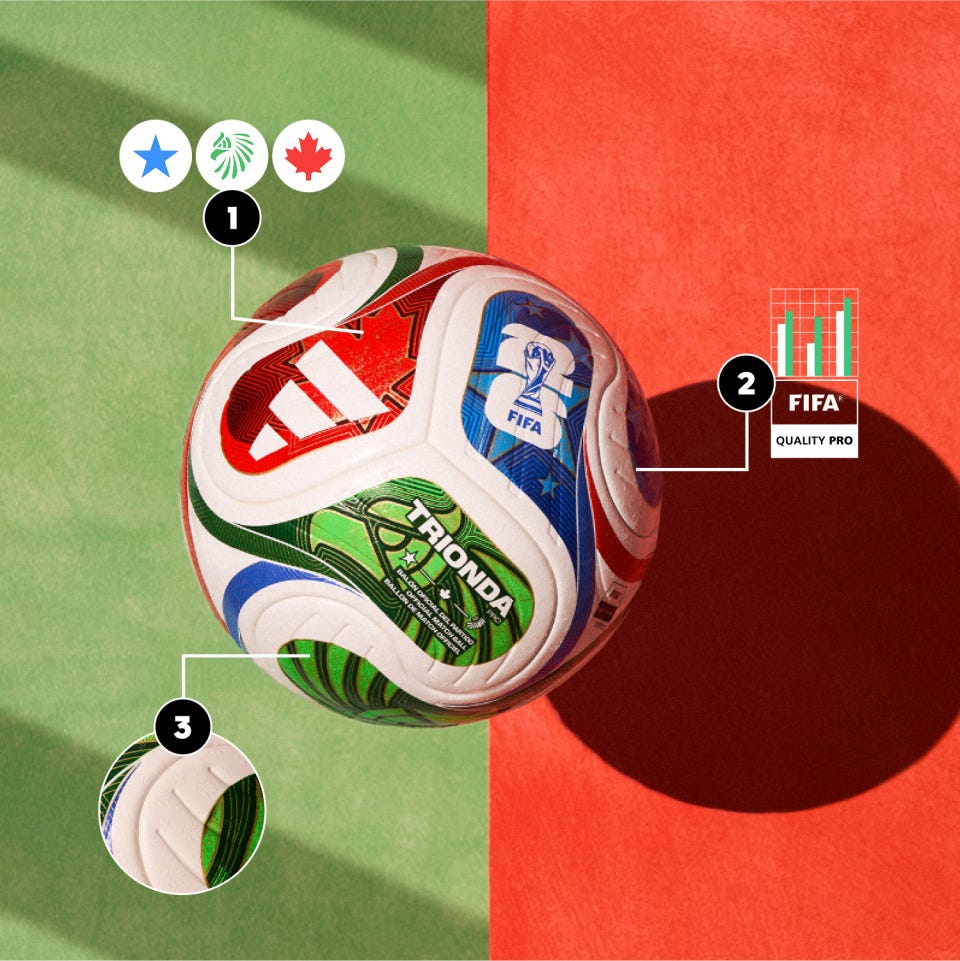
Inside Trionda, the official ball of the 2026 World Cup, is a motion sensor that records data 500 times per second. It tracks the ball’s movement, helps officials identify precise touches and sends information to the VAR system in real time. It even needs to be charged before a match.
Catching one in the stands is less like catching a souvenir and more like briefly taking possession of a very round computer.
During England’s quarter-final against Norway, that computer became the most controversial witness in football.
Norwegian goalkeeper Ørjan Nyland launched the ball high up the pitch. It climbed into the air, seemed to hang there for a moment, then dropped so abruptly that Norway’s players and staff became convinced it had struck one of the cables holding the camera system above the field.
Seconds later, Jude Bellingham scored England’s equaliser.
The rule was straightforward. If the ball had touched the cable, play should have stopped and everything that followed would have been irrelevant. Nyland protested immediately. Norway’s staff pointed toward the wire, the replays looked unusual, and manager Ståle Solbakken remained convinced that the ball had changed direction in mid-air.
But the most important witness was not the referee, the goalkeeper or even the Spidercam footage.
It was the ball itself.
FIFA examined the data from the sensor inside it, what it calls the ball’s “heartbeat”. A cable impact should have created an additional spike while the ball was airborne. According to FIFA, no such spike appeared, so there was no evidence of contact.
The goal stood.
The decision was settled. The argument was not.
Many England supporters and neutral observers accepted the sensor data as more reliable than human perception. Others watched the ball’s sudden movement and reached the opposite conclusion: they trusted what they believed they had seen with their own eyes.
The sensor had data. Norway had eyes.
Neither side thought the other had presented enough evidence.
That is what makes this story interesting. Not whether the cable was definitely touched, or whether millions of football supporters need an emergency lesson in the Magnus effect. The more useful lesson is that a system can produce an answer without producing trust.
Accuracy and trust are different products.
A machine may reach the correct conclusion and still fail to persuade people. That is because we do not trust technology simply because it gives us an answer. We trust it when we understand how the answer was reached, what evidence was used and whether the conclusion can be challenged.
Good technology should hide its operational complexity. It should not hide its reasoning.
AI is About to Learn the Same Lesson
Most companies currently have the opposite problem. Their AI systems are highly visible while the work is being done and strangely opaque when something goes wrong.
An employee chooses a tool, opens another tab, explains the context again and uploads the same files. They refine the prompt, inspect the result, move the output into another system and perhaps ask a second AI to improve what the first one produced.
Then they check the final work themselves, because nobody wants to discover a hallucinated number halfway through a board meeting.
We bought AI to reduce people’s workload. Instead, we created a new operating role: manager of artificial employees who require constant supervision.
One tool writes. Another researches. Another analyses spreadsheets. Another creates presentations. A fifth promises to automate the first four. Each product looks useful in isolation, but together they form a small digital organisation with no chief of staff.
The employee still has to break down the objective, select the right system, transfer the context, monitor the outputs and assemble the final result.
We automated production. We did not automate coordination.
This coordination cost rarely appears in a software budget. It appears in interruptions, repeated explanations, fragmented attention and the small decisions employees make every time they wonder which tool they are supposed to use.
One AI application may save ten minutes. Fifteen disconnected applications can create an entirely new management layer.
The obvious solution is to make the complexity disappear: one interface, one AI coworker and a collection of specialists working behind it. But simply hiding everything inside a black box creates a different problem.
The first time the system makes a questionable decision, the user will want to know what it did, which information it used and why it chose that particular path. They will also need some way to inspect the work, correct the result and remain responsible for the final decision.
A black box feels magical until the first controversial call.
The right standard for an AI coworker is therefore not that it never makes a mistake. Human coworkers fail that test before lunch.
A more useful standard is whether it can reduce the amount of coordination you perform without reducing your ability to understand what happened.
The work should become less visible.
The accountability should not.
THIS ISSUE IS BROUGHT TO YOU BY APPY.AI
One AI Coworker, Fifteen Specialists Behind It
This is what makes Appy.AI’s approach interesting.
Instead of giving employees another collection of separate AI tools to coordinate, Appy gives them one AI business partner called Violet. Behind Violet is a team of 15 specialists that can help with work such as marketing strategy, project management, financial modelling and presentation creation.
You describe the outcome you need in plain English. Violet determines which specialists are relevant, coordinates the work and returns with the result.
More importantly, this happens inside Slack or Microsoft Teams, the places where teams already communicate. There is no new dashboard employees have to remember to check, no code to write and no complicated workflow builder to maintain.
That does not mean people should blindly accept whatever an AI coworker produces. It means they can delegate the coordination without surrendering their judgment.
The aim is not invisible magic.
It is less management, fewer handoffs and a clearer path from request to result.

Hire Appy.AI and get $100 in free credits. No credit card required.
The AI industry remains obsessed with capability. Which model reasons better? Which agent can browse the web? Which tool can create the most impressive presentation?
Those questions matter, but they are not the questions most employees feel during the working day.
Employees feel the management burden. They notice how many systems they need to open, how often they must explain the same task and how much of the final output they still have to assemble themselves. They also notice when an automated system expects trust without offering enough evidence to deserve it.
The World Cup ball offers a useful model because the footballer does not have to operate the technology. The player simply kicks the ball. The sensor carries the context, sends the information to the relevant system and produces evidence when the moment requires it.
That is good product design.
But the controversy also showed that producing data is not the same as producing confidence. When the decision feels wrong, people want to inspect the evidence rather than being told that the machine has spoken.
That is trust design.
The winning AI products will not necessarily be the ones with the longest feature lists or the most specialists. They will be the products that remove the most coordination from the working day while making their actions easier to understand.
The World Cup ball did not ask the player to become a sensor operator.
AI should not ask every employee to become an AI manager.
Good technology should disappear from the workflow, not from accountability.