

We have a paradox on our hands.
We are living in an era of infinite stimulation. At any given second, you can pull out a device and access every song, show, and snippet of information ever created.
By all logic, boredom should be extinct.
Yet, people are more bored than ever.
And it’s not an accident. It’s a design flaw.
A new bombshell perspective in Nature just handed us the treasure map. It argues that the very digital media we build, market, and sell is the cause of this new boredom epidemic.
For founders, indie hackers, and marketers like us, this isn’t just an academic curiosity. It’s a flashing neon sign pointing to one of the biggest, most underserved markets of the next decade.
The “Boredom Epidemic” Is Real and Measurable
This isn’t just a “feeling”. This is hard data.
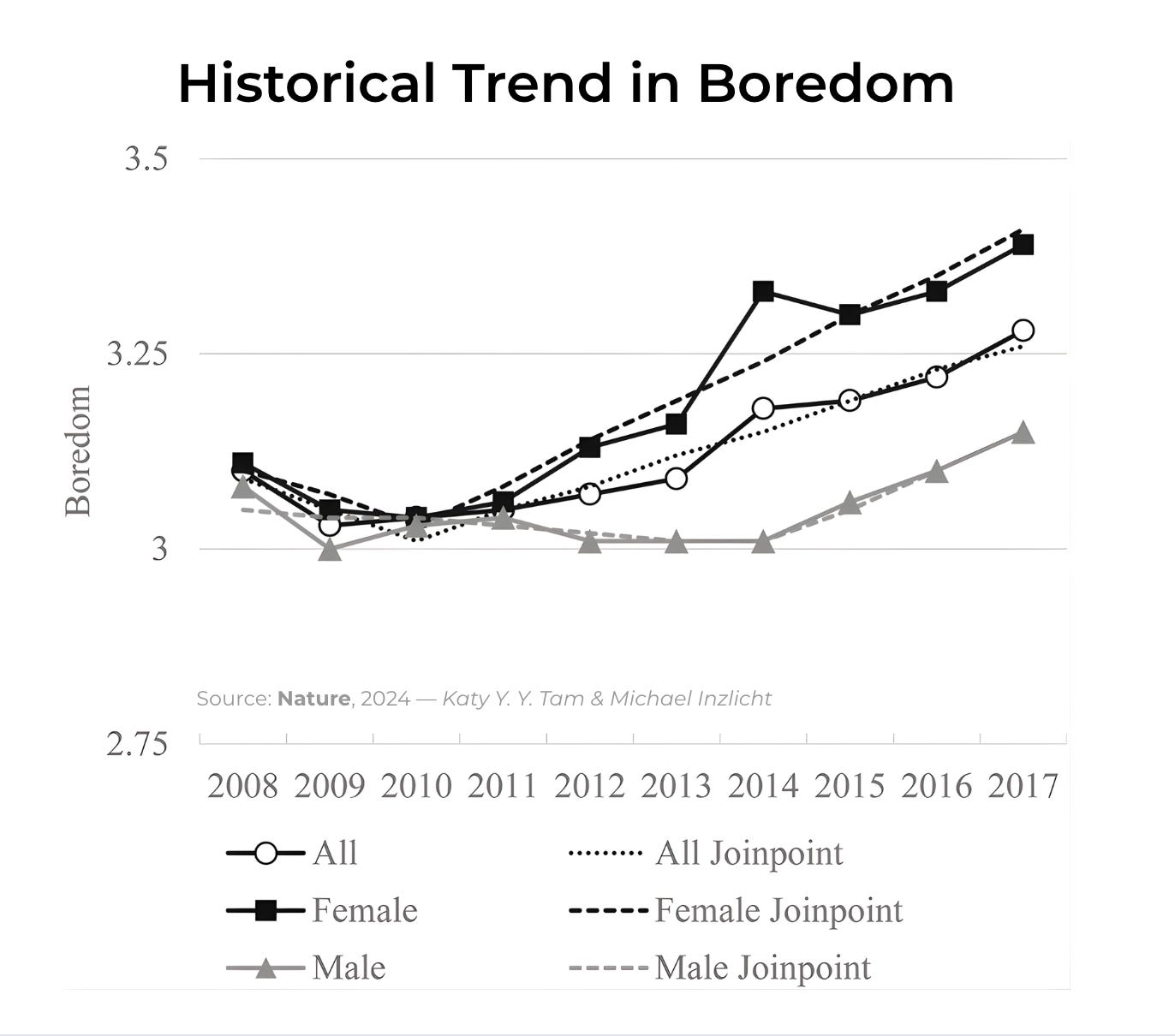
I’m looking at the research right now. It highlights a “concerning rise in boredom” from 2009 to 2020.
This, of course, maps perfectly to the explosion of smartphones, social media, and streaming.
One study of U.S. high school students found a significant, steady increase in boredom from 2010 to 2017.
Another, even more staggering meta-analysis of Chinese college students from 2009 to 2020 found that boredom proneness went from the 50th percentile to the 94th percentile.
That’s not a trend. That’s a societal-level psychological shift.
And here’s the kicker. People use digital media to relieve boredom. It’s one of the top-cited reasons for use. But the data is brutal: it’s an ineffective coping strategy.
Worse, it’s not just ineffective—it causally increases boredom. Studies showed that using social media, and even just skipping and fast-forwarding online videos, made participants more bored over time.
You’ve built the perfect “Boredom Feedback Loop”.
How We Accidentally Built the Boredom Machine
The research breaks down exactly why this happens. As product builders, this is the “why” we need to understand.