


🎙️ AUDIO DEEP DIVE OF THIS ISSUE:
Sammy & Mila offer in-depth analysis on each newsletter issue. Subscribe to their podcast on Spotify or any other podcast platform.
🧙♂️ TIPS & TRICKS:
Listen Up, Startups: Focus on What Investors Want
Y Combinator, a well-known startup accelerator, occasionally puts together a list of areas they're particularly interested in supporting – basically, a “Request for Startups”.
This list signals to entrepreneurs that if their venture aligns with these areas, they're more likely to get Y Combinator's attention and even investment.
Just like we tailor our startups to address user problems and needs, it's smart to understand what investors are looking for when seeking funding. Sometimes, it means adding some extra “flavor” to our product to match their interests.
Here's a breakdown of the key takeaways:
Pay attention to investor signals: Y Combinator's "Request for Startups" list is a prime example of how investors communicate their preferences. Keep an eye out for similar cues from other potential funders.
Align your startup with investor interests: While staying true to your vision is crucial, don't be afraid to adapt your approach to align with the priorities of investors you're targeting. This could involve highlighting certain aspects of your product or emphasizing specific market opportunities.
Tailor your pitch to each investor: Investors have different backgrounds, expertise, and investment goals. Research each one thoroughly and craft a pitch that resonates with their unique interests.
Investors are looking for startups with the potential for high returns. By understanding their needs and aligning your venture accordingly, you increase your chances of securing funding and propelling your startup towards success.
🧙♂️ TIPS & TRICKS:
Starting with an Idea Before Money
We don't have to always rely on investor money to bring our business ideas to life. We should focus on bootstrapping, which is how to start without a lot of money.
Money only allows us to grow faster or bigger. First, we need to make sure the business itself works.
We need to talk to the people (customers) we want to get money from, we need to do manually what the code will do automatically, etc.
Steve Blank's “customer development” and Eric Ries' “lean startup” models explain this in detail.
There are many people who have done this and have shared their experiences in detail. We should take inspiration from them.
Check out the Indie Hackers website. They share the full story of how they built their businesses with small amounts of money, including their earnings and mistakes. It's a treasure trove of information on this topic.
Follow Greg Isenberg on LinkedIn. He shares his experience beautifully. See how he reached 25,000 customers in 40 days for $65.
Follow Pieter Levels on Twitter. He transparently shares his income, expenses, and tactics. He has built successful businesses with small amounts of money, including Photo AI (monthly income of $46,000), Interior AI (monthly income of $31,000), and Nomad List (monthly income of $40,000).
Follow Andrew Gazdecki on Twitter. He is the founder of Acquire, a marketplace for people who want to create businesses with small amounts of money and those who want to sell the businesses they have created.
Follow Justin Welsh on Twitter. He shares how he built a $3 million business in 1000 days.
Bootstrapping can be a challenging but rewarding way to start a business. With hard work and dedication, you can achieve your goals even without a lot of money.
📊 TRENDS, RESEARCH & REPORTS:
AI Experts Shocked by Rapid Progress - 2026
We all know that technology is advancing at an incredible pace. Thanks to Moore's Law, which states that computing power doubles every two years, we can even predict this speed. But not anymore!
The advancements we've seen in AI in the past few years have stunned not just average people like you and me, but even the experts in the field.
Every year, ARK releases a report called Big Ideas. This year's report includes a graph that perfectly summarizes this shock.
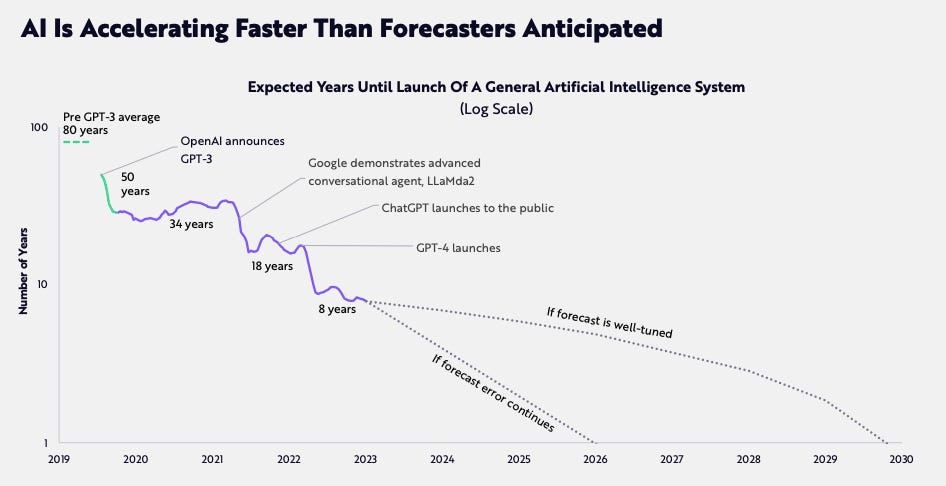
They ask experts, “How many years until we reach human-level artificial intelligence?” In 2020, “experts” said 50 years. Today, they say 8 years. That's how big the shock is!
If the experts continue to be this inaccurate, we'll be facing machines that are as intelligent as we are by 2026, and none of us are ready for that.
That’s presents both great opportunities and great risks. It all depends on which side of things you're on.
💡 INSPIRING IDEA:
“A new day: Be open enough to see opportunities. Be wise enough to be grateful. Be courageous enough to be happy.”
— Steve Maraboli