


🎙️ AUDIO DEEP DIVE OF THIS ISSUE:
Sammy & Mila offer in-depth analysis on each newsletter issue. Subscribe to their podcast on Spotify or any other podcast platform.
📱 NEXT BIG APPS:
How Specialized AI is Transforming Workflows
Large language models (LLMs) like ChatGPT are impressive tools for general conversation and information retrieval. However, their true potential lies not in mimicking human interaction, but in tackling specific tasks and streamlining workflows.
As ChatGPT's developers themselves acknowledge, the future of LLMs lies in specialized solutions designed to solve real-world problems.
Large language models (LLMs) are rapidly evolving from chatbots to powerful problem-solvers. Here's how these specialized LLMs are empowering specific professions:
Profession: Data Analyst
Need: Simplify complex data manipulation and visualization.
Solution: Numerous.ai (Excel with LLM): Describe your desired outcome in natural language, and the AI generates the necessary formulas in Excel, saving you time and reducing errors.
Profession: Marketing Professional
Need: Generate high-quality visuals to complement marketing campaigns.
Solution: Stockimg.ai (GPT for Images): Skip keyword searches! Describe the image you envision (e.g., "product launch party with diverse group celebrating"), and the AI delivers a range of royalty-free options, accelerating your creative process.
Profession: Business Analyst/Data Scientist
Need: Create clear and impactful data visualizations to communicate insights.
Solution: ChartGPT.dev (GPT for Charts): No more struggling with chart types! Upload your data and let the AI recommend the most effective chart format (e.g., bar chart for comparisons, line graph for trends) and handle the formatting, ensuring your data story shines.
Profession: Student/Researcher
Need: Research and writing support to improve efficiency and learning.
Solution: Paperpal.com (GPT for Students): Your AI research companion! Leverage Paperpal to generate outlines, summarize complex topics you're studying, and even receive feedback on your writing style, boosting your academic performance.
Profession: Video Creator/Content Producer
Need: Bridge the gap between creative ideas and video production.
Solution: Pixverse.ai (GPT for Video): Describe your video concept (e.g., “explainer video on climate change solutions”), and the AI generates script suggestions, storyboard outlines, or even draft footage, streamlining your video production workflow.
These are just a few examples of how LLMs are becoming specialized tools for various professions. As LLM technology continues to advance, expect even more innovative solutions tailored to address specific industry needs and revolutionize how we work.
🧙♂️ TIPS & TRICKS:
Build Your Own ChatGPT-like LLM from Scratch!
Have you ever wondered what it takes to build a large language model (LLM) like ChatGPT? Well, wonder no more! The GitHub repository LLMs-from-scratch by Sebastian Raschka is your ultimate guide.
There's a good chance (99.9%!) you don't need to write your own LLM. There are thousands of pre-trained models available on Hugging Face that can be applied to a wide range of tasks. You're likely to find one that suits your needs without needing to build from scratch.
If you're set on building your own, LLMs-from-scratch is a great step-by-step guide. This resource walks you through the process of creating a GPT-like LLM using PyTorch, making it accessible even if you're not a machine learning expert.
First things first, setting up your environment is crucial. The repository provides detailed instructions on installing Python, necessary packages, and setting up your coding environment. If you're new to this, check out the README.md file in the setup directory. It's packed with tips on getting started, ensuring you're ready to dive into the coding journey without a hitch.
Once you're all set up, you'll explore the inner workings of LLMs. The chapters cover everything from working with text data and coding attention mechanisms to implementing and fine-tuning your very own GPT model. With clear explanations, diagrams, and example codes, you'll not only build a small-but-functional model but also gain insights into the approaches used to create large-scale models like ChatGPT. So, roll up your sleeves, fire up your IDE, and start building your LLM from scratch!
🧙♂️ TIPS & TRICKS:
The Secrets Behind Attio's Growth

Looking to skyrocket your company's growth like Attio? We’ve got you covered with some insider tips from How They Grow.
Attio, a CRM platform, has been making waves by seamlessly blending customer relationship management with a modern, user-friendly interface.
Attio's story is sprawling, clocking in at a length that rivals some ebooks. While it might require some dedication to get through, I believe it's worth the effort. To save you some time, I've included a summary below, but I highly recommend experiencing the full story for yourself.
Their Secret Sauce:
Unified CRM System: Implementing a centralized CRM to manage customer data and interactions seamlessly.
AI-Driven Insights: Utilizing AI to analyze customer behavior and predict trends, enabling proactive decision-making.
Automated Workflows: Automating repetitive tasks to free up time for high-impact activities.
Collaborative Tools: Encouraging team collaboration through integrated tools that enhance communication and project management.
Results:
Improved Customer Retention: Higher customer satisfaction and retention rates due to personalized and timely interactions.
Increased Efficiency: Significant reduction in manual tasks, leading to faster turnaround times.
Scalable Operations: Enhanced ability to scale operations smoothly as the company grows.
Boosted Revenue: Notable increase in revenue from optimized sales and marketing efforts.
It's worth noting that these kind of articles can be a subtle form of advertising for startups. While they chronicle the challenges and triumphs of a startup's journey, they also showcase the team's meticulousness and perseverance. Additionally, they provide a platform to highlight unique features and differentiators of the startup's product.
Consider crafting a similar story about your own startup – it can be a powerful marketing tool.
📊 TRENDS, RESEARCH & REPORTS:
The Energy Paradox of Progress: From Bitcoin to AI Simulations
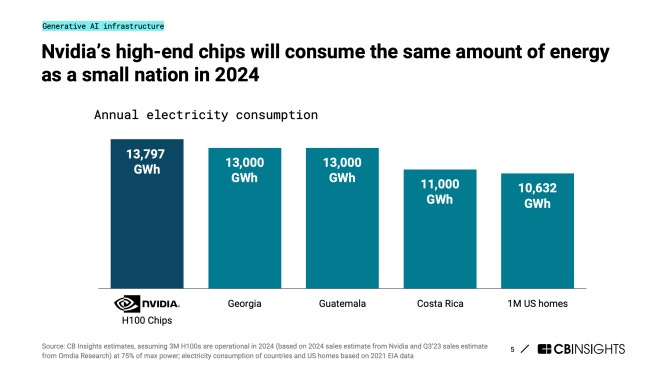
Many of you might recall the frenzy surrounding Bitcoin's peak, when self-proclaimed experts loudly decried its energy consumption. Today, a similar wave of criticism is washing over Artificial Intelligence. While these concerns are valid on the surface, they often overlook the broader forces at play in technological development.
The current generation of video games boasts astonishing levels of realism, blurring the lines between reality and simulation. This immersive trend extends further into the burgeoning metaverse concept, a virtual world Facebook (now Meta) is heavily invested in. These advancements highlight a growing fascination with creating intricate digital representations of our world. Some, like Elon Musk, have even posited the possibility that we already reside within such a simulation.
This potential future, where simulations play a significant role, necessitates a dramatic increase in energy consumption. However, this isn't necessarily a dead end. Historically, technological advancements have often spurred innovations in energy efficiency. As our reliance on technology grows, the need for sustainable and efficient energy solutions will become paramount. This aligns with Michio Kaku's theory of different civilization types defined by their energy utilization. Kaku suggests that more advanced civilizations harness energy in increasingly sophisticated ways.
Michio Kaku builds upon the concept developed by Russian astrophysicist Nikolai Kardashev in 1964. The Kardashev Scale theorizes that advanced civilizations can be categorized based on the amount of usable energy they can harness and control. This scale has three main types:
Type I Civilization (Planetary): This civilization has mastered utilizing all the energy resources available on its home planet. They can control their environment, manipulate weather patterns, and efficiently tap into resources like geothermal or solar power on a global scale. Imagine a society with complete control over its energy needs, drawing power from diverse sources across the entire planet.
Type II Civilization (Stellar): This civilization has transcended planetary limitations and can harness the full energy output of its star. Imagine a civilization capable of building vast structures around their sun, like Dyson Spheres, to capture most of its stellar energy. This would provide them with an unimaginable amount of power compared to a Type I civilization.
Type III Civilization (Galactic): This is the most advanced category, theorized to be able to control and utilize the energy of an entire galaxy. Imagine a civilization with technology so advanced they can manipulate vast amounts of energy from black holes, neutron stars, or even develop methods to harvest energy from the very fabric of space itself.
Kaku acknowledges the Kardashev Scale but also proposes an additional category:
Type IV Civilization (Extra-galactic): This hypothetical civilization could tap into energy sources beyond our galaxy, potentially harnessing energy from quasars or even manipulating space-time itself.
Kaku's theory, along with the Kardashev Scale, provides a framework for thinking about the potential trajectory of technological advancement. It suggests that as civilizations progress, their energy needs will exponentially increase, driving innovation in areas like energy production and potentially forcing them to explore alternative energy sources.
By analyzing our current energy consumption, we can't necessarily predict the specific path we'll take. However, the theory highlights the crucial role energy plays in development and suggests that future civilizations might be defined not just by their technology but also by their ability to manage their energy demands in a sustainable way.
Therefore, the concerns surrounding AI's energy needs might inadvertently propel us towards a future with cleaner and more efficient energy sources. This wouldn't be the first time technology has presented a seemingly insurmountable challenge that ultimately triggered a leap forward.
Ps: Now, I freely admit to a certain fondness for hop on intellectual journeys that begin with seemingly unconnected topics. I weave them together, exploring the connections, and often arrive at surprising destinations. Perhaps this approach reflects the interconnected nature of knowledge itself.
📰 LATEST NEWS DECODED:
Google creates AI for drug discovery and therapeutic development
News Source: Mobi Health News
Why it Matters
Google's Tx-LLM has the potential to revolutionize the drug discovery and therapeutic development process, making it faster, more efficient, and cost-effective. This technology can significantly impact the pharmaceutical industry, leading to breakthroughs in disease treatment and patient care.
Future Effects
Increased adoption of AI-powered drug discovery tools, leading to a shift in the way pharmaceutical companies approach research and development.
Potential for faster and more accurate identification of new drug candidates, reducing the time and cost associated with traditional methods.
Enhanced collaboration between tech companies, pharmaceutical companies, and researchers, driving innovation and progress in the field.
Actionable Steps
Pharmaceutical companies:
Allocate a dedicated budget for AI-powered drug discovery initiatives and partner with tech companies to develop customized Tx-LLM models for specific therapeutic areas.
Establish an internal AI training program for researchers and scientists to learn how to work with Tx-LLM and integrate it into their workflows.
Develop a data management strategy to ensure seamless integration of Tx-LLM with existing data systems and pipelines.
Researchers and scientists:
Attend workshops and conferences focused on AI-powered drug discovery to learn about the latest advancements and best practices.
Collaborate with Google DeepMind and other tech companies to fine-tune Tx-LLM models for specific disease areas and develop new use cases.
Develop expertise in SMILES strings and other molecular representation formats to effectively work with Tx-LLM.
Investors and venture capitalists:
Invest in startups developing AI-powered drug discovery platforms that leverage Tx-LLM or similar technologies.
Provide funding for research initiatives focused on developing new AI models for specific therapeutic areas, such as oncology or neurology.
Establish a dedicated AI-focused investment fund to support the growth of AI-powered drug discovery companies.
💡 INSPIRING IDEAS:
“The only thing standing between you and your goal is the bullshit story you keep telling yourself as to why you can't achieve it.”
— Jordan Belfort